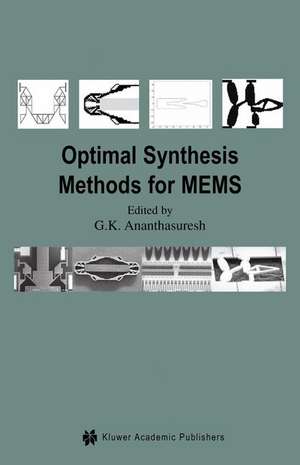
Optimal Synthesis Methods for MEMS
Editat de S. G. K. Ananthasureshen Limba Engleză Hardback – 30 noi 2003
Preț: 955.63 lei
Preț vechi: 1165.40 lei
-18%
Puncte Express: 1433
Carte tipărită la comandă
Livrare economică 21 noiembrie-05 decembrie
Livrare prin curier în România Termenul estimat este afișat lângă disponibilitate.
Transport gratuit pentru acest produs Plată online sau ramburs, în funcție de opțiunile comenzii.
Retur gratuit în 14 zile Comandă securizată și suport în română.
Specificații
ISBN-13: 9781402076206
ISBN-10: 1402076207
Pagini: 340
Ilustrații: XIII, 320 p. 187 illus.
Dimensiuni: 156 x 234 x 21 mm
Greutate: 0.65 kg
Ediția:2003 edition
Editura: Springer Nature B.V.
Locul publicării:New York, NY, United States
ISBN-10: 1402076207
Pagini: 340
Ilustrații: XIII, 320 p. 187 illus.
Dimensiuni: 156 x 234 x 21 mm
Greutate: 0.65 kg
Ediția:2003 edition
Editura: Springer Nature B.V.
Locul publicării:New York, NY, United States
V-ar putea interesa
-
 Machine Tools: Specification, Purchase, and InstallationRussell Gamblin-18%Preț: 918.03 lei1119.55 lei
 -
 Maintenance Engineering Handbook, Eighth EditionKeith Mobley-18%Preț: 1106.67 lei1349.59 lei
 -
 -9%Preț: 694.80 lei763.52 lei
 -
 -27%Preț: 828.89 lei1135.46 lei
 -
 Handbook of Compliant MechanismsBrian M. Olsen-23%Preț: 657.81 lei854.30 lei
 -
 -17%Preț: 443.33 lei534.35 lei
 -
 Centrifugal PumpsIgor Karassik-18%Preț: 1212.36 lei1478.49 lei
 -
 Preț: 390.08 lei
 -
 Methane: Fuel for the FutureEnoch Durbin-15%Preț: 622.59 lei732.46 lei
 -
 -24%Preț: 1059.45 lei1394.02 lei
 -
 Journal Bearings in TurbomachineryDavid MacLeish. SmithPreț: 367.97 lei
 -
 -18%Preț: 1240.17 lei1512.40 lei
 -
 Magnetohydrodynamics of Liquid MetalsIgor M. Kirko-15%Preț: 636.26 lei748.55 lei
 -
 Mixture Formation in Spark-Ignition EnginesHans Peter LenzPreț: 394.68 lei
 -
 Teaching Learning Based Optimization AlgorithmR. Venkata Rao-18%Preț: 954.32 lei1163.81 lei
 -
 -18%Preț: 745.14 lei908.71 lei
Public țintă
ResearchCuprins
1 Introduction.- 1. Design of Microelectromechanical Systems.- 2. Synthesis vs. Analysis.- 3. Optimization as a synthesis tool.- 4. Contents of the chapters.- 5. Closure.- 2 Synthesis for Mechanical Behavior.- 1. Introduction.- 2. Synthesis of beam-like structures.- 3. Topology Synthesis.- 4. Synthesis for dynamic attributes.- 5. Conclusions.- 3 Synthesis of Electrostatically Actuated Mems.- 1. Introduction.- 2. Governing Equations.- 3. Shape Synthesis of Electrostatically Driven Actuators.- 4. An Example: Variable Comb-drive Actuators.- 5. Closure.- 4 Synthesis Methods for Electrothermal Actuation.- 1. Introduction.- 2. Generalization of the BasiC electro-thermal actuator.- 3. Modeling.- 4. Synthesis.- 5. Numerical examples.- 6. Alternative implementation using “line elements”.- 7. Advanced example.- 8. MicroFabrication.- 9. Closure.- 5 Synthesis with Piezoelectric Actuation.- 1. Introduction.- 2. Background Theory for Piezoelectricity.- 3. FEM Applied to Piezoelectricity.- 4. Flextensional Actuator Design.- 5. Conclusion.- 6 Synthesis of Piezocomposites.- 1. Piezocomposite Design.- 2. Homogenization Method.- 3. Piezocomposite Design Problem.- 4. Examples.- 5. Conclusions.- 7 Synthesis of Periodic Micro Mechanisms.- 1. Introduction.- 2. Numerical homogenization, FE modeling, and sensitivity analysis.- 3. Formulation of the problem.- 4. Numerical implementation.- 5. Examples.- 6. Wave propagation.- 7. Concluding remarks.- 8 Process Synthesis.- 1. Introduction.- 2. State-space representation.- 3. Planar device representation.- 4. Basic synthesis method.- 5. Cardinality of design space.- 6. Granularity control through condensation.- 7. Other miscellaneous graph-theoretical results.- 8. Process flow construction.- 9. Determination of selective operators.- 10. Processflow parameters.- 11. Software implementation.- 12. Compiler testing.- 13. Summary.- 9 Mask Synthesis.- 1. Introduction.- 2. Related work.- 3. Mathematical framework.- 4. Synthesis.- 5. Examples.- 6. Conclusions.- 10 System-Level Synthesis.- 1. MEMS Design representations.- 2. Synthesis Methodology.- 3. Performance Models.- 4. Synthesis Results.- 5. Summary.