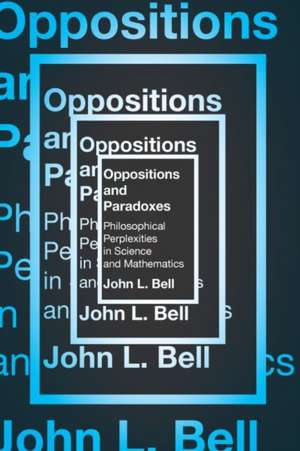
Oppositions and Paradoxes: Philosophical Perplexities in Science and Mathematics
Autor John L. Bellen Limba Engleză Paperback – 18 apr 2016
These paradoxes are often as fun as they are flabbergasting. Consider, for example, the famous Tristram Shandy paradox: an immortal man composing an autobiography so slowly as to require a year of writing to describe each day of his life — he would, if he had infinite time, presumably never complete the work, although no individual part of it would remain unwritten. Or think of an office mailbox labelled “mail for those with no mailbox”—if this is a person’s mailbox, how can they possibly have “no mailbox”? These and many other paradoxes straddle the boundary between physics and metaphysics, and demonstrate the hidden difficulty in many of our most basic concepts.
Preț: 277.99 lei
Preț vechi: 335.31 lei
-17%
Puncte Express: 417
Carte disponibilă
Livrare economică 22 mai-05 iunie
Livrare express 07-13 mai pentru 86.21 lei
Specificații
ISBN-13: 9781554813025
ISBN-10: 1554813026
Pagini: 216
Dimensiuni: 152 x 229 x 10 mm
Greutate: 0.28 kg
Editura: BROADVIEW PR
Colecția Broadview Press
Locul publicării:Peterborough, Canada
ISBN-10: 1554813026
Pagini: 216
Dimensiuni: 152 x 229 x 10 mm
Greutate: 0.28 kg
Editura: BROADVIEW PR
Colecția Broadview Press
Locul publicării:Peterborough, Canada
V-ar putea interesa
-
 Principles of French LawJohn Bell-29%Preț: 836.06 lei1179.31 lei
 -
 Principles of French LawJohn Bell-14%Preț: 592.44 lei688.89 lei
 -
 Preț: 409.97 lei
 -
 Preț: 223.62 lei
 -
 La Muerte Es Una IlusionElse ByskovPreț: 167.58 lei
 -
 Preț: 101.94 lei
 -
 Creative EvolutionHenri BergsonPreț: 70.33 lei
 -
 God, Einstein, Existence, Cosmos, Life, Love, YouLachlen Paul FrenchPreț: 179.68 lei
 -
 -22%Preț: 326.68 lei420.61 lei
 -
 Discourse on Metaphysics and Other WritingsGottfried Wilhelm Leibniz-11%Preț: 125.51 lei141.71 lei
 -
 Preț: 85.70 lei
 -
 Preț: 104.38 lei
Recenzii
Since antiquity, opposed concepts such as the One and the Many, the Finite and the Infinite, and the Absolute and the Relative, have been a driving force in philosophical, scientific, and mathematical thought. Yet they have also given rise to perplexing problems and conceptual paradoxes which continue to haunt scientists and philosophers. In Oppositions and Paradoxes, John L. Bell explains and investigates the paradoxes and puzzles that arise out of conceptual oppositions in physics and mathematics. In the process, Bell not only motivates abstract conceptual thinking about the paradoxes at issue, but he also offers a compelling introduction to central ideas in such otherwise-difficult topics as non-Euclidean geometry, relativity, and quantum physics.
These paradoxes are often as fun as they are flabbergasting. Consider, for example, the famous Tristram Shandy paradox: an immortal man composing an autobiography so slowly as to require a year of writing to describe each day of his life — he would, if he had infinite time, presumably never complete the work, although no individual part of it would remain unwritten. Or think of an office mailbox labelled “mail for those with no mailbox”—if this is a person’s mailbox, how can they possibly have “no mailbox”? These and many other paradoxes straddle the boundary between physics and metaphysics, and demonstrate the hidden difficulty in many of our most basic concepts.
“Who else but John Bell could write a book like this one? One of the leading logicians of our day, Bell uses the role of conceptual oppositions and the paradoxes to which they occasionally give rise to take readers on a whirlwind tour through great swaths of the history of human thought. The sophisticated discussion of deep and difficult topics is highly digestible thanks to Bell wearing his expertise lightly and presenting things with dollops of his clever—and sometimes silly—humour.” — David DeVidi, University of Waterloo
“Bell is a master of simplicity and clarity, while sacrificing nothing of accuracy and erudition. His enthusiasm for his subject is palpable and infectious. Oppositions and Paradoxes is a pleasure to read.” — Graham Priest, CUNY Graduate Center
“John L. Bell is the true philosophical heir of Bertrand Russell, and his new book, Oppositions and Paradoxes, exemplifies all the best traits in Russell’s legacy. His presentation of philosophical paradoxes and perplexities in logic, mathematics, and physics is a model of lucidity and economy, and his analysis of these problems is secure and sane. Oppositions and Paradoxes is readily accessible and a sure path into some of philosophy’s greatest themes.” — Bradley Bassler, University of Georgia
These paradoxes are often as fun as they are flabbergasting. Consider, for example, the famous Tristram Shandy paradox: an immortal man composing an autobiography so slowly as to require a year of writing to describe each day of his life — he would, if he had infinite time, presumably never complete the work, although no individual part of it would remain unwritten. Or think of an office mailbox labelled “mail for those with no mailbox”—if this is a person’s mailbox, how can they possibly have “no mailbox”? These and many other paradoxes straddle the boundary between physics and metaphysics, and demonstrate the hidden difficulty in many of our most basic concepts.
“Who else but John Bell could write a book like this one? One of the leading logicians of our day, Bell uses the role of conceptual oppositions and the paradoxes to which they occasionally give rise to take readers on a whirlwind tour through great swaths of the history of human thought. The sophisticated discussion of deep and difficult topics is highly digestible thanks to Bell wearing his expertise lightly and presenting things with dollops of his clever—and sometimes silly—humour.” — David DeVidi, University of Waterloo
“Bell is a master of simplicity and clarity, while sacrificing nothing of accuracy and erudition. His enthusiasm for his subject is palpable and infectious. Oppositions and Paradoxes is a pleasure to read.” — Graham Priest, CUNY Graduate Center
“John L. Bell is the true philosophical heir of Bertrand Russell, and his new book, Oppositions and Paradoxes, exemplifies all the best traits in Russell’s legacy. His presentation of philosophical paradoxes and perplexities in logic, mathematics, and physics is a model of lucidity and economy, and his analysis of these problems is secure and sane. Oppositions and Paradoxes is readily accessible and a sure path into some of philosophy’s greatest themes.” — Bradley Bassler, University of Georgia
Cuprins
Acknowledgements
What Is This Book About?
Chapter I: The Continuous and the Discrete
Continuity and Discreteness
The Pythagorean School and Incommensurable Magnitudes
Atomism
The Stoics and the Continuum Theory of Matter
Zeno’s Paradoxes
Contemporary Versions of Zeno’s Paradoxes: Supertasks
Infinitesimals
Chapter II: Oppositions and Paradoxes in Mathematics: Set Theory and the Infinite
Set Theory and the One/Many Opposition
Paradoxes of the Infinite
Uncountable Infinities
Set-Theoretic Antinomies
The Axiom of Choice
Chapter III: The Strange Universe of Non-Euclidean Geometry
Hyperbolic Geometry
Riemannian Geometry
Chapter IV: Puzzles and Paradoxes of Time Travel
Time Travel into the Past: Branching Timelines
Temporal Loops
Time Travel into the Future
The Future Time Viewer
Two-Dimensional Time
Temporal Interdicts
Time Travel as a Physical Possibility
Chapter V: Puzzles and Paradoxes of Relativity Theory
Special Relativity
Spacetime
Faster-than-Light Particles in Special Relativity: Tachyons
General Relativity: The Principle of Equivalence
Black Holes
Chapter VI: Puzzles and Paradoxes in Quantum Physics
Waves vs. Particles
Heisenberg’s Uncertainty Principle and Bohr’s Principle of Complementarity
Quantum Tunneling
The Riddle of Polarization
Schrödinger’s Cat Paradox
Interpretations of Quantum Theory
The EPR Paradox and Nonlocality
Chapter VII: Cosmic Enigmas
The Beginnings of Cosmology
Steady-State vs. Big Bang
The Problem of the Origin of the Universe
Dark Matter, Dark Energy, and Cosmic Acceleration
The Argument from Design vs. the Multiverse
A Philosophical Coda
Appendix 1: Paradoxes in Logic and Language
The Liar Paradox
The Liar, the Truth-Teller, and the Dice Man
Curry’s Paradox
The Grelling-Nelson Paradox
Berry’s Paradox
Richard’s Paradox
The Paradox of the Heap
Appendix 2: Reflections on the Constant and the Changing
Appendix 3: Oppositions in Kant’s Philosophy
Appendix 4: The Principle of Microstraightness, Nilpotent Infinitesimals, and the Differential Calculus
Further ReadingList of OppositionsList of ParadoxesIndex
What Is This Book About?
Chapter I: The Continuous and the Discrete
Continuity and Discreteness
The Pythagorean School and Incommensurable Magnitudes
Atomism
The Stoics and the Continuum Theory of Matter
Zeno’s Paradoxes
Contemporary Versions of Zeno’s Paradoxes: Supertasks
Infinitesimals
Chapter II: Oppositions and Paradoxes in Mathematics: Set Theory and the Infinite
Set Theory and the One/Many Opposition
Paradoxes of the Infinite
Uncountable Infinities
Set-Theoretic Antinomies
The Axiom of Choice
Chapter III: The Strange Universe of Non-Euclidean Geometry
Hyperbolic Geometry
Riemannian Geometry
Chapter IV: Puzzles and Paradoxes of Time Travel
Time Travel into the Past: Branching Timelines
Temporal Loops
Time Travel into the Future
The Future Time Viewer
Two-Dimensional Time
Temporal Interdicts
Time Travel as a Physical Possibility
Chapter V: Puzzles and Paradoxes of Relativity Theory
Special Relativity
Spacetime
Faster-than-Light Particles in Special Relativity: Tachyons
General Relativity: The Principle of Equivalence
Black Holes
Chapter VI: Puzzles and Paradoxes in Quantum Physics
Waves vs. Particles
Heisenberg’s Uncertainty Principle and Bohr’s Principle of Complementarity
Quantum Tunneling
The Riddle of Polarization
Schrödinger’s Cat Paradox
Interpretations of Quantum Theory
The EPR Paradox and Nonlocality
Chapter VII: Cosmic Enigmas
The Beginnings of Cosmology
Steady-State vs. Big Bang
The Problem of the Origin of the Universe
Dark Matter, Dark Energy, and Cosmic Acceleration
The Argument from Design vs. the Multiverse
A Philosophical Coda
Appendix 1: Paradoxes in Logic and Language
The Liar Paradox
The Liar, the Truth-Teller, and the Dice Man
Curry’s Paradox
The Grelling-Nelson Paradox
Berry’s Paradox
Richard’s Paradox
The Paradox of the Heap
Appendix 2: Reflections on the Constant and the Changing
Appendix 3: Oppositions in Kant’s Philosophy
Appendix 4: The Principle of Microstraightness, Nilpotent Infinitesimals, and the Differential Calculus
Further ReadingList of OppositionsList of ParadoxesIndex