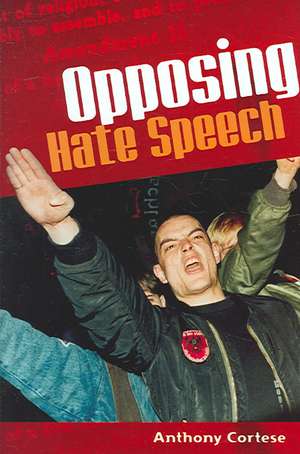
Opposing Hate Speech
Autor Anthony Corteseen Limba Engleză Hardback – 30 noi 2005
Is there a limit to freedom of expression in a democracy, and if so, where should the line be drawn? In attempting to answer that question, Cortese makes a solid case for paying attention to context and common sense. Some hate speech is more reprehensible than others; not all discriminatory statements are equally serious. There is a discernible difference between an offensive remark and an incitement to commit murder. There is also a fundamental distinction between intentional and unintentional discrimination. In this book, Cortese rethinks some of the issues that have been silenced in ways harmful to many-especially those that have been brutalized, oppressed, manipulated, dominated, segregated, and disadvantaged. We should recognize the grave injuries inflicted by hate speech and the potential tensions between legal solutions to those injuries and the First Amendment. We must push for moral education, educational speech codes, and when necessary, a formal, legal-structural response to hate speech in order to reinforce our commitment to tolerance as a value.
Preț: 332.81 lei
Preț vechi: 418.28 lei
-20%
Puncte Express: 499
Carte tipărită la comandă
Livrare economică 24 noiembrie-08 decembrie
Livrare prin curier în România Termenul estimat este afișat lângă disponibilitate.
Transport gratuit de la 400.00 lei Plată online sau ramburs, în funcție de opțiunile comenzii.
Retur gratuit în 14 zile Comandă securizată și suport în română.
Specificații
ISBN-13: 9780275984274
ISBN-10: 0275984273
Pagini: 248
Ilustrații: 2 tables
Dimensiuni: 156 x 235 x 8 mm
Greutate: 0.52 kg
Editura: Bloomsbury Publishing
Colecția Praeger
Locul publicării:New York, United States
ISBN-10: 0275984273
Pagini: 248
Ilustrații: 2 tables
Dimensiuni: 156 x 235 x 8 mm
Greutate: 0.52 kg
Editura: Bloomsbury Publishing
Colecția Praeger
Locul publicării:New York, United States
V-ar putea interesa
-
 -19%Preț: 336.76 lei417.15 lei
 -
 Democracy and Disenfranchisement: The Morality of Electoral ExclusionsClaudio López-Guerra-31%Preț: 708.34 lei1029.55 lei
 -
 Inside Immigration DetentionMary Bosworth-22%Preț: 413.99 lei533.82 lei
 -
 Defending Politics: Why Democracy Matters in the 21st CenturyMatthew Flinders-19%Preț: 76.33 lei93.70 lei
 -
 Liberal Rights and Responsibilities: Essays on Citizenship and SovereigntyChristopher Heath Wellman-35%Preț: 563.86 lei863.32 lei
 -
 -39%Preț: 17.43 lei28.47 lei
 -
 -19%Preț: 64.40 lei79.15 lei
 -
 The Nine Elements of a Sustainable CampusMitchell ThomashowPreț: 239.50 lei
 -
 Regulation of Political ConflictEduard A. Ziegenhagen-30%Preț: 473.16 lei674.78 lei
 -
 -40%Preț: 471.98 lei789.74 lei
 -
 -30%Preț: 374.13 lei532.13 lei
 -
 -30%Preț: 472.25 lei674.26 lei
 -
 -30%Preț: 470.33 lei673.14 lei
 -
 The War on PrivacyJacqueline Klosek-21%Preț: 347.66 lei437.80 lei
 -
 -29%Preț: 379.20 lei535.11 lei
 -
 -11%Preț: 332.18 lei374.03 lei
 -
 Human DignityGeorge KatebPreț: 203.12 lei
 -
 Preț: 233.09 lei
 -
 The Sociology of Human RightsMark FrezzoPreț: 195.46 lei
 -
 Running for FreedomSteven F. LawsonPreț: 425.60 lei
 -
 The Contradictions of Media PowerDr. Des Freedman-20%Preț: 192.53 lei239.38 lei
Cuprins
Foreword: Several Things We Know about Hate Speech . . . and Several Misconceptions by Richard Delgado
Preface
1. Free Expression versus Equal Protection: What Harm Is Hate Speech?
2. Race, Ethnicity, and Hate Speech
3. Religion and Hate Speech
4. Gender and Hate Speech
5. Sexual Orientation and Hate Speech
6. The Future of Democracy: Beyond Legal Realism
Appendix: Gay, Lesbian, and Bisexual Television Characters
References
Index
Preface
1. Free Expression versus Equal Protection: What Harm Is Hate Speech?
2. Race, Ethnicity, and Hate Speech
3. Religion and Hate Speech
4. Gender and Hate Speech
5. Sexual Orientation and Hate Speech
6. The Future of Democracy: Beyond Legal Realism
Appendix: Gay, Lesbian, and Bisexual Television Characters
References
Index
Recenzii
Employing critical race theory to structure his thesis, Cortese sketches a stage-developmental model of hate speech severity to make a case for the pervasiveness and perniciousness of hate speech in various institutional sectors of contemporary society..Recommended. General collections.
Cortese provides his readers with tools for talking back to speech that incites hatred or violence based on religion, race, ethnicity, gender, or sexual orientation. Cortese sees prevention as a more effective technique than legal restrictions on hate speech; he outlines a rational basis for rejecting bigoted talk by focusing on equal treatment and equal protection under the law. His focus is on media sources--Web sites, film, television, radio, newspapers, magazines--as well as social movements, pride marches, and demonstrations that fight for minority rights and those that oppose them. He concludes by exploring what readers can do to counter and eliminate hate speech at the individual level.
Cortese provides his readers with tools for talking back to speech that incites hatred or violence based on religion, race, ethnicity, gender, or sexual orientation. Cortese sees prevention as a more effective technique than legal restrictions on hate speech; he outlines a rational basis for rejecting bigoted talk by focusing on equal treatment and equal protection under the law. His focus is on media sources--Web sites, film, television, radio, newspapers, magazines--as well as social movements, pride marches, and demonstrations that fight for minority rights and those that oppose them. He concludes by exploring what readers can do to counter and eliminate hate speech at the individual level.