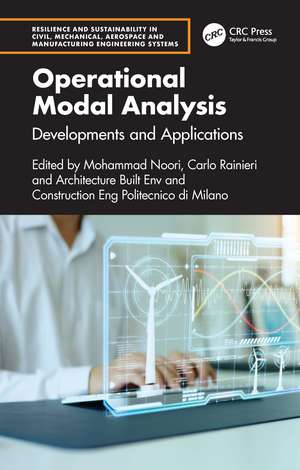
Operational Modal Analysis: Developments and Applications: Resilience and Sustainability in Civil, Mechanical, Aerospace and Manufacturing Engineering Systems
Editat de Mohammad Noori, Carlo Rainieri, Carmelo Gentileen Limba Engleză Hardback – 14 apr 2026
Features
- Presents numerous application examples and case studies.
- Shows how advanced AI technologies contribute to the progress of methodologies and techniques of OMA and SHM in the field.
- Introduces the applicability of OMA for the devlopment of structural digital twins.





Preț: 908.26 lei
Preț vechi: 1179.55 lei
-23%
Puncte Express: 1362
Carte tipărită la comandă
Livrare economică 23-30 noiembrie
Livrare prin curier în România Termenul estimat este afișat lângă disponibilitate.
Transport gratuit pentru acest produs Plată online sau ramburs, în funcție de opțiunile comenzii.
Retur gratuit în 14 zile Comandă securizată și suport în română.
Specificații
ISBN-13: 9781032851754
ISBN-10: 1032851759
Pagini: 238
Ilustrații: 256
Dimensiuni: 156 x 234 mm
Greutate: 0.6 kg
Ediția:1
Editura: CRC Press
Colecția CRC Press
Seria Resilience and Sustainability in Civil, Mechanical, Aerospace and Manufacturing Engineering Systems
ISBN-10: 1032851759
Pagini: 238
Ilustrații: 256
Dimensiuni: 156 x 234 mm
Greutate: 0.6 kg
Ediția:1
Editura: CRC Press
Colecția CRC Press
Seria Resilience and Sustainability in Civil, Mechanical, Aerospace and Manufacturing Engineering Systems
V-ar putea interesa
-
 Analytical and Experimental Modal AnalysisSubodh V. Modak-19%Preț: 668.50 lei825.31 lei
 -
 -18%Preț: 1196.77 lei1459.47 lei
 -
 Topics in Modal Analysis, Volume 7Randall Allemang-18%Preț: 1874.46 lei2285.92 lei
 -
 Structural Health Monitoring in AustraliaTommy Chan-27%Preț: 1493.87 lei2034.60 lei
 -
 -24%Preț: 1135.45 lei1494.02 lei
 -
 Topics in Modal Analysis & Testing, Volume 8Brandon Dilworth-18%Preț: 1242.67 lei1515.45 lei
 -
 -18%Preț: 1221.06 lei1489.09 lei
 -
 European Workshop on Structural Health MonitoringPiervincenzo Rizzo-18%Preț: 1628.41 lei1985.87 lei
 -
 Topics in Modal Analysis & Testing, Volume 8Brandon J. Dilworth-18%Preț: 1322.64 lei1612.97 lei
 -
 Dynamics of Civil Structures, Volume 2Kirk Grimmelsman-18%Preț: 1326.72 lei1617.95 lei
 -
 Data Science in Engineering, Volume 9Ramin Madarshahian-20%Preț: 1161.18 lei1451.48 lei
 -
 -18%Preț: 1546.37 lei1885.82 lei
 -
 Topics in Modal Analysis & Parameter Identification, Volume 8Brandon J. Dilworth-18%Preț: 1550.00 lei1890.25 lei
 -
 Dynamics of Civil Structures, Volume 2Hae Young Noh-18%Preț: 1216.79 lei1483.89 lei
 -
 Preț: 385.91 lei
 -
 New Trends in Structural Health MonitoringWieslaw Ostachowicz-18%Preț: 925.75 lei1128.97 lei
 -
 -24%Preț: 1189.37 lei1564.96 lei
 -
 -18%Preț: 1328.18 lei1619.73 lei
 -
 Recent Advances in Structural Health Monitoring and Engineering StructuresRavipudi Venkata Rao-24%Preț: 1306.16 lei1718.62 lei
 -
 -18%Preț: 1239.85 lei1512.01 lei
Public țintă
Professional ReferenceCuprins
Chapter 1: High-speed Camera Based Methods for Experimental and Operational Modal Analysis
Zaletelj K., Gorjup D., and Slavic J.
Chapter 2: Vision-based dynamic monitoring of a steel footbridge adopting artificial targets of different geometries
Onyedikachi Uchechi Bliss , Shimaa Abdelhafeez, Adimuko Goodluck, Humphrey Sam Samuel and Obi Charles Kingsley
Chapter 3: Structural displacement estimation through data fusion of GNSS and acceleration data
Ponsi F., Castagnetti C., Eslami Varzaneth G., Bassoli E., Mancini F. and Vincenzi L.
Chapter 4: Stochastic Modal Appropriation method: time domain extension for MDOF systems
Giuliano Coppotelli and Maher Abdelghani
Chapter 5: Automated DBSCAN-Based approach for the estimate of the modal parameters
Sbarra R.G., and Coppotelli G.
Chapter 6: Modal, frequency-response, and moving-load analysis for system and damage identification of various structures
Auersch L., Said S.
Chapter 7: Temperature compensation in vibration based Structural Health Monitoring: static vs. dynamic regression models
Soroosh Kamali
Stefano Mariani and Alessandro Marzani
Chapter 8: Vibration-based Structural Health Monitoring of a Steel-concrete Composite Bridge
Gentile C., Avramova A.
Chapter 9: Deep Learning-based Structural Health Monitoring of Historical Towers
Girardi M., Gurioli G., Messina N., Padovani C., and Pellegrini D.
Chapter 10: Assessment of Bridges using Dynamic Monitoring and Sparse Autoencoders
Pirrò M. and Gentile C.
Chapter 11: OMA-Driven FE Model Validation: An Engineering Perspective on a Lively Footbridge
M.G. Mulas, C. Fortis and C. Gentile
Chapter 12: Development of a continuous model updating strategy for vibration-based civil SHM
Rosati I. and Rainieri C.
Chapter 13: Measuring Structural Vibration Behavior Via Deep Learning And Wavelet Transform in Laminated Composite Plates with Nonlinearity in Dimensions and Boundary Conditions
Altabey W.A., Noori M., Silik A. Wael A. Altabey, Mohammad Noori, and Ahmed Silik
Chapter 14: Vibration-Based Assessment of the Effect of Prehydration on the Early-Age Stiffness of Cement Pastes
P. Cassese, L. Cieri and C. Rainieri
Zaletelj K., Gorjup D., and Slavic J.
Chapter 2: Vision-based dynamic monitoring of a steel footbridge adopting artificial targets of different geometries
Onyedikachi Uchechi Bliss , Shimaa Abdelhafeez, Adimuko Goodluck, Humphrey Sam Samuel and Obi Charles Kingsley
Chapter 3: Structural displacement estimation through data fusion of GNSS and acceleration data
Ponsi F., Castagnetti C., Eslami Varzaneth G., Bassoli E., Mancini F. and Vincenzi L.
Chapter 4: Stochastic Modal Appropriation method: time domain extension for MDOF systems
Giuliano Coppotelli and Maher Abdelghani
Chapter 5: Automated DBSCAN-Based approach for the estimate of the modal parameters
Sbarra R.G., and Coppotelli G.
Chapter 6: Modal, frequency-response, and moving-load analysis for system and damage identification of various structures
Auersch L., Said S.
Chapter 7: Temperature compensation in vibration based Structural Health Monitoring: static vs. dynamic regression models
Soroosh Kamali
Stefano Mariani and Alessandro Marzani
Chapter 8: Vibration-based Structural Health Monitoring of a Steel-concrete Composite Bridge
Gentile C., Avramova A.
Chapter 9: Deep Learning-based Structural Health Monitoring of Historical Towers
Girardi M., Gurioli G., Messina N., Padovani C., and Pellegrini D.
Chapter 10: Assessment of Bridges using Dynamic Monitoring and Sparse Autoencoders
Pirrò M. and Gentile C.
Chapter 11: OMA-Driven FE Model Validation: An Engineering Perspective on a Lively Footbridge
M.G. Mulas, C. Fortis and C. Gentile
Chapter 12: Development of a continuous model updating strategy for vibration-based civil SHM
Rosati I. and Rainieri C.
Chapter 13: Measuring Structural Vibration Behavior Via Deep Learning And Wavelet Transform in Laminated Composite Plates with Nonlinearity in Dimensions and Boundary Conditions
Altabey W.A., Noori M., Silik A. Wael A. Altabey, Mohammad Noori, and Ahmed Silik
Chapter 14: Vibration-Based Assessment of the Effect of Prehydration on the Early-Age Stiffness of Cement Pastes
P. Cassese, L. Cieri and C. Rainieri
Notă biografică
About the Authors
Mohammad Noori is an Emeritus Professor of Mechanical Engineering at Cal Poly, San Luis Obispo and a Visiting Professor at the University of Leeds, UK where he is a founding director of Intelligent and Resilient Infrastructure Center. Dr. Noori is a Fellow and Life Member of the American Society of Mechanical Engineers, has been a Fellow of the Japanese Society for Promotion of Science, and has held distinguished visiting professorships at several universities abroad. His work in modelling the complex hysteretic behavior of structural systems, including pinching phenomenon, widely cited in the literature as the Bouc-Wen-Baber-Noori (BWBN) model. It has been used in nonlinear random vibrations, for seismic response analysis of concrete structures and other applications, and has been incorporated in OpenSees seismic analysis program and ABAQUS finite element software. His work in non-zero mean, non-Gaussian response analysis of hysteretic systems in random vibrations are also original contributions. He has also carried out pioneering work in seismic isolation using shape memory alloys and holds two US patents in that area. Noori has carried out some of the earliest work in the application of AI-based methods and wavelet transform for structural health monitoring. He has authored over 300 refereed papers, 7 scientific books, 32 book chapters and has edited 25 scientific books and special journal volumes. Noori has supervised over 100 graduate students and post-doc scholars and has presented over 100 keynotes, plenaries, and invited talks. He is the founding Executive Editor of an international journal, has served on the editorial boards or as the associate editor of over 12 other journals and is the founding editor of three scientific collections by CRC Press/Taylor & Francis, among others, and has served on numerous international scientific and advisory boards. Noori directed the Sensors Program at the NSF in 2014. He served as the Dean of engineering at Cal Poly as the Higgins professor and head of mechanical engineering department at WPI and as the Reynolds Professor and head of MAE department at North Carolina State University. Noori also served as the Chair of the national committee of mechanical engineering department heads and was one of seven co-founders of the National Institute of Aerospace, in partnership with NASA Langley Research Center. Nori is an elected member of several national scientific honor societies and has received several awards in recognition of his research and teaching.
Carlo Rainieri is currently senior researcher at the National Research Council of Italy. His research interests are in the fields of civil Structural Health Monitoring, Operational Modal Analysis, and smart materials. He has joined several research projects focused on civil Structural Health Monitoring. He is Member of the Scientific committee of the IOMAC Association since 2015. In 2019 he received the IOMAC scientific Award for his contribution to the development of Operational Modal Analysis. He was Chair of the 8th Civil Structural Health Monitoring Workshop (2021) and of the 10th International Operational Modal Analysis Conference (2024). In 2021 he was also appointed as Council Member of the International Society for Structural Health Monitoring of Intelligent Infrastructure. He is author of the first book on Operational Modal Analysis appeared in the literature (“Operational Modal Analysis of Civil Engineering Structure: An Introduction and Guide for Applications”) and of about 200 scientific papers published on international peer-reviewed Journals and National and International conference proceedings. His main achievements in the field of Operational Modal Analysis and civil Structural Health Monitoring concern the development of data processing methods for vibration-based Structural Health Monitoring applications, including original automated Operational Modal Analysis procedures and novel methods for compensation of environmental/operational influence on modal properties. He is also founder and former CEO of S2X s.r.l. (www.s2x.it), a spin-off company of the University of Molise aimed at providing highly qualified solutions and services in the fields of Civil Structural Health Monitoring and Operational Modal Analysis.
Carmelo Gentile is a full professor of Structural Engineering at the Department of Architecture, Built environment and Construction engineering (DABC), Technical University of Milan (Politecnico di Milano), Italy. He has been the author or co-author of more than 300 technical and scientific papers. His main research expertise and interests are Bridge engineering, Cultural Heritage structures, Dynamic tests and continuous monitoring of bridges and historic structures, Earthquake engineering, Modal and structural identification, Structural Dynamics, Vibration-based damage assessment, Microwave Remote Sensing. Dr. Gentile serves as a member of the Scientific Committee of the main international conferences on Structural and Experimental Dynamics (e.g., EURODYN, EVACES, IOMAC, SMART, etc). He is also a member of the Scientific Committee of the Laboratory of Testing Materials and Structures (LPM), Politecnico di Milano, since 2019. He has been the Scientific consultant of the Laboratory of Vibrations and Dynamic Monitoring of Structures (section of LPM) since 2006. He is also responsible for the the Laboratory of Vibrations and Dynamic Monitoring of Structures, for the full-scale testing and/or continuous dynamic monitoring of more than 200 bridges, including several arch bridges and cable-stayed bridges and the viaducts of the new A58 motorway. He is also the coordinator and responsible for several projects of vibration-based SHM, such as the dynamic monitoring of the historic San Michele bridge (2011-2015), the structural monitoring of the Milan Cathedral since 2018, the continuous dynamic monitoring of the Brivio arch bridge (1917) since 2020 and the dynamic monitoring of a steel-concrete composite bridge overpassing the A4 motorway (since late January 2021). Dr. Gentile also serves as a member of the Scientific Committee and of the Board of the FABRE Consortium, involved in research in the field of structural assessment and monitoring of existing bridges. He has delivered invited keynote lectures at various international conferences (e.g., SF&R 2022, JISDM2019, IOMAC 2019, ICEM 2018, SF&R 2018, EVACES 2013, IABSE Conference Rotterdam 2013, EURODYN 2011).
Mohammad Noori is an Emeritus Professor of Mechanical Engineering at Cal Poly, San Luis Obispo and a Visiting Professor at the University of Leeds, UK where he is a founding director of Intelligent and Resilient Infrastructure Center. Dr. Noori is a Fellow and Life Member of the American Society of Mechanical Engineers, has been a Fellow of the Japanese Society for Promotion of Science, and has held distinguished visiting professorships at several universities abroad. His work in modelling the complex hysteretic behavior of structural systems, including pinching phenomenon, widely cited in the literature as the Bouc-Wen-Baber-Noori (BWBN) model. It has been used in nonlinear random vibrations, for seismic response analysis of concrete structures and other applications, and has been incorporated in OpenSees seismic analysis program and ABAQUS finite element software. His work in non-zero mean, non-Gaussian response analysis of hysteretic systems in random vibrations are also original contributions. He has also carried out pioneering work in seismic isolation using shape memory alloys and holds two US patents in that area. Noori has carried out some of the earliest work in the application of AI-based methods and wavelet transform for structural health monitoring. He has authored over 300 refereed papers, 7 scientific books, 32 book chapters and has edited 25 scientific books and special journal volumes. Noori has supervised over 100 graduate students and post-doc scholars and has presented over 100 keynotes, plenaries, and invited talks. He is the founding Executive Editor of an international journal, has served on the editorial boards or as the associate editor of over 12 other journals and is the founding editor of three scientific collections by CRC Press/Taylor & Francis, among others, and has served on numerous international scientific and advisory boards. Noori directed the Sensors Program at the NSF in 2014. He served as the Dean of engineering at Cal Poly as the Higgins professor and head of mechanical engineering department at WPI and as the Reynolds Professor and head of MAE department at North Carolina State University. Noori also served as the Chair of the national committee of mechanical engineering department heads and was one of seven co-founders of the National Institute of Aerospace, in partnership with NASA Langley Research Center. Nori is an elected member of several national scientific honor societies and has received several awards in recognition of his research and teaching.
Carlo Rainieri is currently senior researcher at the National Research Council of Italy. His research interests are in the fields of civil Structural Health Monitoring, Operational Modal Analysis, and smart materials. He has joined several research projects focused on civil Structural Health Monitoring. He is Member of the Scientific committee of the IOMAC Association since 2015. In 2019 he received the IOMAC scientific Award for his contribution to the development of Operational Modal Analysis. He was Chair of the 8th Civil Structural Health Monitoring Workshop (2021) and of the 10th International Operational Modal Analysis Conference (2024). In 2021 he was also appointed as Council Member of the International Society for Structural Health Monitoring of Intelligent Infrastructure. He is author of the first book on Operational Modal Analysis appeared in the literature (“Operational Modal Analysis of Civil Engineering Structure: An Introduction and Guide for Applications”) and of about 200 scientific papers published on international peer-reviewed Journals and National and International conference proceedings. His main achievements in the field of Operational Modal Analysis and civil Structural Health Monitoring concern the development of data processing methods for vibration-based Structural Health Monitoring applications, including original automated Operational Modal Analysis procedures and novel methods for compensation of environmental/operational influence on modal properties. He is also founder and former CEO of S2X s.r.l. (www.s2x.it), a spin-off company of the University of Molise aimed at providing highly qualified solutions and services in the fields of Civil Structural Health Monitoring and Operational Modal Analysis.
Carmelo Gentile is a full professor of Structural Engineering at the Department of Architecture, Built environment and Construction engineering (DABC), Technical University of Milan (Politecnico di Milano), Italy. He has been the author or co-author of more than 300 technical and scientific papers. His main research expertise and interests are Bridge engineering, Cultural Heritage structures, Dynamic tests and continuous monitoring of bridges and historic structures, Earthquake engineering, Modal and structural identification, Structural Dynamics, Vibration-based damage assessment, Microwave Remote Sensing. Dr. Gentile serves as a member of the Scientific Committee of the main international conferences on Structural and Experimental Dynamics (e.g., EURODYN, EVACES, IOMAC, SMART, etc). He is also a member of the Scientific Committee of the Laboratory of Testing Materials and Structures (LPM), Politecnico di Milano, since 2019. He has been the Scientific consultant of the Laboratory of Vibrations and Dynamic Monitoring of Structures (section of LPM) since 2006. He is also responsible for the the Laboratory of Vibrations and Dynamic Monitoring of Structures, for the full-scale testing and/or continuous dynamic monitoring of more than 200 bridges, including several arch bridges and cable-stayed bridges and the viaducts of the new A58 motorway. He is also the coordinator and responsible for several projects of vibration-based SHM, such as the dynamic monitoring of the historic San Michele bridge (2011-2015), the structural monitoring of the Milan Cathedral since 2018, the continuous dynamic monitoring of the Brivio arch bridge (1917) since 2020 and the dynamic monitoring of a steel-concrete composite bridge overpassing the A4 motorway (since late January 2021). Dr. Gentile also serves as a member of the Scientific Committee and of the Board of the FABRE Consortium, involved in research in the field of structural assessment and monitoring of existing bridges. He has delivered invited keynote lectures at various international conferences (e.g., SF&R 2022, JISDM2019, IOMAC 2019, ICEM 2018, SF&R 2018, EVACES 2013, IABSE Conference Rotterdam 2013, EURODYN 2011).
Descriere
Operational Modal Analysis: Developments and Applications provides a comprehensive overview of OMA and related technologies and practical usage.