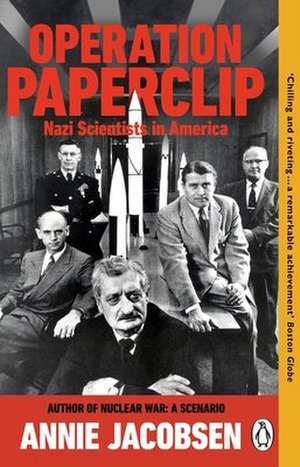
Operation Paperclip: Annie Jacobsen
Autor Annie Jacobsenen Limba Engleză Paperback – 15 ian 2026
Găsim în lucrarea Operation Paperclip o documentare riguroasă a unuia dintre cele mai controversate programe postbelice ale Statelor Unite. Față de literatura existentă pe acest subiect, Annie Jacobsen aduce un plus de profunzime prin utilizarea unor surse primare anterior inaccesibile: documente din arhive germane puse la dispoziție de descendenții membrilor celui de-al Treilea Reich și dosare de la Universitatea Harvard. Remarcăm cum autoarea nu se limitează la o cronologie tehnică, ci construiește o narațiune bazată pe experiențele umane complexe ale celor peste 12 cercetători naziști transferați în SUA pentru a susține eforturile din timpul Războiului Rece. Suntem de părere că volumul reușește să echilibreze succesul tehnologic — cum ar fi progresele în rachete și programul spațial — cu realitatea brutală a trecutului acestor oameni, unii fiind acuzați de crime de război la Nürnberg. Stilul este precis și investigativ, evitând speculațiile nefondate și bazându-se pe interviuri directe cu interogatori și rude ale celor implicați. Această abordare amintește de rigoarea din Area 51, lucrarea anterioară a autoarei, unde s-a concentrat tot pe secretele militare ale Războiului Rece, însă aici dilema morală este mult mai pregnantă. Ca alternativă la Spies, Lies, and Citizenship pentru cursurile de relații internaționale și istoria serviciilor secrete, Operation Paperclip are avantajul de a oferi o perspectivă biografică detaliată, transformând datele de arhivă într-o expunere fluidă despre prețul securității naționale. În comparație cu abordările mai generale, cercetarea lui Jacobsen oferă o bază factuală solidă pentru analiza modului în care interesele strategice pot eclipsa considerentele etice într-un context de criză globală.


Preț: 95.87 lei
Carte disponibilă
Livrare economică 10-24 noiembrie
Livrare express 24-30 octombrie pentru 30.69 lei
Specificații
ISBN-10: 1804998826
Pagini: 608
Dimensiuni: 124 x 194 x 47 mm
Greutate: 0.44 kg
Editura: Transworld Publishers Ltd
Colecția Annie Jacobsen
Seria Annie Jacobsen
V-ar putea interesa
-
 Preț: 81.94 lei
 -
 Philosophy DeMYSTiFiedRobert ArpPreț: 211.58 lei
 -
 The Early ChurchHenry ChadwickPreț: 93.27 lei
 -
 Fateful ChoicesIan Kershaw-17%Preț: 102.42 lei124.02 lei
 -
 The EndIan Kershaw-18%Preț: 100.75 lei123.33 lei
 -
 Berlin. 75th Anniversary EditionAntony Beevor-17%Preț: 79.72 lei95.67 lei
 -
 The VanquishedRobert Gerwarth-18%Preț: 88.82 lei108.56 lei
 -
 Wannsee: The Road to the Final SolutionPeter Longerich-25%Preț: 164.18 lei219.04 lei
 -
 Legacy of AshesTim Weiner-21%Preț: 115.56 lei146.30 leiRecomandat
 -
 Networks of the BrainOlaf Sporns-5%Preț: 541.21 lei569.70 lei
 -
 Breath, Eyes, MemoryEdwidge Danticat-37%Preț: 55.97 lei89.06 lei
 -
 The PlotWill EisnerPreț: 112.02 lei
 -
 Henri Cartier-Bresson: China 1948-1949, 1958Michel Frizot-15%Preț: 341.20 lei403.32 lei
 -
 It's Only a Movie: Alfred Hitchcock A Personal BiographyCharlotte Chandler-55%Preț: 47.54 lei105.94 lei
 -
 Our Story BeginsTobias Wolff-26%Preț: 80.28 lei108.27 lei
 -
 Preț: 138.54 lei
 -
 Dark ArchivesMegan RosenbloomPreț: 108.48 lei
 -
 Albert Speer - Escaping the GallowsAdrian GreavesPreț: 142.50 lei
 -
 The Diary of Lena MukhinaLena Mukhina-30%Preț: 57.00 lei81.50 lei
 -
 The Road to EleusisR Gordon WassonPreț: 112.05 lei
 -
 Frans Hals: The Male PortraitLelia Packer-43%Preț: 133.84 lei234.82 lei
 -
 -23%Preț: 114.15 lei148.62 lei
 -
 Balfour and WeizmannGeoffrey Lewis-40%Preț: 118.18 lei195.75 lei
De ce să citești această carte
Această carte este esențială pentru cititorii pasionați de istoria spionajului și de culisele Războiului Rece. Annie Jacobsen oferă o perspectivă documentată asupra modului în care oameni de știință naziști au devenit piloni ai programelor spațiale și medicale americane. Veți câștiga o înțelegere profundă a compromisurilor etice făcute în numele securității naționale, totul printr-o scriitură alertă, bazată pe dovezi solide și mărturii exclusive.
Despre autor
Annie Jacobsen este o jurnalistă de investigație reputată, finalistă a premiului Pulitzer și colaboratoare pentru Los Angeles Times Magazine. Absolventă a Universității Princeton, s-a specializat în cercetarea programelor guvernamentale secrete și a istoriei militare. Succesul său editorial a fost consolidat de Area 51, un bestseller New York Times care a explorat misterele bazei militare din Nevada. În Operation Paperclip, Jacobsen își continuă misiunea de a scoate la lumină arhive clasificate, folosind tehnici de investigație de lungă durată pentru a analiza intersecția dintre știință, politică și servicii de informații.
Notă biografică
Descriere scurtă
In this engrossing and deeply disturbing exposé from the bestselling author of Nuclear War: A Scenario, Annie Jacobsen tells the gripping story of a decades-long, covert project to bring Hitler's scientists and their families to the United States.
In the chaos following the Second World War, the US government faced a critical decision: what to do with the great scientific minds of the Third Reich. Many were accused of war crimes, and others had stood trial at Nuremberg; one was convicted of mass murder. Nevertheless, the US government secretly decided that their knowledge of rocketry and medical advances were vital to the outcome of the Cold War.
Drawing on exclusive interviews with dozens of Paperclip family members, colleagues, and interrogators, and dossiers discovered in archives across the world, Annie Jacobsen follows more than a dozen German scientists through their postwar lives and into one of the most startling, complex, nefarious, and jealously guarded government secrets of the twentieth century.
'Chilling and riveting . . . a remarkable achievement of investigative reporting and historical writing' Boston Globe
'The most in-depth account yet of the lives of Paperclip recruits and their American counterparts' New York Times Book Review
Recenzii
One of iBooks' Top Ten Nonfiction Books of the Year
"Important, superbly written.... Jacobsen's book allows us to explore these questions with the ultimate tool: hard evidence. She confronts us with the full extent of Paperclip's deal with the devil, and it's difficult to look away."—Matt Damsker, USA Today (4 stars)
"With Annie Jacobsen's OPERATION PAPERCLIP for the first time the enormity of the effort has been laid bare. The result is a book that is at once chilling and riveting, and one that raises substantial and difficult questions about national honor and security...This book is a remarkable achievement of investigative reporting and historical writing."—Boston Globe
"As comprehensive as it is critical, this latest expose from Jacobsen is perhaps her most important work to date.... Jacobsen persuasively shows that it in fact happened and aptly frames the dilemma.... Rife with hypocrisy, lies, and deceit, Jacobsen's story explores a conveniently overlooked bit of history." -- Publishers Weekly (starred)
"The most in depth account yet of the lives of Paperclip recruits and their American counterparts.... Jacobsen deftly untangles the myriad German and American agencies and personnel involved...more gripping and skillfully rendered are the stories of American and British officials who scoured defeated Germany for Nazi scientists and their research."—New York Times Book Review
"Chilling, compelling, and comprehensive accounting.... Jacobsen's impressive book plumbs the dark depths of this postwar recruiting and shows the historical truths behind the space race and postwar US dominance. Highly recommended for readers in World War II history, espionage, government cover-ups, or the Cold War." -- Library Journal (starred)
"Darkly picaresque.... Jacobsen persuasively argues that the mindset of the former Nazi scientists who ended up working for the American government may have exacerbated Cold War paranoia."—New Yorker
"An engrossing and deeply disturbing exposé that poses ultimate questions of means versus ends." -- Booklist (starred)
"Annie Jacobsen's Operation Paperclip is a superb investigation, showing how the U.S. government recruited the Nazis' best scientists to work for Uncle Sam on a stunning scale. Sobering and brilliantly researched." -- Alex Kershaw, author of The Liberator
"Throughout, the author delivers harrowing passages of immorality, duplicity and deception, as well as some decency and lots of high drama. How Dr. Strangelove came to America and thrived, told in graphic detail." -- Kirkus Reviews
"[A] gripping, always disquieting story of a nation forced to trade principle for power.... Jacobsen gives us many vivid moments.... OPERATION PAPERCLIP takes its place in the annals of Cold War literature, one more proof that moral purity and great power can seldom coexist."—Chris Tucker, The Dallas Morning News
"Jacobsen uses newly released documents, court transcripts, and family-held archives to give the fullest accounting yet of this endeavor." -- The New York Post
"Doggedly researched." -- Parade
"A compelling work with interesting historical and personal revelations."—Jay Watkins, CIA's Intelligence in Public Literature