Operation 'Chariot'
Autor Jean Paul Palluden Limba Engleză Hardback – 30 mai 2027
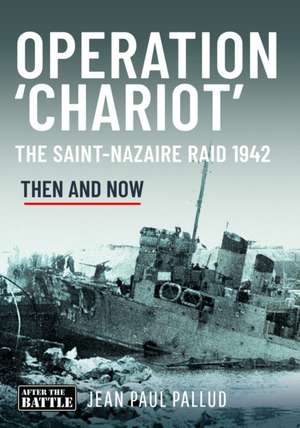
The primary objective of what was named Operation 'Chariot' was to destroy the Normandie Dock, the only dry dock on the Atlantic coast capable of servicing large German warships such as the battleship Tirpitz. Denying its use would limit the ability of major Kriegsmarine vessels to operate in the Atlantic. The assault force consisted of 345 Royal Navy personnel, 257 Commandos, a four-man medical team, three liaison officers and two representatives from the press - in total 611 men.
For its part in the attack, HMS Campbeltown had been modified to resemble a German torpedo boat and packed with a huge delayed-action explosive charge concealed within its bow. Under heavy fire as they entered the Loire estuary, the force pressed on toward the dock gates. Campbeltown was deliberately rammed into the Normandie Dock caisson, embedding itself firmly. Commandos disembarked under intense German fire to destroy key infrastructure, including pumping stations, machinery, and gun emplacements. Despite significant casualties, demolition teams successfully completed many of their objectives.
Several hours after the initial assault, the explosives hidden aboard Campbeltown detonated, destroying the dock gate and rendering the facility unusable for the remainder of the war. Many of the assault force were killed or captured, and only a third of the men who sailed into the Loire on 28 March managed to escape back to Britain. Despite these losses, the raid achieved its strategic aim. The Germans were never able to use the dry dock again, which limited the operational flexibility of the Kriegsmarine in the Atlantic and contributed to Allied naval advantage. Moreover, the daring operation signalled to occupied Europe that Germany had not won the war.
In Operation 'Chariot', the renowned historian Jean-Paul Pallud reveals the full story of the raid, and the men who took part, all of which is explored in After the Battle's well-known 'Then & Now' format.
Preț: 320.33 lei
Precomandă
Puncte Express: 480
Carte nepublicată încă
Livrare prin curier în România Precomanda se expediază când titlul devine disponibil.
Transport gratuit de la 400.00 lei Plată online sau ramburs, în funcție de opțiunile comenzii.
Retur gratuit în 14 zile Comandă securizată și suport în română.
Doresc să fiu notificat când acest titlu va fi disponibil:
Se trimite...
Specificații
Notă biografică
JEAN PAUL PALLUD was born in France in 1949 and studied physics at Grenoble University, graduating as a physicist engineer. Specialising in the history of the Second World War, he has worked alongside After the Battle for over 43 years, his first submission to the magazine appearing in 1979, and his last in 2022 in the last issue.
As one of the main contributors to the magazine, he ventured behind the then-Iron Curtain, journeyed north of the Northern Circle, and far into the deserts of North Africa. He has written and contributed to over 80 articles on a wide variety of wartime topics and is the author of many of the After the Battle's most memorable feats. He authored five major books: The Battle of the Bulge Then and Now, Blitzkrieg in the West Then and Now, Rückmarsch Then and Now, Operation 'Torch' Then and Now and The Desert War Then and Now. He also co-authored German Coastal Radar Stations Then and Now with Winston Ramsey and has contributed to three more major After the Battle books. He has written over 150 articles and books in French.
As one of the main contributors to the magazine, he ventured behind the then-Iron Curtain, journeyed north of the Northern Circle, and far into the deserts of North Africa. He has written and contributed to over 80 articles on a wide variety of wartime topics and is the author of many of the After the Battle's most memorable feats. He authored five major books: The Battle of the Bulge Then and Now, Blitzkrieg in the West Then and Now, Rückmarsch Then and Now, Operation 'Torch' Then and Now and The Desert War Then and Now. He also co-authored German Coastal Radar Stations Then and Now with Winston Ramsey and has contributed to three more major After the Battle books. He has written over 150 articles and books in French.