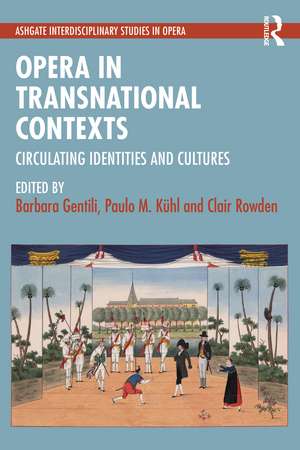
Opera in Transnational Contexts: Circulating Identities and Cultures: Ashgate Interdisciplinary Studies in Opera
Editat de Barbara Gentili, Paulo M. Kühl, Clair Rowdenen Limba Engleză Hardback – 10 apr 2026
Contributors reveal how complex constructions of identity and cultural value have been forged through the circulation, production, translation, adaptation and reception of different operatic and non-operatic genres. Engaging with decolonial agendas in North Africa, postcolonial and imperial history in Latin America, cultural dissonances and hegemonic aspirations in Japan, localities and peripheries from the old world to Australia, and the centrality of Europe in historiographies of opera, the chapters examine the dynamics and multifaceted effects of transnational mobility.
The book will be important not only for opera studies, musicology, and music and voice studies, but also for researchers in history, art history, literary studies, translation and cultural studies.
Chapter 14 of this book is freely available as a downloadable Open Access PDF at http://www.taylorfrancis.com under a Creative Commons Creative Commons Attribution-No Derivatives 4.0 International (CC BY-ND)
Din seria Ashgate Interdisciplinary Studies in Opera
-
 Preț: 446.86 lei
 -
 Preț: 433.69 lei
 -
 Preț: 470.92 lei
 -
 Preț: 434.15 lei
 -
 Preț: 472.07 lei
 - 15%
 Preț: 444.87 lei
 -
 Preț: 384.10 lei
 -
 Preț: 441.13 lei
 - 15%
 Preț: 438.34 lei
 - 15%
 Preț: 486.79 lei
 - 15%
 Preț: 473.86 lei
 -
 Preț: 437.08 lei
 - 15%
 Preț: 415.95 lei
 -
 Preț: 382.69 lei
 - 18%
 Preț: 1116.20 lei
 -
 Preț: 484.98 lei
 -
 Preț: 409.15 lei
 -
 Preț: 481.42 lei
 -
 Preț: 482.42 lei
 -
 Preț: 440.27 lei
 - 15%
 Preț: 473.86 lei
 -
 Preț: 435.80 lei
 - 18%
 Preț: 1254.53 lei
 - 15%
 Preț: 445.93 lei
 -
 Preț: 410.44 lei
 -
 Preț: 406.18 lei
 -
 Preț: 435.80 lei
 - 15%
 Preț: 483.89 lei
Preț: 1102.90 lei
Preț vechi: 1460.59 lei
-24%
Puncte Express: 1654
Carte indisponibilă temporar
Doresc să fiu notificat când acest titlu va fi disponibil:
Se trimite...
Specificații
ISBN-13: 9781032861111
ISBN-10: 1032861118
Pagini: 246
Ilustrații: 36
Dimensiuni: 156 x 234 mm
Greutate: 0.62 kg
Ediția:1
Editura: Taylor & Francis
Colecția Routledge
Seria Ashgate Interdisciplinary Studies in Opera
Locul publicării:Oxford, United Kingdom
ISBN-10: 1032861118
Pagini: 246
Ilustrații: 36
Dimensiuni: 156 x 234 mm
Greutate: 0.62 kg
Ediția:1
Editura: Taylor & Francis
Colecția Routledge
Seria Ashgate Interdisciplinary Studies in Opera
Locul publicării:Oxford, United Kingdom
Public țintă
Postgraduate and Undergraduate AdvancedCuprins
Introduction
Section I: Identity, Adaptation, Genre
1. Opera and Modernity in Independent Latin America (1820–1825)
2. Reception and Creation of Musical Theatre in the Arab World: A Decolonial Approach
3. Nation and Adaptation in Eighteenth-Century Swedish Opera
Section II: Networks and Impresarios: The Mechanics of the Business
4. Consuming Operetta: Gender, Genre and the Bandmann Opera Company in Early-Twentieth-Century Japan
5. From the Caffè Martini in Milan to Atlantic South America: The Global Rise of the Italian Opera Industry in the 1840s
6. Importing and Adapting between Milan and Paris: The Case of Edoardo Sonzogno
7. Theatre and Soft Power in Fascist Italy: A Place for Opera in the International Arena
Section III: The Transnational Reception of Singing and Singers
8. Continuities and Fissures in the Cultural Reception of Italian Opera and Singers in Early-Twentieth-Century Buenos Aires
9. Translating Opera in Brazil (Rio de Janeiro) and Colombia (Bogotá) in the Nineteenth Century
10. The Diva and Transnational Singing: Anne Charton-Demeur
Section IV: Repertoires, Production and Localities
11. Transnational Italian Opera Production in Nineteenth-Century Vienna: Aida, a Case Study
12. Dreaming of Wagner: Performing Gluck and the Aspiration for a National Theatre in Japan
13. Adjö Mimi! Margit Rosengren and the Transfer of Popular Musical Theatre to Sweden in the 1920s
14. Constructing Opera: Transnational Forces in Opera in Australia (1955–1985) – A Building, a Diva and Three Musical Directors
Section I: Identity, Adaptation, Genre
1. Opera and Modernity in Independent Latin America (1820–1825)
2. Reception and Creation of Musical Theatre in the Arab World: A Decolonial Approach
3. Nation and Adaptation in Eighteenth-Century Swedish Opera
Section II: Networks and Impresarios: The Mechanics of the Business
4. Consuming Operetta: Gender, Genre and the Bandmann Opera Company in Early-Twentieth-Century Japan
5. From the Caffè Martini in Milan to Atlantic South America: The Global Rise of the Italian Opera Industry in the 1840s
6. Importing and Adapting between Milan and Paris: The Case of Edoardo Sonzogno
7. Theatre and Soft Power in Fascist Italy: A Place for Opera in the International Arena
Section III: The Transnational Reception of Singing and Singers
8. Continuities and Fissures in the Cultural Reception of Italian Opera and Singers in Early-Twentieth-Century Buenos Aires
9. Translating Opera in Brazil (Rio de Janeiro) and Colombia (Bogotá) in the Nineteenth Century
10. The Diva and Transnational Singing: Anne Charton-Demeur
Section IV: Repertoires, Production and Localities
11. Transnational Italian Opera Production in Nineteenth-Century Vienna: Aida, a Case Study
12. Dreaming of Wagner: Performing Gluck and the Aspiration for a National Theatre in Japan
13. Adjö Mimi! Margit Rosengren and the Transfer of Popular Musical Theatre to Sweden in the 1920s
14. Constructing Opera: Transnational Forces in Opera in Australia (1955–1985) – A Building, a Diva and Three Musical Directors
Notă biografică
Barbara Gentili is Senior Lecturer and Director of the Theatrical Voice Research Centre, University of Surrey.
Paulo M. Kühl is Professor of Art History and History of Opera at the Arts Institute, Universidade Estadual de Campinas (Brazil).
Clair Rowden is Professor of Musicology and Head of Music at the School of Culture and Creative Arts (SCCA), University of Glasgow.
Paulo M. Kühl is Professor of Art History and History of Opera at the Arts Institute, Universidade Estadual de Campinas (Brazil).
Clair Rowden is Professor of Musicology and Head of Music at the School of Culture and Creative Arts (SCCA), University of Glasgow.
Descriere
Opera in Transnational Contexts sheds important light onto the travels of operatic works and the types of cultural exchanges that occurred as a result of the music, composers, singers, impresarios, and others moving from one locale to another between the late eighteenth and twentieth centuries.