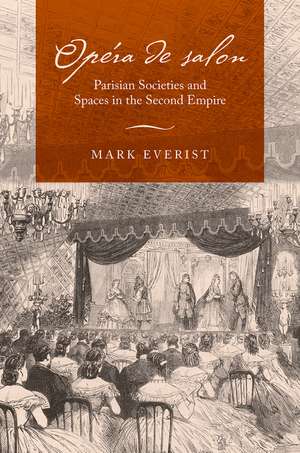
Opéra de salon: Parisian Societies and Spaces in the Second Empire
Autor Mark Everisten Limba Engleză Hardback – 30 sep 2025
Preț: 434.76 lei
Preț vechi: 620.70 lei
-30%
Puncte Express: 652
Carte disponibilă
Livrare economică 16-27 octombrie
Livrare prin curier în România Termenul estimat este afișat lângă disponibilitate.
Transport gratuit pentru acest produs Plată online sau ramburs, în funcție de opțiunile comenzii.
Retur gratuit în 14 zile Comandă securizată și suport în română.
Specificații
ISBN-13: 9780197695180
ISBN-10: 0197695183
Pagini: 290
Ilustrații: 28 illustrations, 13 tables
Dimensiuni: 166 x 245 x 24 mm
Greutate: 0.58 kg
Editura: Oxford University Press
Colecția OUP USA
Locul publicării:New York, United States
ISBN-10: 0197695183
Pagini: 290
Ilustrații: 28 illustrations, 13 tables
Dimensiuni: 166 x 245 x 24 mm
Greutate: 0.58 kg
Editura: Oxford University Press
Colecția OUP USA
Locul publicării:New York, United States
V-ar putea interesa
-
 The Phantom of the OperaGaston LerouxPreț: 28.01 lei
 -
 History of OperaCarolyn AbbatePreț: 135.73 lei
 -
 The Oxford Handbook of the Operatic CanonCormac Newark-32%Preț: 991.57 lei1464.16 lei
 -
 The Oxford Handbook of OperaHelen M. Greenwald-13%Preț: 391.89 lei449.04 lei
 -
 -33%Preț: 560.63 lei830.81 lei
 -
 Opera: The Definitive Illustrated StoryAlan Riding-18%Preț: 182.72 lei222.53 lei
 -
 The Cambridge Companion to Opera StudiesNicholas TillPreț: 218.26 lei
 -
 Dreaming in EnsembleLucy CaplanPreț: 250.82 lei
 -
 Salon culture in JapanAkiko Yano-14%Preț: 204.60 lei239.23 lei
 -
 Concert Life in Nineteenth-Century New OrleansJohn H. Baron-15%Preț: 606.95 lei714.05 lei
 -
 Opera, a History of the Impossible GenreJeffrey LangfordPreț: 364.41 lei
 -
 -11%Preț: 397.81 lei446.99 lei
 -
 A Cultural History of Western Music in the Age of EnlightenmentDavid R M Irving-45%Preț: 402.74 lei726.81 lei
 -
 A New Philosophy of OperaYuval SharonPreț: 170.55 lei
 -
 Introduction to OperaPaul TerryPreț: 115.14 lei
 -
 The Gilded StageDaniel Snowman-18%Preț: 189.61 lei230.48 lei
 -
 The Beggar's OperaJohn GayPreț: 27.88 lei
 -
 The Importance of Being EarnestOscar WildePreț: 47.72 lei
 -
 Nobody Sits Like the FrenchCharles PappasPreț: 164.89 lei
Notă biografică
Mark Everist is Professor of Music at the University of Southampton. His research focuses on the music of western Europe from 1150-1330, music for the stage in nineteenth-century France, Mozart, reception theory, and historiography. He is the author of six monographs, the most recent of which are Genealogies of Music and Memory and The Empire at the Opera, editor of three volumes of the Magnus Liber Organi, and has published over 80 articles in peer-reviewed journals and collections of essays. The recipient of the Solie (2010) and Slim (2011) awards of the American Musicological Society, he was elected a fellow of the Academia Europaea in 2012. Everist was President of the Royal Musical Association from 2011-17 and was elected a corresponding member of the American Musicological Society in 2014. He was visiting professor at the Sorbonne in 2021-22 and was elected to a fellowship at the FrenchInstitute of Advanced Studies from 2023-24. In July 2024, Everist was named Chevalier de l'Ordre des Arts et des Lettres by the French Minister of Culture.