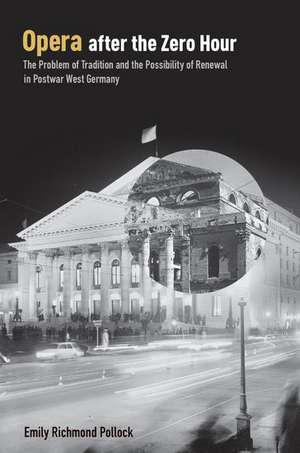
Opera After the Zero Hour: The Problem of Tradition and the Possibility of Renewal in Postwar West Germany
Autor Emily Richmond Pollocken Limba Engleză Hardback – 14 oct 2019
Preț: 448.56 lei
Preț vechi: 626.22 lei
-28%
Puncte Express: 673
Carte tipărită la comandă
Livrare economică 13-18 noiembrie
Livrare prin curier în România Termenul estimat este afișat lângă disponibilitate.
Transport gratuit pentru acest produs Plată online sau ramburs, în funcție de opțiunile comenzii.
Retur gratuit în 14 zile Comandă securizată și suport în română.
Specificații
ISBN-13: 9780190063733
ISBN-10: 0190063734
Pagini: 312
Ilustrații: 79 line, 15 halftone
Dimensiuni: 236 x 160 x 18 mm
Greutate: 0.61 kg
Editura: Oxford University Press
Colecția OUP USA
Locul publicării:New York, United States
ISBN-10: 0190063734
Pagini: 312
Ilustrații: 79 line, 15 halftone
Dimensiuni: 236 x 160 x 18 mm
Greutate: 0.61 kg
Editura: Oxford University Press
Colecția OUP USA
Locul publicării:New York, United States
Recenzii
In tackling the operatic history of Germany's haunted postwar years, Opera after the Zero Hour brings a fresh approach to the study of opera as an emblem of public life. With ethically nuanced attention to Germany's post-genocidal setting, Emily Pollock makes a powerful case for taking seriously long-neglected operatic works that speak to a vexed cultural history still relevant in the present.
Pollock's monograph is a welcome, complicating intervention in a period of time that has suffered from overly simplistic readingsof musical culture and political power.
Pollock's monograph is a welcome, complicating intervention in a period of time that has suffered from overly simplistic readingsof musical culture and political power.
Notă biografică
Emily Richmond Pollock is a member of the faculty in the Music and Theater Arts Section of the Massachusetts Institute of Technology. She earned her PhD in music history and literature from the University of California, Berkeley in 2012. Her articles and reviews have appeared in the Journal of Musicology, Journal of the American Musicological Society, Opera Quarterly, and Notes. Her research has been supported by the German Academic Exchange Service (DAAD), the Paul Sacher Stiftung, and the Class of 1947 at MIT.
Cuprins
- Introduction
- Chapter One: Placement and Displacement
- Rank and File: Opera's Everyday Biographies
- The Situation of New Opera in the Post-War Repertoire
- Chapter Two: The Significance of Nonsense: Boris Blacher's Abstrakte Oper Nr. 1
- Why Abstract an Opera?
- Linguistic Abstraction in the Libretto
- Making Music from Nonsense
- Hearing Controversy and Politics in Abstraction
- Chapter Three: Italy, Atonally: Hans Werner Henze's König Hirsch
- The Bondage of bel canto
- The Magic of König Hirsch
- From Sketches to Songs
- Melody, the "Renegade's Hara-kiri"
- Chapter Four: The Opera Underneath: Carl Orff's Oedipus der Tyrann
- Origin Stories I: Ancient Greece in Germany
- Origin Stories II: Ancient Greece against the Opera
- An Opera without Music?
- Traces of the Opera Underneath
- Chapter Five: Explosive Pluralisms: Bernd Alois Zimmermann's Die Soldaten
- Wagner and Berg: Zimmermann's Operatic Pasts
- A Spaceship of the Mind: Zimmermann's Operatic Futures
- From Lenz to Literaturoper
- The Structure of Pluralism
- Serialism and Expression(ism)
- In the End
- Chapter Six: Rebuilding and Retrenchment: The Munich Nationaltheater and Werner Egk's Die Verlobung in San Domingo
- Ideas of Reconstruction
- The Reconstruction of the Munich Nationaltheater
- November 1963: The Gala Reopening
- Who Was Werner Egk?
- Operaticism and Racial Stereotypes in Die Verlobung in San Domingo
- Epilogue
- Bibliography