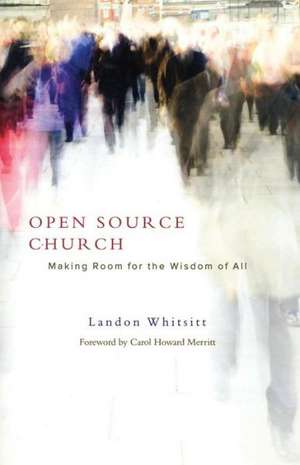
Open Source Church: Making Room for the Wisdom of All
Autor Rev. Landon Whitsitten Limba Engleză Paperback – 8 apr 2011
Preț: 177.48 lei
Preț vechi: 237.86 lei
-25%
Puncte Express: 266
Carte tipărită la comandă
Livrare economică 24 noiembrie-08 decembrie
Livrare prin curier în România Termenul estimat este afișat lângă disponibilitate.
Transport gratuit de la 400.00 lei Plată online sau ramburs, în funcție de opțiunile comenzii.
Retur gratuit în 14 zile Comandă securizată și suport în română.
Specificații
ISBN-13: 9781566994125
ISBN-10: 1566994128
Pagini: 192
Dimensiuni: 140 x 215 x 14 mm
Greutate: 0.25 kg
Ediția:New.
Editura: Bloomsbury Publishing
Colecția Rowman & Littlefield
Locul publicării:New York, United States
ISBN-10: 1566994128
Pagini: 192
Dimensiuni: 140 x 215 x 14 mm
Greutate: 0.25 kg
Ediția:New.
Editura: Bloomsbury Publishing
Colecția Rowman & Littlefield
Locul publicării:New York, United States
Recenzii
Open Source Church is the most effective metaphor I've read in years for expressing the kinds of community that Jesus's followers are called to create and to live. For Christians under 40 or so, and for more seekers than you can imagine, the open-source world is everyday reality. People today connect through facebook and google, through social media and peer-to-peer networking. If the church is to be a vibrant social force in our day, it can only be an open source church.
Whitsitt envisions a church where openness and inclusion don't just affect what happens at the front door but become the cornerstone upon which the entire structure is built.
God calls us together because of who God is. God is not a dry, detached singular being, but a holy community. We are made in God's image. So we are designed to be together. The church needs to hear, believe and live this reality in every facet of its life. Together we are smarter, better, even more faithful, than any one of us can possibly be individually. Any attempt to limit the openness, the variety and innovation of the whole in the name of the few (or the one) inevitably undercuts the life of faith. In part, this is the message of Landon Whitsitt's Open Source Church. But there's much more here. What we need today is churchly thinking for "What's Next." And, as Landon knows, "What's Next" will certainly not be a single model of church. Of course, there has never been just one single way of being the church any way - never! In this book, Landon provides a vivid and compelling picture of "What's Next." Welcome to the future!
Landon Whitsitt's vision of a new kind of church is revolutionary and hopeful, particularly for faithful men and women who feel they are locked into systems that are shutting down with very few reasons to hope for a reboot. What Chris Anderson's book 'Free' did for the tech and business sectors, Landon Whitsitt's 'Open Source Church' looks poised to do for the Church -- open up access points to new ways of thinking about how we function and who we are. This is not a book about churches embracing new media and new technology. This is a book about our churches installing a whole new, participatory operating system. The innovation we need for forming faith communities in this new era of mission will come from this kind of thinking.
Whitsitt offers a model for changing church structures that could work. He translates the principles of open-source technology to imagine a new framework for fluid and faithful mission. If you are searching for more responsive, agile, and inclusive-of-all-generations ways to organize church life, read this book.
Whitsitt envisions a church where openness and inclusion don't just affect what happens at the front door but become the cornerstone upon which the entire structure is built.
God calls us together because of who God is. God is not a dry, detached singular being, but a holy community. We are made in God's image. So we are designed to be together. The church needs to hear, believe and live this reality in every facet of its life. Together we are smarter, better, even more faithful, than any one of us can possibly be individually. Any attempt to limit the openness, the variety and innovation of the whole in the name of the few (or the one) inevitably undercuts the life of faith. In part, this is the message of Landon Whitsitt's Open Source Church. But there's much more here. What we need today is churchly thinking for "What's Next." And, as Landon knows, "What's Next" will certainly not be a single model of church. Of course, there has never been just one single way of being the church any way - never! In this book, Landon provides a vivid and compelling picture of "What's Next." Welcome to the future!
Landon Whitsitt's vision of a new kind of church is revolutionary and hopeful, particularly for faithful men and women who feel they are locked into systems that are shutting down with very few reasons to hope for a reboot. What Chris Anderson's book 'Free' did for the tech and business sectors, Landon Whitsitt's 'Open Source Church' looks poised to do for the Church -- open up access points to new ways of thinking about how we function and who we are. This is not a book about churches embracing new media and new technology. This is a book about our churches installing a whole new, participatory operating system. The innovation we need for forming faith communities in this new era of mission will come from this kind of thinking.
Whitsitt offers a model for changing church structures that could work. He translates the principles of open-source technology to imagine a new framework for fluid and faithful mission. If you are searching for more responsive, agile, and inclusive-of-all-generations ways to organize church life, read this book.