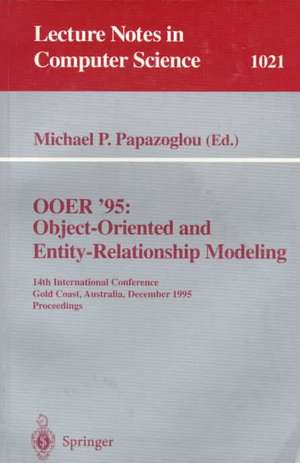
OOER '95 Object-Oriented and Entity-Relationship Modeling
Editat de Michael Papazoglouen Limba Engleză Paperback – 23 noi 1995
The 36 papers presented together with an invited presentation by Gio Wiederhold were selected from a total of 120 submissions. The papers are organized in sections on object design and modelling, models and languages, reverse engineering and schema transformation, behavioral modelling, non-traditional modelling, theoretical foundations, business re-engineering, integrated approaches, cooperative work modelling, temporal data modelling, federated systems design, and industrial stream papers
Preț: 331.16 lei
Preț vechi: 413.95 lei
-20%
Puncte Express: 497
Carte tipărită la comandă
Livrare economică 07-21 decembrie
Livrare prin curier în România Termenul estimat este afișat lângă disponibilitate.
Transport gratuit de la 400.00 lei Plată online sau ramburs, în funcție de opțiunile comenzii.
Retur gratuit în 14 zile Comandă securizată și suport în română.
Specificații
ISBN-13: 9783540606727
ISBN-10: 3540606726
Pagini: 476
Ilustrații: XVII, 459 p.
Dimensiuni: 155 x 235 x 26 mm
Greutate: 0.72 kg
Ediția:1995
Editura: Springer
Locul publicării:Berlin, Heidelberg, Germany
ISBN-10: 3540606726
Pagini: 476
Ilustrații: XVII, 459 p.
Dimensiuni: 155 x 235 x 26 mm
Greutate: 0.72 kg
Ediția:1995
Editura: Springer
Locul publicării:Berlin, Heidelberg, Germany
V-ar putea interesa
-
 Weapons of Math DestructionCathy O'Neil-30%Preț: 64.70 lei92.81 lei
 -
 An Introduction to Quantum ComputingPhillip Kaye-21%Preț: 473.00 lei601.00 lei
 -
 -22%Preț: 377.32 lei482.83 lei
 -
 Algorithmic PuzzlesAnany Levitin-30%Preț: 251.05 lei359.44 lei
 -
 Algorithms UnlockedThomas H. Cormen-26%Preț: 189.43 lei256.67 lei
 -
 Concentration of Measure for the Analysis of Randomized AlgorithmsDevdatt P. Dubhashi-20%Preț: 319.28 lei399.10 lei
 -
 -20%Preț: 860.62 lei1075.77 lei
 -
 -20%Preț: 311.44 lei389.30 lei
 -
 -18%Preț: 1194.20 lei1456.35 lei
 -
 -20%Preț: 652.57 lei815.71 lei
 -
 Object-Oriented Behavioral SpecificationsHaim Kilov-20%Preț: 950.56 lei1188.20 lei
 -
 -20%Preț: 656.61 lei820.77 lei
 -
 Algorithms and Models for the Web GraphAnthony Bonato-20%Preț: 319.28 lei399.10 lei
 -
 Advanced Information Systems Engineering WorkshopsLazaros Iliadis-20%Preț: 323.95 lei404.94 lei
 -
 Applications of Evolutionary ComputationGiovanni Squillero-20%Preț: 333.31 lei416.64 lei
 -
 Digital Logic for ComputingJohn Seiffertt-20%Preț: 529.53 lei661.90 lei
 -
 Algorithmic Aspects of Cloud ComputingTimos Sellis-20%Preț: 316.83 lei396.04 lei
 -
 Algorithms and ComplexityDimitris Fotakis-20%Preț: 355.67 lei444.59 lei
 -
 ArithmetikDonald E. Knuth-20%Preț: 348.87 lei436.10 lei
 -
 Grundlegende Algorithmen mit JavaDoina Logof¿tu-20%Preț: 310.64 lei388.30 lei
 -
 ALGORITHMICS OF MATCHING UNDER PREFERENCManlove David-20%Preț: 1152.49 lei1440.61 lei
Public țintă
ResearchCuprins
Modeling and system maintenance.- Adaptive schema design and evaluation in an object-oriented information system.- Assertion of consistency within a complex object database using a relationship construct.- A cryptographic mechanism for object-instance-based authorization in object-oriented database systems.- Unifying modeling and programming through an active, object-oriented, model-equivalent programming language.- A declarative query approach to object identification.- Versatile querying facilities for a dynamic object clustering model.- Reverse engineering of relational database applications.- A rigorous approach to schema restructuring.- Managing schema changes in object-relationship databases.- Behavioural constraints: Why using events instead of states.- Behavior consistent extension of object life cycles.- Color-X Event Model: Integrated specification of the dynamics of individual objects.- Database design with behavior and views using parameterized Petri nets.- SEER: Security enhanced entity-relationship model for secure relational databases.- Neural network technology to support view integration.- Database schema transformation and optimization.- Mapping an extended entity-relationship schema into a schema of complex objects.- Binary representation of ternary relationships in ER conceptual modeling.- Variable sets and functions framework for conceptual modeling: Integrating ER and OO via sketches with dynamic markers.- A logic framework for a semantics of object oriented data modelling.- Object-oriented meta modelling.- A conceptual model for business re-engineering methods and tools.- Data model evolution as a basis of business process management.- Reengineering processes in public administrations.- Uniqueness conditions for ER representations.- Rapid prototyping: An integrated CASE based approach.- Integrating and supporting Entity Relationship and Object Role Models.- From object specification towards agent design.- Conceptual modeling of workflows.- An object oriented approach for CSCW system design.- Semantics of time-varying attributes and their use for temporal database design.- Handling change management using temporal active repositories.- A graphical query language for temporal databases.- Managing object identity in federated database systems.- Management of inconsistent information in federated systems.- Resolving structural conflicts in the integration of Entity-Relationship schemas.- Use and control of data models: A repository approach.- The seven habits of highly effective data modellers (and object modellers?).- Object responsibility categories in support of top-down object discovery.- Denormalisation as an OO extension.- Development of a financial markets analytical product: A MOSES casestudy.- The practice of nuclear integrated design and engineering database establishment using object-oriented DBMS.- Application of “consistent dependency” to corporate and project information models.- The use of agglomerative categorisation to build a conceptual view of statistical data.