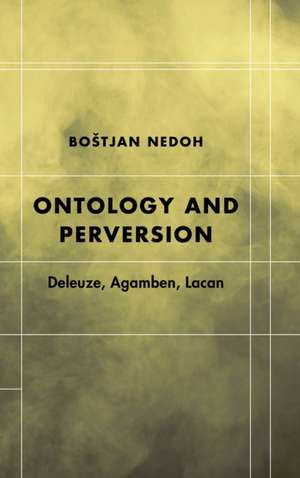
Ontology and Perversion: Deleuze, Agamben, Lacan: Futures of the Archive
Autor Boštjan Nedohen Limba Engleză Hardback – 4 iun 2019
Perversion is often understood simply in terms of cultural or sexual phenomena. By contrast, Bostjan Nedoh places perversion at the heart of philosophical, ontological and political issues in the works of Deleuze, Agamben and Lacan. He examines the relevance of their discussions of perversion for their respective critical ontological projects. By tracing the differences between these thinkers' understanding of perversion, the book finally draws lines of delimitation between the vitalist and the structuralist or psychoanalytic philosophical positions in contemporary philosophy.





Preț: 765.74 lei
Preț vechi: 1094.40 lei
-30%
Puncte Express: 1149
Carte tipărită la comandă
Livrare economică 21 noiembrie-05 decembrie
Livrare prin curier în România Termenul estimat este afișat lângă disponibilitate.
Transport gratuit pentru acest produs Plată online sau ramburs, în funcție de opțiunile comenzii.
Retur gratuit în 14 zile Comandă securizată și suport în română.
Specificații
ISBN-13: 9781786605511
ISBN-10: 1786605511
Pagini: 176
Dimensiuni: 154 x 230 x 18 mm
Greutate: 0.49 kg
Editura: Bloomsbury Publishing
Colecția Rowman & Littlefield
Seria Futures of the Archive
Locul publicării:New York, United States
ISBN-10: 1786605511
Pagini: 176
Dimensiuni: 154 x 230 x 18 mm
Greutate: 0.49 kg
Editura: Bloomsbury Publishing
Colecția Rowman & Littlefield
Seria Futures of the Archive
Locul publicării:New York, United States
Cuprins
Acknowledgments
Preface
Part I: Introductory: Perversion as a Theatre of Being
1 Perversions and Critical Ontologies: Ontologysing Perversion, Perverting Ontology in Deleuze, Agamben, and Lacan
Part II: Perversion between Deleuze's Transcendental Empiricism and the Ontology of Immanence Theatrum Philosophicum
2 Deleuze's Transcendental Empiricism: Simulacrum, Divergence and the Ontology of Difference
3 Masoch as a Name-of-Being
4 From Masoch to Tao: The Revision of Masochism in Late Deleuze
Part III: Beyond Metaphysics? Perversion in Agamben's Philosophy of Language and Political Philosophy Theatrum Politicum
5 Perverse Sphinx Against Oedipal Metaphysics: (Anti-)Metaphysics of Perversion in Agamben's Critique of Derrida and Freud
6 Messianism between Religion and Post-Religion: On the Perverse Structure of the Messianic Time
7 State of Exception and Sade's Biopolitical Manifesto
Part IV: Not Without the Other: Ontology and Perversion in Lacanian Psychoanalysis Theatrum Analiticum
8 Why Perversi
Preface
Part I: Introductory: Perversion as a Theatre of Being
1 Perversions and Critical Ontologies: Ontologysing Perversion, Perverting Ontology in Deleuze, Agamben, and Lacan
Part II: Perversion between Deleuze's Transcendental Empiricism and the Ontology of Immanence Theatrum Philosophicum
2 Deleuze's Transcendental Empiricism: Simulacrum, Divergence and the Ontology of Difference
3 Masoch as a Name-of-Being
4 From Masoch to Tao: The Revision of Masochism in Late Deleuze
Part III: Beyond Metaphysics? Perversion in Agamben's Philosophy of Language and Political Philosophy Theatrum Politicum
5 Perverse Sphinx Against Oedipal Metaphysics: (Anti-)Metaphysics of Perversion in Agamben's Critique of Derrida and Freud
6 Messianism between Religion and Post-Religion: On the Perverse Structure of the Messianic Time
7 State of Exception and Sade's Biopolitical Manifesto
Part IV: Not Without the Other: Ontology and Perversion in Lacanian Psychoanalysis Theatrum Analiticum
8 Why Perversi
Recenzii
Why is perversion not simply a social phenomenon but a mode of being? In this remarkable book, Nedoh audaciously stalks a novel ontology that dresses in variegated furs. Lacan's indifferently ferocious superego is juxtaposed to and played against the vitalist simulacra of Deleuze's Masoch and Agamben's Sphinx. Should critique drive with high heels?
For an ontology to be truly fundamental and absolute, it must account for everything under the sun. Given this, the category of the perverse, with its peculiarities and strangenesses, represents perhaps the greatest challenge to any ontological ambitions. In Ontology and Perversion, Bostjan Nedoh admirably rises to this challenge. He does so through a wonderfully illuminating defense of Lacan's reflections on ontology in relation to the ontologies of Deleuze and Agamben. Nedoh's book makes perversion an unavoidable point of reference for contemporary Continental metaphysics.
For an ontology to be truly fundamental and absolute, it must account for everything under the sun. Given this, the category of the perverse, with its peculiarities and strangenesses, represents perhaps the greatest challenge to any ontological ambitions. In Ontology and Perversion, Bostjan Nedoh admirably rises to this challenge. He does so through a wonderfully illuminating defense of Lacan's reflections on ontology in relation to the ontologies of Deleuze and Agamben. Nedoh's book makes perversion an unavoidable point of reference for contemporary Continental metaphysics.
Notă biografică
Bötjan Nedoh is a Research Assistant at the Institute of Philosophy, Scientific Research Centre of the Slovenian Academy of Sciences and Arts in Ljubljana.