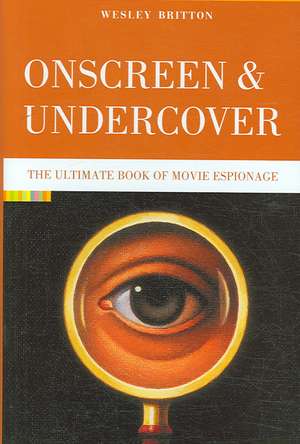
Onscreen and Undercover: The Ultimate Book of Movie Espionage
Autor Wesley Brittonen Limba Engleză Hardback – 30 oct 2006
Since the days of the silent documentary short, spying has been a staple of the movie business. It has been the subject of thrillers, melodramas, political films, romances, and endless parodies as well. But despite the developing mistrust of the spy as a figure of hope and good works, the variable relationship between real spying and screen spying over the past 100 years sheds light on how we live, what we fear, who we admire, and what we want our culture-and our world-to become.
Onscreen and Undercover describes now forgotten trends, traces surprising themes, and spotlights the major contributions of directors, actors, and other American and English artists. The focus is on movies, on and off camera.
In a 1989 National Public Radio interview, famed author John Le Carre said a spy must be entertaining. Spies have to interest potential sources, and be able to draw people in to succeed in recruiting informants. In that spirit, Wes Britton now offers Onscreen and Undercover.
Preț: 498.75 lei
Preț vechi: 635.32 lei
-21%
Puncte Express: 748
Carte disponibilă
Livrare economică 16-30 noiembrie
Livrare prin curier în România Termenul estimat este afișat lângă disponibilitate.
Transport gratuit pentru acest produs Plată online sau ramburs, în funcție de opțiunile comenzii.
Retur gratuit în 14 zile Comandă securizată și suport în română.
Specificații
ISBN-13: 9780275992811
ISBN-10: 0275992810
Pagini: 232
Dimensiuni: 156 x 235 x 25 mm
Greutate: 0.51 kg
Editura: Bloomsbury Publishing
Colecția Praeger
Locul publicării:New York, United States
ISBN-10: 0275992810
Pagini: 232
Dimensiuni: 156 x 235 x 25 mm
Greutate: 0.51 kg
Editura: Bloomsbury Publishing
Colecția Praeger
Locul publicării:New York, United States
V-ar putea interesa
-
 -25%Preț: 208.80 lei280.21 lei
 -
 The Oxford Handbook of Dance and the Popular ScreenMelissa Blanco Borelli-14%Preț: 1049.52 lei1220.37 lei
 -
 Lady in the Dark – Iris Barry and the Art of FilmRobert SittonPreț: 374.20 lei
 -
 -27%Preț: 499.92 lei680.61 lei
 -
 -30%Preț: 474.07 lei675.32 lei
 -
 Literature and Film as Modern MythologyWilliam K. Ferrell-27%Preț: 499.29 lei680.19 lei
 -
 -26%Preț: 404.23 lei545.24 lei
 -
 The Films of Kenneth BranaghSamuel Crowl-30%Preț: 510.61 lei724.73 lei
 -
 Spy TelevisionWesley Britton-20%Preț: 335.39 lei420.11 lei
 -
 Cinematic Savior: Hollywood's Making of the American ChristStephenson Humphries-Brooks-27%Preț: 392.35 lei534.28 lei
 -
 Beyond BondWesley Britton-16%Preț: 394.77 lei472.26 lei
 -
 -20%Preț: 340.87 lei426.13 lei
 -
 Future Imperfect: Philip K. Dick at the MoviesJason P. Vest-27%Preț: 499.29 lei680.19 lei
 -
 Picture ThisMolly Bang-13%Preț: 121.27 lei139.43 lei
 -
 The Encyclopedia of TV SpiesWesley BrittonPreț: 250.92 lei
Recenzii
How well did The Manchurian Candidate describe the fears of the early 1960s? Who remembers that Buster Keaton's classic The General was actually a spy yarn? Enthusiast Britton starts his hunt from the silent film and treads to the films that are likely to come our way soon, looking at the former as a form of Victorian melodrama with a rather scattered system of villains and fears and the latter as what the viewing public assumes about terrorists. Along the way he examines early civil war flicks and oaters, the aristocratic and elegant espionage of the 1930s, various narratives of nazis from the 1930s to 2005, the Bond, et. al. worship of the 1960s and 1970s, and the antiheroes from then to now. A fascinating chapter details how those who made movies somehow found spies of World War II and the Cold War hilarious.