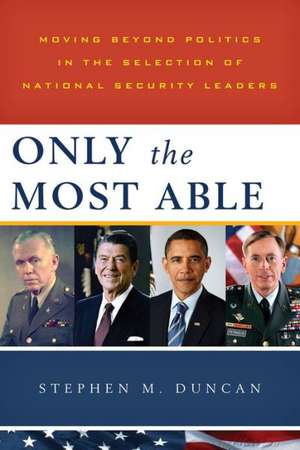
Only the Most Able: Moving Beyond Politics in the Selection of National Security Leaders
Autor Stephen M. Duncanen Limba Engleză Hardback – 25 oct 2012
Preț: 413.40 lei
Preț vechi: 572.21 lei
-28%
Puncte Express: 620
Preț estimativ în valută:
73.19€ • 85.22$ • 63.58£
73.19€ • 85.22$ • 63.58£
Carte tipărită la comandă
Livrare economică 23 februarie-09 martie
Preluare comenzi: 021 569.72.76
Specificații
ISBN-13: 9781442220225
ISBN-10: 1442220228
Pagini: 296
Dimensiuni: 161 x 236 x 26 mm
Greutate: 0.59 kg
Ediția:New.
Editura: Bloomsbury Publishing
Colecția Rowman & Littlefield Publishers
Locul publicării:New York, United States
ISBN-10: 1442220228
Pagini: 296
Dimensiuni: 161 x 236 x 26 mm
Greutate: 0.59 kg
Ediția:New.
Editura: Bloomsbury Publishing
Colecția Rowman & Littlefield Publishers
Locul publicării:New York, United States
Cuprins
Introduction
Chapter 1: The Power to Appoint Civilian Leaders
Chapter 2: The Professionalism of Military Leaders Prior to 1972
Chapter 3: Personnel is Policy
Chapter 4: Politics and Unqualified Civilian Leaders
Chapter 5: The Professionalism of Military Leaders from 1972 to 9/11/2001
Chapter 6: Civilian Leaders Who Can Get Things Done
Chapter 7: Professionalism in the Era of Wars of a Different Kind
Chapter 8: Trust and Clashes of Culture and Competence
Chapter 9: Politics in the Middle of War
Chapter 10: The "Professionalization" of Amateur Appointees
Conclusion
Notes
Chapter 1: The Power to Appoint Civilian Leaders
Chapter 2: The Professionalism of Military Leaders Prior to 1972
Chapter 3: Personnel is Policy
Chapter 4: Politics and Unqualified Civilian Leaders
Chapter 5: The Professionalism of Military Leaders from 1972 to 9/11/2001
Chapter 6: Civilian Leaders Who Can Get Things Done
Chapter 7: Professionalism in the Era of Wars of a Different Kind
Chapter 8: Trust and Clashes of Culture and Competence
Chapter 9: Politics in the Middle of War
Chapter 10: The "Professionalization" of Amateur Appointees
Conclusion
Notes
Recenzii
Stephen M. Duncan focuses much needed attention on the badly dysfunctional process that is used by Presidents to select the political leadership of our government. The problem is particularly egregious for our national security institutions, which otherwise do such an impressive job of developing leaders in the uniform services. Our country's future depends on getting this right.
President Reagan said that "To control and successfully implement policy, you need to control appointments." Stephen Duncan gives insight and illustrations of mistakes officials in various Administrations have made in not heeding this advice. A must read for all serving in higher levels of government and for all Americans who desire a government that works.
This is a timely book about a critically important subject. Stephen Duncan argues what increasing numbers of leaders believe, that the security environment which the United States currently faces has drastically reduced the margin for error in the appointment of senior officials in those agencies that are responsible for the security and safety of American citizens. He contends that the emphasis in both the nomination and confirmation processes must be on the particular qualities of the individual under consideration and he suggests ways to accomplish this goal.
The thesis of this book is that the current process of selecting national security leaders is inadequate. The military is capable of selecting and disciplining its leaders, but the presidents and senators who appoint political leaders to various national security agencies have not developed a successful system. Hence, key national security officials are haphazardly selected, often ineffective, and seldom disciplined when they fail. This book is distinctive because Duncan (formerly, assistant secretary of defense) has not only the courage but also the knowledge to cite examples of political appointees who should never have been appointed and whose mistakes jeopardized the safety of the American people. Too often, neither presidents nor senators understand what qualities an individual must have to be effective. Hence, they use misguided political criteria rather than substantial qualifications to make selections. The problem has become more acute in recent decades because of the decline in the number of presidents or senators who have security-related experience. The solution: those who do the selecting must understand that appointing a leader to a national security agency for political reasons is just as bad as selecting a military leader for political reasons. Summing Up: Recommended.
[Stephen Duncan's] arguments surely will touch a nerve, but he is well balanced - he skewers everyone: current and former Republican and Democratic administrations, cabinets, and Congresses.
The contribution of Duncan's book is to shine the light of analysis on an area that for too long has been exempt from rigorous scrutiny. Whereas military leaders know that they are subject to rigorous performance standards, their Constitutional bosses remain exempt - free to pursue whatever ideological agenda they please. Under present arrangements, no systematic scrutiny and evaluation of civilian leadership exists. Only until the magnitude of civilian failure is sufficiently great are ad hoc evaluation processes hastily thrown into place. Duncan is correct. There must be a better way.
President Reagan said that "To control and successfully implement policy, you need to control appointments." Stephen Duncan gives insight and illustrations of mistakes officials in various Administrations have made in not heeding this advice. A must read for all serving in higher levels of government and for all Americans who desire a government that works.
This is a timely book about a critically important subject. Stephen Duncan argues what increasing numbers of leaders believe, that the security environment which the United States currently faces has drastically reduced the margin for error in the appointment of senior officials in those agencies that are responsible for the security and safety of American citizens. He contends that the emphasis in both the nomination and confirmation processes must be on the particular qualities of the individual under consideration and he suggests ways to accomplish this goal.
The thesis of this book is that the current process of selecting national security leaders is inadequate. The military is capable of selecting and disciplining its leaders, but the presidents and senators who appoint political leaders to various national security agencies have not developed a successful system. Hence, key national security officials are haphazardly selected, often ineffective, and seldom disciplined when they fail. This book is distinctive because Duncan (formerly, assistant secretary of defense) has not only the courage but also the knowledge to cite examples of political appointees who should never have been appointed and whose mistakes jeopardized the safety of the American people. Too often, neither presidents nor senators understand what qualities an individual must have to be effective. Hence, they use misguided political criteria rather than substantial qualifications to make selections. The problem has become more acute in recent decades because of the decline in the number of presidents or senators who have security-related experience. The solution: those who do the selecting must understand that appointing a leader to a national security agency for political reasons is just as bad as selecting a military leader for political reasons. Summing Up: Recommended.
[Stephen Duncan's] arguments surely will touch a nerve, but he is well balanced - he skewers everyone: current and former Republican and Democratic administrations, cabinets, and Congresses.
The contribution of Duncan's book is to shine the light of analysis on an area that for too long has been exempt from rigorous scrutiny. Whereas military leaders know that they are subject to rigorous performance standards, their Constitutional bosses remain exempt - free to pursue whatever ideological agenda they please. Under present arrangements, no systematic scrutiny and evaluation of civilian leadership exists. Only until the magnitude of civilian failure is sufficiently great are ad hoc evaluation processes hastily thrown into place. Duncan is correct. There must be a better way.