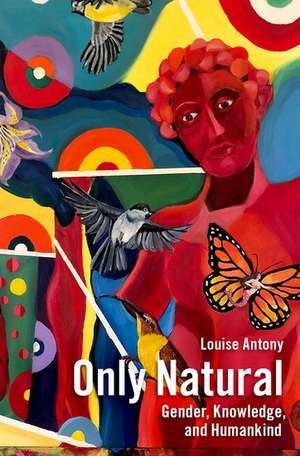
Only Natural: Gender, Knowledge, and Humankind
Autor Louise Antonyen Limba Engleză Hardback – 14 noi 2022
Preț: 666.40 lei
Preț vechi: 984.94 lei
-32%
Puncte Express: 1000
Carte disponibilă
Livrare economică 06-11 noiembrie
Livrare prin curier în România Termenul estimat este afișat lângă disponibilitate.
Transport gratuit pentru acest produs Plată online sau ramburs, în funcție de opțiunile comenzii.
Retur gratuit în 14 zile Comandă securizată și suport în română.
Specificații
ISBN-13: 9780190934361
ISBN-10: 0190934360
Pagini: 432
Dimensiuni: 160 x 244 x 31 mm
Greutate: 0.74 kg
Editura: Oxford University Press
Colecția OUP USA
Locul publicării:New York, United States
ISBN-10: 0190934360
Pagini: 432
Dimensiuni: 160 x 244 x 31 mm
Greutate: 0.74 kg
Editura: Oxford University Press
Colecția OUP USA
Locul publicării:New York, United States
Recenzii
In Only Natural, Antony's tremendous philosophical insight illuminates a wide range of phenomena – some woefully neglected – that feminists of all stripes and disciplines should take seriously. Her tightly argued views draw on her expertise in philosophy of mind and epistemology and demonstrate the tremendous value of feminist work for a wide range of areas. Some of the essays have already had a major impact, and the newer ones surely will. It is essential reading for anyone interested in feminist theory.
The breadth of this collection is staggering: epistemology, metaphysics, philosophy of mind and language, moral and political theory, and the concept of human nature. But the underlying questions always concern the relationship between feminism and analytic philosophy. Antony argues that analytic philosophy has much to learn from feminism and, perhaps more surprisingly, that analytic philosophy has much to offer to feminism, a case she makes mostly through her own example. The discussion is shaped throughout by Antony's characteristic rigor, insight, wit, and humor, which makes it not just rewarding to read but enjoyable as well.
Louise Antony is a towering figure in feminist philosophy, one of the founders of analytic feminism. The release of this volume, then, is a milestone event for feminist philosophy. Antony's work shows that it's possible to combine views that others thought utterly incompatible-- like feminism and individualism, or feminism and nativism. Her vision of feminist philosophy is a unique and necessary one, posing vital and important challenges to deeply held beliefs on all sides. Everyone should read this.
This collection of Antony's essays is an invaluable resource on the thought of one of the most important figures in analytical feminism.
The breadth of this collection is staggering: epistemology, metaphysics, philosophy of mind and language, moral and political theory, and the concept of human nature. But the underlying questions always concern the relationship between feminism and analytic philosophy. Antony argues that analytic philosophy has much to learn from feminism and, perhaps more surprisingly, that analytic philosophy has much to offer to feminism, a case she makes mostly through her own example. The discussion is shaped throughout by Antony's characteristic rigor, insight, wit, and humor, which makes it not just rewarding to read but enjoyable as well.
Louise Antony is a towering figure in feminist philosophy, one of the founders of analytic feminism. The release of this volume, then, is a milestone event for feminist philosophy. Antony's work shows that it's possible to combine views that others thought utterly incompatible-- like feminism and individualism, or feminism and nativism. Her vision of feminist philosophy is a unique and necessary one, posing vital and important challenges to deeply held beliefs on all sides. Everyone should read this.
This collection of Antony's essays is an invaluable resource on the thought of one of the most important figures in analytical feminism.
Notă biografică
Louise Antony is Professor of Philosophy at the University of Massachusetts. Antony has research and teaching interests in the philosophy of mind, feminist philosophy, epistemology, philosophy of cognitive science and the philosophy of religion. She is the co-editor of A Mind of One's Own: Feminist Essays on Reason and Objectivity (with Charlotte Witt), Chomsky and His Critics (with Norbert Hornstein), and editor of Philosophers Without Gods: Meditations on Atheism and the Secular Life . She served as President of the Society for Philosophy and Psychology in 2010-11, and President of the Eastern Division of the American Philosophical Association in 2015-6.
Cuprins
- Introduction
- Part I: (My) Philosophy Meets (My) Feminism
- 1. Quine as Feminist: The Radical Import of Naturalized Epistemology
- 2. Is Psychological Individualism a Piece of Ideology?
- 3. Sisters, Please, I'd Rather Do It Myself: A Defense of Individualism in Epistemology.
- 4. Backlash and Double Binds
- 5. Fantasies of Embodiment and Entitlement: Feminism and Analytic Philosophy
- 6. Is There a 'Feminist' Philosophy of Language?
- 7. Pornography and the Philosophy of Language
- 8. Be What I Say
- Part II: Knowledge and Partiality
- 9. Naturalized Epistemology, Morality, and the Real World
- 10. The Puzzle of Patriotism
- 11. Because I Said So: Toward a Feminist Theory of Authority (with Rebecca Hanrahan)
- 12. The Socialization of Epistemology
- 13. Embodiment and Epistemology
- 14. Bias -- Friend or Foe? Reflections on Saulish Skepticism
- Part III: Beyond Nature v. Nurture
- 15. Human Nature and its Role in Feminist Theory
- 16. Back to Androgyn: What Bathrooms Can Teach Us About Equality
- 17. Natures and Norms
- 18. Different Voices or Perfect Storm? Explaining the Dearth of Women in Philosophy
- 19. Feminism without Metaphysics: A Deflationary Account of Gender