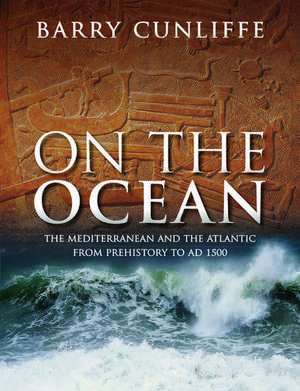
On the Ocean: The Mediterranean and the Atlantic from prehistory to AD 1500
Autor Sir Barry Cunliffeen Limba Engleză Hardback – 28 sep 2017
Preț: 328.50 lei
Puncte Express: 493
Carte disponibilă
Livrare economică 15-29 iulie
Livrare prin curier în România Termenul estimat este afișat lângă disponibilitate.
Transport gratuit de la 400.00 lei Plată online sau ramburs, în funcție de opțiunile comenzii.
Retur gratuit în 14 zile Comandă securizată și suport în română.
Specificații
ISBN-13: 9780198757894
ISBN-10: 0198757891
Pagini: 640
Ilustrații: 220 illustrations, 114 Maps
Dimensiuni: 205 x 253 x 34 mm
Greutate: 1.55 kg
Editura: OUP OXFORD
Colecția OUP Oxford
Locul publicării:Oxford, United Kingdom
ISBN-10: 0198757891
Pagini: 640
Ilustrații: 220 illustrations, 114 Maps
Dimensiuni: 205 x 253 x 34 mm
Greutate: 1.55 kg
Editura: OUP OXFORD
Colecția OUP Oxford
Locul publicării:Oxford, United Kingdom
V-ar putea interesa
-
 Constantine the EmperorDavid Potter-20%Preț: 114.93 lei142.92 lei
 -
 -19%Preț: 93.73 lei115.15 lei
 -
 The Roman RevolutionRonald Syme-42%Preț: 124.92 lei214.26 lei
 -
 Babylonia: A Very Short IntroductionTrevor Bryce-21%Preț: 55.16 lei70.04 lei
 -
 The Tragic Imagination: The Literary AgendaRowan Williams-20%Preț: 170.26 lei212.94 lei
 -
 The Ancient Celts, Second EditionBarry Cunliffe-25%Preț: 162.66 lei216.27 lei
 -
 The Hellenistic AgePeter Thonemann-23%Preț: 86.11 lei112.39 lei
 -
 HomerBarbara GraziosiPreț: 95.34 lei
 -
 The Scythians: Nomad Warriors of the SteppeBarry Cunliffe-20%Preț: 203.73 lei256.00 lei
 -
 Rome Resurgent: War and Empire in the Age of JustinianPeter Heather-29%Preț: 207.83 lei292.57 lei
 -
 The Jewish WarJosephus-19%Preț: 75.49 lei93.37 lei
 -
 Britain BeginsBarry Cunliffe-27%Preț: 182.23 lei249.62 lei
 -
 By Steppe, Desert, and Ocean: The Birth of EurasiaBarry Cunliffe-22%Preț: 173.12 lei223.25 lei
 -
 Antony and CleopatraAdrian Goldsworthy-27%Preț: 89.40 lei121.84 lei
 -
 The Barbarians of Ancient EuropeLarissa Bonfante-11%Preț: 424.71 lei477.20 lei
 -
 SexAlastair J L BlanshardPreț: 240.26 lei
 -
 Preț: 233.85 lei
 -
 Preț: 205.53 lei
 -
 The Complete Works of TacitusCornelius TacitusPreț: 168.96 lei
 -
 The Restoration of RomePeter Heather-24%Preț: 112.07 lei147.16 lei
 -
 Roman WarfareAdrian GoldsworthyPreț: 100.22 lei
 -
 CannaeAdrian GoldsworthyPreț: 98.92 lei
 -
 -19%Preț: 289.29 lei356.99 lei
 -
 Preț: 200.49 lei
Recenzii
This beguiling, thought-provoking, sumptuously illustrated, and engaging book is essential reading.
On the Ocean is about overcoming the bias of traditional land based narratives, emphasising maritime Europe and what this reveals about our past. As such it is an important and enjoyable book, and one that deserves to be widely read.
On the Ocean is a magnificent book, being carefully crafted and requiring all of Barry Cunliffe's encyclopaedic knowledge. The image portrayed, through multilateral means, offers a coherent narrative that can be followed through different times and spaces, offering both the overall view and the detailed developments.
On the Ocean is a book all nautical (and terrestrial) archaeologists should read... It provides a comprehensive overview from a seafaring perspective of the Mediterranean and Atlantic from the beginnings of humankinds voyaging in these waters to the discovery of the Americas.
The book adopts a familiar format to Cunliffes other recent volumes and supplies everything we have come to expect. It is hugely ambitious in scope, fluently written and beautifully illustrated with panoramic photographs of landscapes and monuments, plus trademark mapping... In between, the narrative takes in deep geological history, the nature of winds, tides and currents, the night sky, the peopling of islands and coastal areas and details of ship- and boat-building technology.
Another magisterial tour de force replete with informative charts and beautiful illustrations... [On the Ocean is] an extraordinary achievement, all the more so for its engaging and elegant style.
An absorbing and lively account of the early Atlantic and Mediterranean. Importantly, it reflects the latest research and delves deeply into the motives of those who sailed them: not just where and how they travelled, but what fears these seas evoked.
A grand and beautifully illustrated work, offering a fascinating perspective from which to understand human development and achievement.
Cunliffe writes sparse, clear, uncluttered prose that never tires... The maps are staggeringly good, all drawn with great freedom, in defiance of hidebound cartographical conventions... The copious illustrations are well chosen, too - always engaging, often dramatic... Overall, the total effect of On the Ocean is to encourage a new way of looking at European history using a maritime perspective. I hope it changes the way people think: it is good enough to do so.
Cunliffe's On the Ocean is a beautifully illustrated and well-designed book.
[An] impressive new book ... On the Ocean was conceived as a synthesis aimed at a broad audience, and for that purpose it is well-suited, being easy to read and unemcumbered by in-text references.
This beautifully and clearly written volume, with its superb colour illustrations, informative maps and diagrams, is nothing less than a masterpiece of multidisciplinary history wrought large as a powerful narrative.
On the Ocean is about overcoming the bias of traditional land based narratives, emphasising maritime Europe and what this reveals about our past. As such it is an important and enjoyable book, and one that deserves to be widely read.
On the Ocean is a magnificent book, being carefully crafted and requiring all of Barry Cunliffe's encyclopaedic knowledge. The image portrayed, through multilateral means, offers a coherent narrative that can be followed through different times and spaces, offering both the overall view and the detailed developments.
On the Ocean is a book all nautical (and terrestrial) archaeologists should read... It provides a comprehensive overview from a seafaring perspective of the Mediterranean and Atlantic from the beginnings of humankinds voyaging in these waters to the discovery of the Americas.
The book adopts a familiar format to Cunliffes other recent volumes and supplies everything we have come to expect. It is hugely ambitious in scope, fluently written and beautifully illustrated with panoramic photographs of landscapes and monuments, plus trademark mapping... In between, the narrative takes in deep geological history, the nature of winds, tides and currents, the night sky, the peopling of islands and coastal areas and details of ship- and boat-building technology.
Another magisterial tour de force replete with informative charts and beautiful illustrations... [On the Ocean is] an extraordinary achievement, all the more so for its engaging and elegant style.
An absorbing and lively account of the early Atlantic and Mediterranean. Importantly, it reflects the latest research and delves deeply into the motives of those who sailed them: not just where and how they travelled, but what fears these seas evoked.
A grand and beautifully illustrated work, offering a fascinating perspective from which to understand human development and achievement.
Cunliffe writes sparse, clear, uncluttered prose that never tires... The maps are staggeringly good, all drawn with great freedom, in defiance of hidebound cartographical conventions... The copious illustrations are well chosen, too - always engaging, often dramatic... Overall, the total effect of On the Ocean is to encourage a new way of looking at European history using a maritime perspective. I hope it changes the way people think: it is good enough to do so.
Cunliffe's On the Ocean is a beautifully illustrated and well-designed book.
[An] impressive new book ... On the Ocean was conceived as a synthesis aimed at a broad audience, and for that purpose it is well-suited, being easy to read and unemcumbered by in-text references.
This beautifully and clearly written volume, with its superb colour illustrations, informative maps and diagrams, is nothing less than a masterpiece of multidisciplinary history wrought large as a powerful narrative.
Notă biografică
Barry Cunliffe taught archaeology in the Universities of Bristol and Southampton and was Professor of European Archaeology at the University of Oxford from 1972 to 2008, thereafter becoming Emeritus Professor. He has excavated widely in Britain (Fishbourne, Bath, Danebury, Hengistbury Head, Brading) and in the Channel Islands, Brittany, and Spain, and has been President of the Council for British Archaeology and of the Society of Antiquaries, a Governor of the Museum of London, and a Trustee of the British Museum. He is currently a Commissioner of English Heritage. His many publications include The Ancient Celts (1997), Facing the Ocean (2001), The Druids: A Very Short Introduction (2010), Britain Begins (2012), and By Steppe, Desert, and Ocean (2015), all published by Oxford University Press. He received a knighthood in 2006.