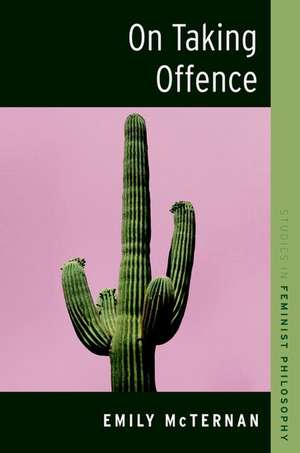
On Taking Offence: STUDIES IN FEMINIST PHILOSOPHY SERIES
Autor Emily McTernanen Limba Engleză Paperback – 14 iul 2023
Preț: 192.01 lei
Preț vechi: 240.37 lei
-20%
Puncte Express: 288
Carte disponibilă
Livrare economică 13-24 noiembrie
Livrare prin curier în România Termenul estimat este afișat lângă disponibilitate.
Transport gratuit de la 400.00 lei Plată online sau ramburs, în funcție de opțiunile comenzii.
Retur gratuit în 14 zile Comandă securizată și suport în română.
Specificații
ISBN-13: 9780197613108
ISBN-10: 0197613101
Pagini: 208
Dimensiuni: 156 x 236 x 13 mm
Greutate: 0.31 kg
Editura: Oxford University Press
Colecția OUP USA
Seria STUDIES IN FEMINIST PHILOSOPHY SERIES
Locul publicării:New York, United States
ISBN-10: 0197613101
Pagini: 208
Dimensiuni: 156 x 236 x 13 mm
Greutate: 0.31 kg
Editura: Oxford University Press
Colecția OUP USA
Seria STUDIES IN FEMINIST PHILOSOPHY SERIES
Locul publicării:New York, United States
Recenzii
In On Taking Offence, Emily McTernan develops a new, subtle, and compelling account of what it is to take offence and why taking offence is sometimes, but not always, morally justified. McTernan's admirably clear and judicious style, many vivid and timely examples, and significant moral sensitivity make this book a 'must read' for those who are interested in the nature and value of respect and, more generally, in central aspects of the moral life beyond rights and duties
Emily McTernan offers an analysis of taking offence that insightfully gets past the troubling public rhetoric around this emotion. McTernan provides a sorely needed repositioning of this emotion that encourages long overdue philosophical attention to social standing and status. She lucidly details how offence can serve both to defend and destabilize social status arrangements and suggests how each of these may stimulate important moral progress.
Taking offence - how it feels, when it's appropriate, and when steps should be taken to make it less likely to happen - are familiar components of day-to-day moral and political interactions. Yet political philosophers have tip-toed around the subject, rarely engaging beyond questions of legal regulation. In her nuanced, entertaining, clear sighted and highly original analysis Emily McTernan relates taking offence to the idea of social standing and demonstrates that it should attract the attention of anyone concerned with questions of equality.
On Taking Offence is an imperative investigation into the emotional workings of the Western world.
McTernan rightly notes that contemporary moral and political philosophers have tended to neglect emotions in general, except perhaps for anger, and taking offence in particular. Her elegantly written and tightly argued book is a welcome and major contribution to this growing field of research.
Offence has a bad reputation. Few are more aware of this than Emily McTernan, who sets out to defend taking offence against its many critics…. invaluable reading for anybody interested in social norms and freedom of expression.
McTernan's analysis of offence and humour is a fascinating and timely contribution to a topic that is infamous for generating lots of heat and very little light.
Emily McTernan's book, On Taking Offense, makes an original and important contribution to the moral psychology of offense.
Emily McTernan has done us a great service in providing a rich and topical philosophical account of taking offence.
Emily McTernan offers an analysis of taking offence that insightfully gets past the troubling public rhetoric around this emotion. McTernan provides a sorely needed repositioning of this emotion that encourages long overdue philosophical attention to social standing and status. She lucidly details how offence can serve both to defend and destabilize social status arrangements and suggests how each of these may stimulate important moral progress.
Taking offence - how it feels, when it's appropriate, and when steps should be taken to make it less likely to happen - are familiar components of day-to-day moral and political interactions. Yet political philosophers have tip-toed around the subject, rarely engaging beyond questions of legal regulation. In her nuanced, entertaining, clear sighted and highly original analysis Emily McTernan relates taking offence to the idea of social standing and demonstrates that it should attract the attention of anyone concerned with questions of equality.
On Taking Offence is an imperative investigation into the emotional workings of the Western world.
McTernan rightly notes that contemporary moral and political philosophers have tended to neglect emotions in general, except perhaps for anger, and taking offence in particular. Her elegantly written and tightly argued book is a welcome and major contribution to this growing field of research.
Offence has a bad reputation. Few are more aware of this than Emily McTernan, who sets out to defend taking offence against its many critics…. invaluable reading for anybody interested in social norms and freedom of expression.
McTernan's analysis of offence and humour is a fascinating and timely contribution to a topic that is infamous for generating lots of heat and very little light.
Emily McTernan's book, On Taking Offense, makes an original and important contribution to the moral psychology of offense.
Emily McTernan has done us a great service in providing a rich and topical philosophical account of taking offence.
Notă biografică
Emily McTernan is an Associate Professor at University College London. She works on political and social philosophy. She has published work on social norms, equality, civic virtue, infertility, and microaggressions.
Cuprins
- Acknowledgements
- Introduction
- 1. Taking offence: An emotion reconsidered
- 1.1. Philosophers on taking offence
- 1.2. An analysis of taking offence
- 1.3. Distinguishing offence
- 1.4. Rethinking offence: Domestic, not catastrophic
- 1.5. The limits of offence
- 1.6. Towards a defence: From victimhood to social standing
- 2. What taking offence does
- 2.1. Social standing and the role of social norms
- 2.2. Taking offence and reinforcing norms
- 2.3. Taking offence and renegotiating norms
- 2.4. In defence of negotiating social norms
- 2.5. On negotiating through offence
- 3. Do sweat the small stuff: The nature and significance of social standing
- 3.1. Between excess and deficiency
- 3.2. Social standing as an equal part I: Why the 'small stuff' matters
- 3.3. Social standing as an equal part II: The power to set the terms
- 3.4. In defence of the significance of affronts
- 3.5. Resisting by taking offence
- 4. The limits of justified offence: On anger, intent, and uptake
- 4.1. Anger, offence, and the act
- 4.2. Contesting offence
- 4.3. 'But I didn't mean it': On intention and blame
- 4.4. 'But that's not offensive': Disagreement and the offensive
- 4.5. When offence lacks uptake
- 5. Only joking!: On the offensiveness of humour
- 5.1. Theories of humour and the offensive
- 5.2. Some linguistics of jokes
- 5.3. How offensive jokes function
- 5.4. The riskiness of humour
- 6. A corrective civic virtue: Weighing the costs and benefits of offence
- 6.1. Offence as a civic virtue: Arguments from equality and civility
- 6.2. The costs of offence to the offending party
- 6.3. Justifying the costs of offence
- 6.4. Burdens on the offended
- 7. A social approach, our lives online, and the social emotions
- 7.1. A regulatory turn
- 7.2. Taking offence online
- 7.3. The social emotions beyond offence
- Bibliography
- Index