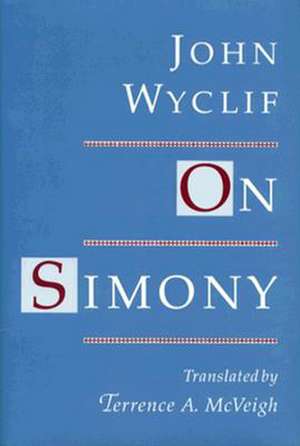
On Simony
Autor John Wyclif Traducere de Terrence A McVeighen Limba Engleză Hardback – 1992
Preț: 416.06 lei
Puncte Express: 624
Carte tipărită la comandă
Livrare economică 30 noiembrie-14 decembrie
Livrare prin curier în România Termenul estimat este afișat lângă disponibilitate.
Transport gratuit pentru acest produs Plată online sau ramburs, în funcție de opțiunile comenzii.
Retur gratuit în 14 zile Comandă securizată și suport în română.
Specificații
ISBN-13: 9780823213498
ISBN-10: 0823213498
Pagini: 179
Dimensiuni: 157 x 235 x 15 mm
Greutate: 0.45 kg
Editura: Fordham University Press
ISBN-10: 0823213498
Pagini: 179
Dimensiuni: 157 x 235 x 15 mm
Greutate: 0.45 kg
Editura: Fordham University Press
V-ar putea interesa
-
 The Second Vatican Council on Other ReligionsGerald O'Collins, SJPreț: 212.30 lei
 -
 The American Catholic Revolution: How the Sixties Changed the Church ForeverMark S. Massa, S.J.-24%Preț: 199.88 lei263.21 lei
 -
 -31%Preț: 756.75 lei1094.38 lei
 -
 -23%Preț: 278.20 lei362.69 lei
 -
 A View from RomeDavid G Schultenover-19%Preț: 565.96 lei698.71 lei
 -
 A View From Rome – On the Eve of the Modernist CrisisDavid G. SchultenoverPreț: 284.05 lei
 -
 A Philosophy of Hope – Josef Pieper and the Contemporary Debate on HopeBernard Schumacher-19%Preț: 504.45 lei622.78 lei
 -
 A Catholic Cold WarPatrick J McNamaraPreț: 495.76 lei
 -
 Let It Shine!Mary E. Mcgann-19%Preț: 481.82 lei594.84 lei
 -
 Bob DrinanRaymond A SchrothPreț: 195.19 lei
 -
 The Church of Mercy: A Vision for the ChurchPope FrancisPreț: 88.11 lei
 -
 The Glories of MaryLiguoriPreț: 207.98 lei
 -
 The Great FacadeChristopher A. FerraraPreț: 191.09 lei
Textul de pe ultima copertă
Repeatedly denounced by bishops, local synods, national councils, and popes, simony - the buying and selling of spiritual offices - had enjoyed a centuries-old existence in the church when John Wyclif penned this treatise in the late fourteenth century. The tenth in a series of twelve treatises the English reformer wrote between 1374 and 1382, On Simony forms an integral part of the writings generally considered his summa. Basing his condemnation of simony on an idiosyncratic concept of dominion developed in earlier treatises, Wyclif argues that the church, with its spiritual message and mission, has no right to temporal power or temporal goods. Viewing simony as a form of theft, the selling of spiritual things over which it has no dominion, Wyclif advocates the removal of all property from the church - by secular force, if necessary - and the abolition of ecclesiastical patronage. In the Introduction to this first-ever English translation, Professor McVeigh traces the history of simony in the church and describes the circumstances prompting Wyclif to develop his theory of dominion, showing the decisive influence of this theory on his concept of simony. A brief discussion of the treatise's influence on later reformers, both inside and outside England, follows a thorough, chapter-by-chapter analysis of the treatise itself.