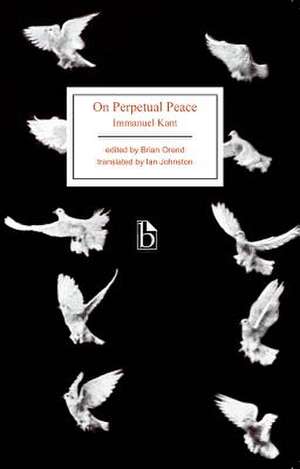
On Perpetual Peace
Autor Immanuel Kant Editat de Brian Orend Traducere de Ian Johnstonen Limba Engleză Paperback – 2 oct 2015
This book features a fresh and vigorous translation of Kant’s essay by Ian Johnston, and it includes an extended introduction by philosopher Brian Orend. The introduction situates Kant’s essay in its historical context and offers a substantial analysis, section by section, of the essay itself. In doing so, Orend not only discusses Kant’s personal life and the history of the perpetual peace tradition, he also shows how Kant’s provocative ideas have inspired and infused our own time, especially the concept of a global alliance of free societies committed to respecting human rights.
Preț: 118.61 lei
Preț vechi: 144.93 lei
-18%
Puncte Express: 178
Carte disponibilă
Livrare economică 31 octombrie-14 noiembrie
Livrare express 17-23 octombrie pentru 46.24 lei
Livrare prin curier în România Termenul estimat este afișat lângă disponibilitate.
Transport gratuit de la 400.00 lei Plată online sau ramburs, în funcție de opțiunile comenzii.
Retur gratuit în 14 zile Comandă securizată și suport în română.
Specificații
ISBN-13: 9781554811939
ISBN-10: 1554811937
Pagini: 136
Dimensiuni: 140 x 216 x 7 mm
Greutate: 0.22 kg
Editura: BROADVIEW PR
Colecția Broadview Press
Locul publicării:Peterborough, Canada
ISBN-10: 1554811937
Pagini: 136
Dimensiuni: 140 x 216 x 7 mm
Greutate: 0.22 kg
Editura: BROADVIEW PR
Colecția Broadview Press
Locul publicării:Peterborough, Canada
Recenzii
Kant’s landmark essay “On Perpetual Peace” is as timely, relevant, and inspiring today as when it was first written over 200 years ago. In it we find a forward-looking vision of a world respectful of human rights, dominated by liberal democracies, and united in a cosmopolitan federation of diverse peoples. The essay is an expression of global idealism that remains an enduring antidote to the violence and cynicism that are all too often on display in international relations and foreign affairs.
This book features a fresh and vigorous translation of Kant’s essay by Ian Johnston, and it includes an extended introduction by philosopher Brian Orend. The introduction situates Kant’s essay in its historical context and offers a substantial analysis, section by section, of the essay itself. In doing so, Orend not only discusses Kant’s personal life and the history of the perpetual peace tradition, he also shows how Kant’s provocative ideas have inspired and infused our own time, especially the concept of a global alliance of free societies committed to respecting human rights.
“This is an immensely valuable volume. It combines a lucid translation of “On Perpetual Peace” and a wide selection of relevant background documents with an expert, insightful, original, and extensive commentary by one of the leading scholars of international ethics.” — Michael W. Doyle, Columbia University
“This accessible translation demonstrates Kant’s deep distrust of just war rhetoric and his clear intent that war should no longer be deployed as a means for regulating international affairs. Brian Orend’s judicious commentary will aid the reader in understanding why Kant regards perpetual peace as a necessary extension of the rule of law.” — Howard Williams, Aberystwyth University
This book features a fresh and vigorous translation of Kant’s essay by Ian Johnston, and it includes an extended introduction by philosopher Brian Orend. The introduction situates Kant’s essay in its historical context and offers a substantial analysis, section by section, of the essay itself. In doing so, Orend not only discusses Kant’s personal life and the history of the perpetual peace tradition, he also shows how Kant’s provocative ideas have inspired and infused our own time, especially the concept of a global alliance of free societies committed to respecting human rights.
“This is an immensely valuable volume. It combines a lucid translation of “On Perpetual Peace” and a wide selection of relevant background documents with an expert, insightful, original, and extensive commentary by one of the leading scholars of international ethics.” — Michael W. Doyle, Columbia University
“This accessible translation demonstrates Kant’s deep distrust of just war rhetoric and his clear intent that war should no longer be deployed as a means for regulating international affairs. Brian Orend’s judicious commentary will aid the reader in understanding why Kant regards perpetual peace as a necessary extension of the rule of law.” — Howard Williams, Aberystwyth University
Cuprins
Acknowledgements
Introduction
Immanuel Kant: A Brief Chronology
A Note on the Text
A Note on the Translation
On Perpetual Peace
Appendix A: The Perpetual Peace Tradition
Introduction
Immanuel Kant: A Brief Chronology
A Note on the Text
A Note on the Translation
On Perpetual Peace
Appendix A: The Perpetual Peace Tradition
- From William Penn, The Political Writings of William Penn (1693)
- From the Abbé de Saint-Pierre, Project for a Perpetual Peace in Europe (1712)
- From Jean-Jacques Rousseau, “A Lasting Peace Through the Federation of Europe” (1756)
- From Jeremy Bentham, “A Plan for a Universal and Perpetual Peace” (1786–89)
- From Immanuel Kant, “Universal History” (1784)
- From Immanuel Kant, “Theory and Practice” (1793)
- From Immanuel Kant, “The Doctrine of Right,” The Metaphysics of Morals (1797)
- Reactions to the Tradition
- From G.W. Leibniz, Reply to the Abbé de Saint-Pierre (1715)
- From Voltaire, “De La Paix Perpétuelle, par Le Docteur Goodheart” (1769)
- Reactions to Kant
- From J.G. Fichte, Foundations of Natural Right (1797)
- From G.W.F. Hegel, Elements of the Philosophy of Right (1820)
- From Carl von Clausewitz, On War (1832)