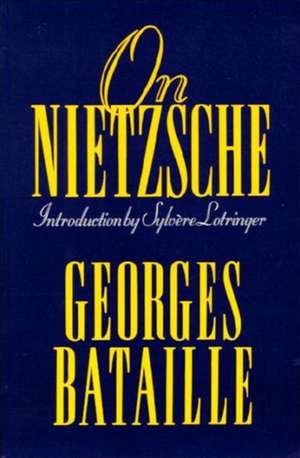
On Nietzsche
Autor Georges Batailleen Limba Engleză Paperback – 27 aug 1998
Descoperim în On Nietzsche o lucrare care sfidează clasificările rigide, situându-se la intersecția dintre jurnal intim și tratat filosofic. Tema centrală a „misticismului fără Dumnezeu” nu este tratată abstract, ci este ancorată în realitatea brutală a ocupației germane, unde autorul își explorează propria angoasă în paralel cu distrugerea lumii exterioare. Remarcăm cum Georges Bataille utilizează textul pentru a recupera moștenirea lui Nietzsche din mâinile interpretărilor fasciste, transformând filosofia într-o experiență trăită, marcată de tensiunea dintre erotism și teologie. Această ediție, tradusă de Bruce Boone, ne oferă o perspectivă unică asupra momentului în care Bataille își cristalizează propriul sistem de gândire. Extinde cadrul propus de Guilty cu date noi din experiența sa internă de la sfârșitul războiului, ambele lucrări partajând formatul de jurnal și preocuparea pentru absența transcendenței. În contextul operei sale, On Nietzsche acționează ca o punte între explorările dorinței din Eroticism și analizele forțelor întunecate ale civilizației din Blue of Noon. Credem că forța acestui volum rezidă în capacitatea sa de a trece rapid de la confesiune la abstracție, oferind cititorului nu doar o analiză critică, ci o participare directă la criza spirituală a autorului. Structura fragmentară, îmbogățită de o introducere semnată de Sylvere Lotringer și de un apendice defensiv împotriva lui Sartre, subliniază ruptura lui Bataille de narațiunea tradițională. Este o lucrare esențială pentru a înțelege cum angoasa personală și cataclismul istoric pot genera o nouă formă de sacralitate, una care nu mai caută refugiul în dogma religioasă, ci în acceptarea lucidă a finitudinii.
Preț: 142.22 lei
Carte disponibilă
Livrare economică 06-20 noiembrie
Specificații
ISBN-10: 1557786445
Pagini: 256
Dimensiuni: 153 x 229 x 17 mm
Greutate: 0.41 kg
Editura: Paragon House Publishers
V-ar putea interesa
-
 Story of the EyeGeorges Bataille-29%Preț: 49.73 lei69.69 lei
 -
 Blue of NoonGeorges Bataille-20%Preț: 61.83 lei77.63 lei
 -
 The Birth of Tragedy & The Genealogy of MoralsFriedrich NietzschePreț: 117.49 lei
 -
 The Birth of Tragedy and The Case of WagnerFriedrich NietzschePreț: 78.08 lei
 -
 The Will to PowerFriedrich NietzschePreț: 71.58 lei
 -
 The Dehumanization of Art and Other Essays on Art, Culture, and LiteratureJosé Ortega Y. GassetPreț: 90.47 lei
 -
 Words in Blood, Like FlowersBabette BabichPreț: 270.44 lei
 -
 The Birth of Tragedy / Unpublished Basel Writings (Winter 1869/70-Fall 1873)Friedrich NietzschePreț: 160.45 lei
 -
 Visions Of Excess: Selected Writings, 1927-1939Georges BataillePreț: 177.37 lei
 -
 Unfinished System Of NonknowledgeGeorges BataillePreț: 208.42 lei
 -
 Desperate ClarityMaurice BlanchotPreț: 253.45 lei
 -
 Friedrich NietzscheTony Lee MoralPreț: 72.78 lei
 -
 World Classics Library: Friedrich NietzscheFrederich NietzschePreț: 152.34 lei
 -
 How Nietzsche Came in from the ColdPhilipp FelschPreț: 167.12 lei
 -
 The ProphetKahlil GibranPreț: 27.21 lei
 -
 Beyond Good And EvilFriedrich NietzschePreț: 46.16 lei
 -
 Critical EssaysGeorges BataillePreț: 178.38 lei
 -
 The Absence of MythGeorges BataillePreț: 99.19 lei
 -
 Human, All Too Human & Beyond Good and EvilFriedrich NietzschePreț: 47.42 lei
 -
 Beyond Good & EvilFriedrich Wilhelm NietzschePreț: 72.68 lei
De ce să citești această carte
Recomandăm această carte celor care doresc să exploreze limitele filosofiei existențiale prin prisma unuia dintre cei mai influenți gânditori francezi. Cititorul va câștiga o înțelegere profundă a modului în care spiritualitatea poate supraviețui în afara religiei, într-un format hibrid ce combină poezia cu analiza politică. Este o lectură fundamentală pentru a înțelege rădăcinile poststructuralismului și dialogul intelectual tensionat din Franța postbelică.
Despre autor
Georges Bataille (1897–1962) a fost un intelectual polivalent, a cărui operă traversează filosofia, literatura, antropologia și istoria artei. Cunoscut pentru explorările sale asupra transgresiunii, erotismului și misticismului, el a exercitat o influență imensă asupra unor gânditori precum Foucault, Derrida și Kristeva. Lucrările sale, adesea marcate de o intensitate viscerală, investighează fundamentele sacre ale societății și mecanismele dorinței umane. De la eseuri teoretice la romane provocatoare, Bataille a rămas o figură centrală a avangardei intelectuale franceze, fiind apreciat de Heidegger drept una dintre cele mai strălucite minți ale Franței.
Descriere scurtă
Hailed by Martin Heidegger as "one of France's best minds," Georges Bataille has become increasingly recognized and respected in the realm of academic and popular intellectual thought. Although Bataille died in 1962, interest in his life and writings have never been as strong as they are today--Barthes, Foucault, Derrida, and Kristeva have all acknowledged their debt to him. In his book, On Nietzsche, as translated by Bruce Boone, Bataille comes as close as he would ever come to formulating his own unique system of philosophy. One could say that reading Nietzsche was something of a revelation to Bataille, and profoundly affected his life. In 1915, in a crisis of guilt after leaving his blind father in the hands of the Germans, Bataille converted to Catholicism. It was Nietzsche's work that lead him to abandon traditional religion for an idiosyncratic form of godless mysticism. In this volume, Bataille becomes, and goes beyond, Nietzsche, assuming Nietzsche's thought where he left off--with God's death. At the heart of this work is Bataille's exploration of how one can have a spiritual life outside religion. On Nietzsche is essentially a journal that brilliantly mixes observations with ruminations in fragments, aphorisms, poems, myths, quotations, and images against the background of World War II and the German occupation. Bataille has a unique way of moving breezily from abstraction to confession, and from theology to eroticism. He skillfully weaves together his own internal experience of anguish with the war and destruction raging outside with arguments against fascist interpretations of Nietzsche and praise for the philosopher as a prophet foretelling "the crude German fate." With an introduction, "Furiously Nietzschean," by Sylvere Lotringer, an Appendix in which Bataille defends himself against Sartre, and an Index, this volume reconfirms Michel Foucault's assertion that Bataille, "broke with traditional narrative to tell us what has never been told before."
Descriere
Georges Bataille (1897-1962) was an essayist, poet, novelist and philosopher of excess. His philosophy emerges from the aesthetic avant-garde of the 1920s and 30s, when he was associated with the surrealist movement, and has since been explored by the major figures of poststructuralism and postmodernism. His classic works include The Story of the Eye and The Accursed Share.
On Nietzsche takes up Nietzschean thought where Nietzsche left off - with the Death of God. Written against the backdrop of Germany under the Third Reich, the book explores the possibility of a spiritual life outside religion. In so doing it weaves an astonishing tapestry of confession, theology, philosophy, myth and eroticism - all shot through with the images of war.
Translated by Bruce Boone
Introduced by Sylvère Lotringer
Recenzii
One of the most original and unsettling of those thinkers who, in the wake of Sade and Nietzsche, have confronted the possibility of thought in a world that has lost its myth of transcendence.
Makes available to sophisticated readers the Bataille experience