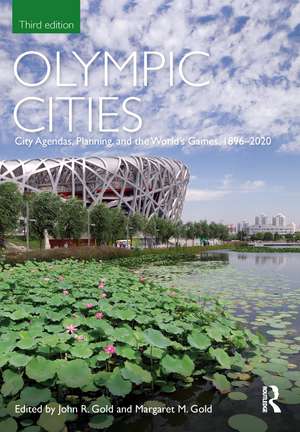
Olympic Cities: City Agendas, Planning, and the World’s Games, 1896 – 2020: Planning, History and Environment Series
Editat de John Gold, Margaret M Golden Limba Engleză Hardback – 11 iul 2016
As controversy over the growing size and expense of the Olympics, with associated issues of accountability and legacy, continues unabated, this book’s incisive and timely assessment of the Games’ development and the complex agendas that host cities attach to the event will be essential reading for a wide audience. This will include not just urban and sports historians, urban geographers, event managers and planners, but also anyone with an interest in the staging of mega-events and concerned with building a better understanding of the relationship between cities, sport and culture.
Din seria Planning, History and Environment Series
- 14%
 Preț: 1065.56 lei
 -
 Preț: 408.95 lei
 -
 Preț: 442.82 lei
 -
 Preț: 381.10 lei
 -
 Preț: 408.66 lei
 - 15%
 Preț: 428.60 lei
 - 15%
 Preț: 431.78 lei
 - 15%
 Preț: 521.93 lei
 - 15%
 Preț: 468.59 lei
 -
 Preț: 442.46 lei
 - 15%
 Preț: 435.08 lei
 -
 Preț: 472.65 lei
 -
 Preț: 405.01 lei
 - 15%
 Preț: 514.24 lei
 -
 Preț: 468.81 lei
 - 15%
 Preț: 500.54 lei
 -
 Preț: 464.99 lei
 - 18%
 Preț: 1248.98 lei
 - 15%
 Preț: 465.83 lei
 -
 Preț: 456.92 lei
 - 15%
 Preț: 452.80 lei
 -
 Preț: 415.12 lei
 -
 Preț: 432.27 lei
 -
 Preț: 470.09 lei
 - 15%
 Preț: 434.24 lei
 -
 Preț: 410.01 lei
 - 15%
 Preț: 521.93 lei
 - 18%
 Preț: 720.15 lei
 - 15%
 Preț: 435.94 lei
 - 15%
 Preț: 516.51 lei
 - 18%
 Preț: 1415.84 lei
 - 15%
 Preț: 425.21 lei
 -
 Preț: 462.43 lei
 - 23%
 Preț: 1483.36 lei
 - 18%
 Preț: 1119.70 lei
 -
 Preț: 485.55 lei
 - 18%
 Preț: 1117.25 lei
Preț: 1315.08 lei
Preț vechi: 1445.14 lei
-9%
Puncte Express: 1973
Carte tipărită la comandă
Livrare economică 28 noiembrie-12 decembrie
Livrare prin curier în România Termenul estimat este afișat lângă disponibilitate.
Transport gratuit pentru acest produs Plată online sau ramburs, în funcție de opțiunile comenzii.
Retur gratuit în 14 zile Comandă securizată și suport în română.
Specificații
ISBN-13: 9781138832671
ISBN-10: 1138832677
Pagini: 504
Dimensiuni: 174 x 246 mm
Greutate: 1.16 kg
Ediția:3
Editura: Taylor & Francis
Colecția Routledge
Seria Planning, History and Environment Series
Locul publicării:Oxford, United Kingdom
ISBN-10: 1138832677
Pagini: 504
Dimensiuni: 174 x 246 mm
Greutate: 1.16 kg
Ediția:3
Editura: Taylor & Francis
Colecția Routledge
Seria Planning, History and Environment Series
Locul publicării:Oxford, United Kingdom
V-ar putea interesa
-
 Amazing Facts: Olympics & ParalympicsCaroline RowlandsPreț: 35.13 lei
 -
 -10%Preț: 141.88 lei157.85 lei
 -
 The Image of the CityKevin LynchPreț: 277.67 lei
 -
 Preț: 414.84 lei
 -
 The City ReaderRichard T. LeGates-8%Preț: 466.10 lei506.63 lei
 -
 The Paralympic Games ExplainedIan BrittainPreț: 387.98 lei
 -
 -15%Preț: 432.20 lei508.47 lei
 -
 Epic CitiesSam Sedgman-30%Preț: 76.47 lei109.98 lei
 -
 -15%Preț: 524.18 lei616.68 lei
 -
 The GamesDavid GoldblattPreț: 126.78 lei
 -
 Power GamesJules BoykoffPreț: 95.26 lei
 -
 Record Breakers at the Olympic GamesRob Walker-22%Preț: 99.83 lei127.98 lei
 -
 Time Out Olympic Games Through a LensEditors of Time OutPreț: 122.48 lei
 -
 Paris 1924Caroline VoutPreț: 260.30 lei
 -
 Rethinking the Olympics: Cultural Histories of the Modern GamesRobert K Barney Ph.D.-21%Preț: 263.90 lei335.48 lei
 -
 The Hard Edge of Soft PowerSven Daniel WolfePreț: 267.49 lei
 -
 Governing Post-Winter Olympic Games LegaciesJinsu ByunPreț: 332.68 lei
 -
 Turin's Olympic LegacyValerio Della SalaPreț: 315.50 lei
 -
 Youth Policy, Citizenship Education and Olympic Games LegaciesSandra Borges TavaresPreț: 320.90 lei
Public țintă
Postgraduate, Professional, and UndergraduateCuprins
1. Introduction (John R. Gold and Margaret M. Gold), Part I: The Olympic Festivals, 2. The Enduring Enterprise: The Summer Olympics, 1896–2012 (John R. Gold and Margaret M. Gold), 3. The Winter Olympics: Driving Urban Change, 1924–2022 (Stephen J. Essex and Jiska de Groot), 4. The Cultural Olympiads (Beatriz García), 5. The Paralympic Games (John R. Gold and Margaret M. Gold), Part II: Planning and Management, 6. Olympic Finance (Holger Preuss), 7. Promoting the Olympic City (Stephen V. Ward), 8. Olympic Villages (Tony Sainsbury), 9. Security (Jon Coaffee and Pete Fussey), 10. Urban Regeneration (Andrew Smith), 11. Olympic Tourism (Mike Weed), 12. Olympic Transport (Eva Kassens-Noor), Part III: City Portraits, 13. Berlin 1936 (Monika Meyer), 14. Mexico City 1968 (Michael Barke), 15. Munich 1972 (Monika Meyer), 16. Sydney 2000 (Robert Freestone and Simon Gunasekara), 17. Athens 2004 (Margaret M. Gold), 18. Beijing 2008 (Ian G. Cook and Steven Miles), 19. London 2012 (Graeme Evans and Özlem Edizel), 20. Rio de Janeiro 2016 (Gabriel Silvestre), 21. Tokyo 2020 (Yasushi Aoyama)
Notă biografică
John R. Gold is Professor of Urban Historical Geography at Oxford Brookes University.
Margaret M. Gold is Senior Lecturer in Creative Industries at London Metropolitan University.
Margaret M. Gold is Senior Lecturer in Creative Industries at London Metropolitan University.
Descriere
The first edition of Olympic Cities, published in 2007, provided a pioneering overview of the changing relationship between cities and the modern Olympic Games. This substantially revised and enlarged third edition builds on the success of its predecessors. The first of its three parts provides overviews of the urban legacy of the four component Olympic festivals: the Summer Games; Winter Games; Cultural Olympiads; and the Paralympics. The second part comprisessystematic surveys of seven key aspects of activity involved in staging the Olympics: finance; place promotion; the creation of Olympic Villages; security; urban regeneration; tourism; and transport. The final part consists of nine chronologically arranged portraits of host cities, from 1936 to 2020, with particular emphasis on the six Summer Olympic and Paralympic Games of the twenty-first century.