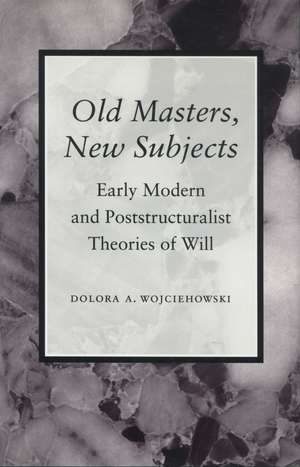
Old Masters, New Subjects: Early Modern and Poststructuralist Theories of Will
Autor Dolora Wojciehowskien Limba Engleză Hardback – noi 1995
The author analyzes "old masteries," certain notions of freedom, individualism, and control long associated with the Renaissance, in relation to the ideologies of non-mastery that recur in theory today.
Preț: 484.36 lei
Preț vechi: 597.97 lei
-19%
Puncte Express: 727
Preț estimativ în valută:
85.72€ • 100.18$ • 74.42£
85.72€ • 100.18$ • 74.42£
Carte tipărită la comandă
Livrare economică 19 februarie-05 martie
Preluare comenzi: 021 569.72.76
Specificații
ISBN-13: 9780804723862
ISBN-10: 0804723869
Pagini: 280
Dimensiuni: 152 x 229 x 22 mm
Greutate: 0.49 kg
Ediția:1
Editura: Stanford University Press
Colecția Stanford University Press
ISBN-10: 0804723869
Pagini: 280
Dimensiuni: 152 x 229 x 22 mm
Greutate: 0.49 kg
Ediția:1
Editura: Stanford University Press
Colecția Stanford University Press
Recenzii
“This is an ambitious, provocative, and innovative exploration of the problem of agency, or will, as it appears in a broad range of Renaissance authors and in the work of poststructuralist theorists. Wojciehowski is most impressive in her ability to mix traditional historical scholarship with an engaged and detailed knowledge of contemporary theoretical debates, grounding both in a real talent for close textual analysis. Writing forcefully and in a remarkably straightforward manner, she raises fundamental issues in a way that invites intellectual engagement by a very diverse group of readers.”—Albert Ascoli,
Northwestern University
Northwestern University
Textul de pe ultima copertă
“This is an ambitious, provocative, and innovative exploration of the problem of agency, or will, as it appears in a broad range of Renaissance authors and in the work of poststructuralist theorists. Wojciehowski is most impressive in her ability to mix traditional historical scholarship with an engaged and detailed knowledge of contemporary theoretical debates, grounding both in a real talent for close textual analysis. Writing forcefully and in a remarkably straightforward manner, she raises fundamental issues in a way that invites intellectual engagement by a very diverse group of readers.” —Albert Ascoli,
Northwestern University
Northwestern University