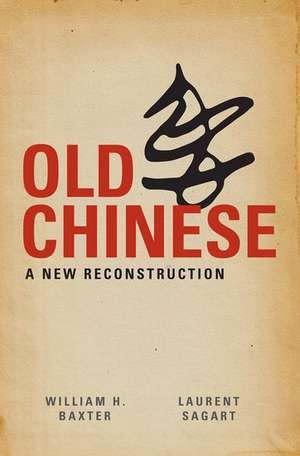
Old Chinese: A New Reconstruction
Autor William H. Baxter, Laurent Sagarten Limba Engleză Hardback – 18 sep 2014
Preț: 807.77 lei
Preț vechi: 1171.31 lei
-31%
Puncte Express: 1212
Carte tipărită la comandă
Livrare economică 19-25 noiembrie
Livrare prin curier în România Termenul estimat este afișat lângă disponibilitate.
Transport gratuit pentru acest produs Plată online sau ramburs, în funcție de opțiunile comenzii.
Retur gratuit în 14 zile Comandă securizată și suport în română.
Specificații
ISBN-13: 9780199945375
ISBN-10: 0199945373
Pagini: 448
Ilustrații: 5 b&w line drawings
Dimensiuni: 236 x 157 x 38 mm
Greutate: 0.7 kg
Editura: Oxford University Press
Colecția OUP USA
Locul publicării:New York, United States
ISBN-10: 0199945373
Pagini: 448
Ilustrații: 5 b&w line drawings
Dimensiuni: 236 x 157 x 38 mm
Greutate: 0.7 kg
Editura: Oxford University Press
Colecția OUP USA
Locul publicării:New York, United States
V-ar putea interesa
-
 Spelling Ages 7-8Collins Easy LearningPreț: 31.16 lei
 -
 Hieroglyphs: A Very Short IntroductionPenelope Wilson-20%Preț: 56.73 lei70.96 lei
 -
 Language, Technology, and SocietyRichard Sproat-22%Preț: 378.29 lei485.01 lei
 -
 The Story of WritingAndrew Robinson-16%Preț: 106.48 lei126.23 lei
 -
 Breaking the Maya CodeMichael D. Coe-17%Preț: 115.14 lei138.36 lei
 -
 Latin PalaeographyBernhard BischoffPreț: 251.07 lei
 -
 The Palaeography of Gothic Manuscript BooksAlbert DerolezPreț: 293.74 lei
 -
 Chambers Spell it Yourself!Gordon T HawkerPreț: 54.31 lei
 -
 Alpha BetaJohn ManPreț: 115.95 lei
 -
 Writing Systems of the WorldCoulmasPreț: 513.09 lei
 -
 Bwell Ency Writing SystemCoulmas-8%Preț: 497.46 lei540.71 lei
 -
 The Alphabet AbecedariumRichard Firmage-24%Preț: 44.12 lei58.11 lei
 -
 Reading in Medieval St. GallAnna A. GrotansPreț: 360.45 lei
 -
 Touchthinklearn: ABCXavier Deneux-23%Preț: 140.73 lei183.17 lei
 -
 -27%Preț: 67.37 lei91.87 lei
 -
 Let's Learn Hiragana: First Book of Basic Japanese WritingYauko Mitamura-19%Preț: 74.73 lei92.51 lei
Recenzii
Overall, it is true to the thoughtful research and scholarly imagination its authors have invested, over a period of four decades, in working out their deeply felt vision of Proto-Chinese morphology.
Notă biografică
William H. Baxter is Professor in the Department of Asian Languages and Cultures and the Department of Linguistics, University of Michigan, Ann Arbor. His research in historical linguistics includes work on both the history of Chinese and its dialects and on the use of mathematical techniques to reconstruct linguistic history.Laurent Sagart is a senior scientist with the French CNRS. He has published widely in Chinese and East Asian language historical linguistics. He is interested in language classification, notably the internal classification of Austronesian, Sinitic and Sino-Tibetan, in the genetic relationships among East Asian language groups, and in East Asian linguistic prehistory.
Cuprins
- 1 Introduction
- 1.1 What is Old Chinese?
- 1.2 Methodology
- 1.3 Plan of the book
- 2 The evidence for Old Chinese
- 2.1 Middle Chinese
- 2.2 Old Chinese rhyme evidence
- 2.3 Evidence from the Chinese script
- 2.4 Modern Chinese dialects
- 2.5 Early Chinese loanwords in other languages
- 2.6 Traditional Chinese texts explicitly discussing language
- 2.7 Tibeto-Burman
- 3 An overview of the reconstruction
- 3.1 Onsets: main hypotheses
- 3.2 Rhymes
- 3.3 Root structure, word structure, and affixation
- 3.4 The nature of the pre-Qín script
- 4 Onsets
- 4.1 The evolution of Old Chinese initial consonants: major processes
- 4.2 Applying the comparative method within Chinese
- 4.3 Singleton onsets
- 4.4 Tightly attached onsets
- 4.5 Onsets with loosely attached preinitials
- 4.6 Onsets with complex preinitials
- 5 Old Chinese rhymes
- 5.1 Overview: vowels, codas, postcodas
- 5.2 The six-vowel system
- 5.3 Rhyme development: main processes
- 5.4 Rhymes with back codas (*-Ø, *-k, and *-?)
- 5.5 Rhymes with acute codas (*-j, *-t, *-n, and *-r)
- 5.6 Rhymes with the codas *-w and *-wk
- 5.7 Rhymes with labial codas (*-p and *-m)
- 6 Conclusion
- 6.1 What kind of language was Old Chinese?
- 6.2 Dialect differences in Old Chinese
- 6.3 Known issues
- 6.4 General directions for future researc
- 6.5 Old Chinese in broad comparative context
- Appendix of reconstructed forms
- References