Cantitate/Preț
Produs

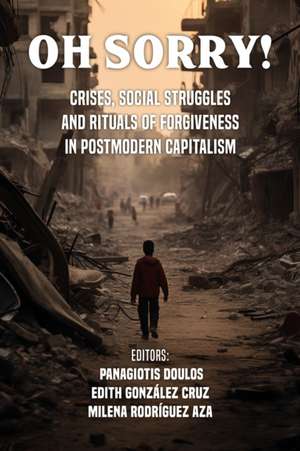
Oh Sorry!: Rituals of forgiveness, crisis, and social struggle in postmodern capitalism

Autor Panagiotis Doulos, Edith Gonzalez Cruz, Milena Rodriguez Aza
en Limba Engleză Paperback – 18 iul 2024

As the world grapples with the legacy of crimes of enslavement, colonialism, genocide and mass killings, imprisonment and murder of children, attempts at eliminating cultures and history of Indigenous peoples, looting and other crimes against humanity, the performance of public atonement has become increasingly prevalent. Apologies from state actors and institutions are issued in solemn ceremonies, often acknowledging the collective guilt for historical atrocities. Despite the solemnity of these events, there is a growing scepticism surrounding the sincerity of these apologies, particularly when they are not accompanied by tangible reparations, healing, reconciliation or systemic change. This scepticism is rooted in a perception that these acts of contrition are sometimes less about making amends to the aggrieved and more about assuaging the guilt of the aggressors and maintaining the status quo, providing the illusion of progress without the substance. In this compelling work, Oh, Sorry! Rituals of Forgiveness, Crises and Social Struggles in Postmodern Capitalism, the authors unveil the complex interplay between public apologies, social justice and popular mobilisations. The chapters are devoted primarily to the experiences of Latin America, particularly of Mexico, Guatemala, Chile, and Brazil. But there is also a chapter on the struggles for Palestine -- so relevant in the face of the current genocidal invasion by the Zionist State of Israel into Gaza, the world's largest and most densely populated concentration camp.

Citește tot Restrânge

Preț: 10874 lei

Preț vechi: 13492 lei
-19%

Puncte Express: 163

Carte disponibilă

Livrare economică 05-11 noiembrie

Livrare prin curier în România Termenul estimat este afișat lângă disponibilitate.
Transport gratuit de la 40000 lei Plată online sau ramburs, în funcție de opțiunile comenzii.
Retur gratuit în 14 zile Comandă securizată și suport în română.

Specificații

ISBN-13: 9781990263934
ISBN-10: 1990263933
Pagini: 200
Dimensiuni: 152 x 229 x 16 mm
Greutate: 0.39 kg
Editura: Daraja Press
Colecția Daraja Press
Locul publicării:Canada

Descriere

In recent years, the apology has become an important feature of politics. States are asking their own citizens or the citizens of other countries for forgiveness. 'Oh, sorry that we rounded up people in West Africa, shipped them across the Atlantic and sold them as slaves'. 'Oh, sorry that we convicted homosexuals as criminals.' 'Oh, sorry that we burnt so many women as witches.' Sometimes the issue arises as a demand for an apology. Thus, Lopez Obrador, the Mexican president, has asked the Spanish government to apologise for the conquista. The zapatistas, on the other hand, said of their recent trip to Spain that they were not going to ask for an apology. How do we understand the rise of the public apology and how do we relate to it politically? In a moment of severe social crisis, the institutional acts of apology and forgiveness could be theorised as a specific type of ritual which aims to respond to public anger and to reestablish social cohesion. In doing so, the state legitimises itself as the guardian of society as a Whole, and capitalism as the only alternative. We consider that in times of capitalist crisis, class struggle becomes a metonym of revenge. Thus, the act of forgiveness - as a secularised ritual, based on reason - allows the violence of social antagonism to be regulated and reconfigured in order to re-establish the Law and Order through the discourse of reconciliation, and renunciation of revenge as a condition for development. The rituals of forgiveness are being presented as crucial steps for pacifying social tensions and establishing a new social contract, leaving behind the bloody past and rewriting historical memory for the sake of the common future. Violence, anger, guilt, memory, the attempt to pacify discontent and secure the continuity of violence: all of these come into play in the rise of the 'Oh, Sorry!'. Our project is to understand these rituals of forgiveness in different sociocultural contexts around the world, and to discuss why at this historical moment the states are proceeding in this way, and what is the relationship with capitalist crisis and social struggle. In other words, we launch this invitation to think about these issues and contribute to the construction of a book with these reflections.

Notă biografică

Panagiotis Doulos currently works as a professor-researcher in the Programa de Investigadoras e Investigadores por México-CONAHCYT and in the Instituto de Ciencias Sociales y Humanidades "Alfonso Vélez Pliego" of the Benemérita Universidad Autónoma de Puebla, Mexico. His research interests include issues of violence, social struggles and critical theory. He has published several articles on violence, the fetishism of the concrete and the crisis of capitalist relations.