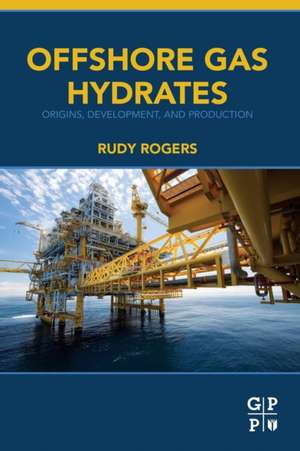
Offshore Gas Hydrates: Origins, Development, and Production
Autor Rudy Rogersen Limba Engleză Paperback – 19 aug 2015
- Addresses the technical, economic, and environmental problems of producing hydrate gas.
- Introduces the overlooked and unchartered role of microbes in catalyzing offshore hydrate formations with attendant effects on stability/dissociation.
- Reviews the latest world-wide field tests, research, and case studies involving seafloor hydrates, inclusive of most known hydrate provinces.
- Displays two videos within the e-book only: (1) hydrates, carbonates, chemosynthetic communities, and natural hydrocarbon leakages on the seafloor at the Mississippi Canyon hydrate observatory site; (2)
hydrate nucleation, migration and self-packing in a laboratory test cell under the influence of anionic surfactants. - Extends deep-water hydrate knowledge regarding the hydrate formation and protective cover for microbes within the extreme environment of Mars.
Preț: 676.16 lei
Preț vechi: 905.62 lei
-25%
Puncte Express: 1014
Carte tipărită la comandă
Livrare economică 20 noiembrie-04 decembrie
Livrare prin curier în România Termenul estimat este afișat lângă disponibilitate.
Transport gratuit pentru acest produs Plată online sau ramburs, în funcție de opțiunile comenzii.
Retur gratuit în 14 zile Comandă securizată și suport în română.
Specificații
ISBN-13: 9780128023198
ISBN-10: 0128023198
Pagini: 398
Ilustrații: 179 illustrations
Dimensiuni: 152 x 229 x 20 mm
Greutate: 0.66 kg
Editura: ELSEVIER SCIENCE
ISBN-10: 0128023198
Pagini: 398
Ilustrații: 179 illustrations
Dimensiuni: 152 x 229 x 20 mm
Greutate: 0.66 kg
Editura: ELSEVIER SCIENCE
V-ar putea interesa
-
 Emissions Reduction: NOx/SOx SuppressionA. Tomita-21%Preț: 354.20 lei447.69 lei
 -
 -26%Preț: 1075.04 lei1450.57 lei
 -
 Advances in Coal Mine Ground ControlSyd S. Peng-26%Preț: 1164.31 lei1574.70 lei
 -
 -21%Preț: 946.52 lei1204.24 lei
 -
 Combustion Ash Residue Management: An Engineering PerspectiveRichard W. Goodwin-26%Preț: 663.69 lei893.04 lei
 -
 Practical Reservoir Engineering and CharacterizationRichard O. Baker-25%Preț: 591.50 lei788.14 lei
 -
 -20%Preț: 755.71 lei946.44 lei
 -
 -25%Preț: 539.59 lei723.18 lei
 -
 -20%Preț: 474.51 lei591.53 lei
 -
 -25%Preț: 616.47 lei820.02 lei
 -
 -20%Preț: 888.67 lei1116.76 lei
 -
 Blowout and Well Control HandbookRobert D. Grace-27%Preț: 1180.94 lei1615.57 lei
 -
 Plant Design and OperationsIan Sutton-27%Preț: 994.56 lei1371.35 lei
 -
 Direct Methane to Methanol: Foundations and Prospects of the ProcessVladimir Arutyunov-30%Preț: 894.84 lei1283.85 lei
 -
 -18%Preț: 1367.70 lei1667.92 lei
 -
 Estimator's Equipment Installation Man-Hour ManualJohn S. Page-26%Preț: 720.89 lei974.64 lei
 -
 Geologic Analysis of Naturally Fractured ReservoirsRonald Nelson-26%Preț: 934.39 lei1256.31 lei
 -
 Handbook on Bioethanol: Production and UtilizationCharles Wyman-18%Preț: 3233.20 lei3942.92 lei
 -
 -31%Preț: 1040.37 lei1507.02 lei
 -
 Reservoir Exploration and AppraisalLuiz Amado-19%Preț: 248.55 lei308.64 lei
 -
 Handbook of Petroleum ProcessingSteven A. Treese-24%Preț: 5369.28 lei7064.85 lei
 -
 -15%Preț: 605.13 lei711.91 lei
 -
 Structure and Reactivity of CoalKe-Chang Xie-15%Preț: 625.77 lei736.21 lei
 -
 Mine Environment and VentilationD.C. Panigrahi-18%Preț: 1705.13 lei2079.42 lei
Cuprins
Chaper 1: IntroductionChapter 2: Deep Ocean Sediment-Hydrate RelationshipsChapter 3: Gulf of Mexico, Thermo-Biogenic HydratesChapter 4: Producing Methane from Offshore HydratesChapter 5: Hydrate Inhibition during Drilling & ProductionChapter 6: Hydrate-Associated Seafloor InstabilitiesChapter 7: Biogenic Hydrate ProvincesChapter 8: Microbe, Mineral Synergy and Seafloor Hydrate NucleationChapter 9: Hydrate Zone EcologyChapter 10: Martian Hydrate Feasibility; Extending Extreme Seafloor Environments
Notă biografică
Rudy Rogers, Professor Emeritus in Chemical Engineering at Mississippi State University, holds BS, MS, and PhD degrees in Chemical Engineering from the University of Arizona and the University of Alabama. Beginning in 1977, Dr. Rogers spent thirty-three years teaching petroleum engineering and chemical engineering at MSU, including eight years as Petroleum Engineering Chairman. During twenty yearsof gas hydrate research, he garnered nearly two million dollars of grants, participated in four scientific cruises to the Gas Hydrate Observatory in the Gulf of Mexico, received three U.S. patents, authored fifteen hydrate papers in peer-reviewed journals, gave over thirty presentations on gas hydrates as author or coauthor at national and international conferences, had numerous hydrate publications in proceedings, and introduced a senior/graduate-level hydrate course.