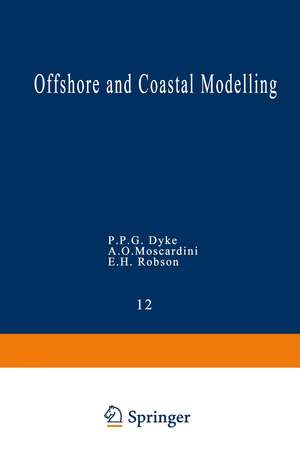
Offshore and Coastal Modelling: Coastal and Estuarine Studies, cartea 12
Editat de P. P. G. Dyke, A. O. Moscardini, E. H. Robsonen Limba Engleză Paperback – 11 mar 1985
Din seria Coastal and Estuarine Studies
- 15%
 Preț: 644.94 lei
 - 15%
 Preț: 611.89 lei
 - 15%
 Preț: 618.03 lei
 -
 Preț: 378.95 lei
 - 15%
 Preț: 629.98 lei
 -
 Preț: 392.64 lei
 -
 Preț: 378.57 lei
 -
 Preț: 382.13 lei
 - 15%
 Preț: 613.00 lei
 - 15%
 Preț: 613.94 lei
 -
 Preț: 384.30 lei
 -
 Preț: 383.38 lei
 - 15%
 Preț: 617.72 lei
 -
 Preț: 384.13 lei
 -
 Preț: 378.02 lei
 - 15%
 Preț: 622.11 lei
 - 15%
 Preț: 627.01 lei
 -
 Preț: 380.20 lei
 - 18%
 Preț: 911.94 lei
 - 15%
 Preț: 617.89 lei
 - 15%
 Preț: 622.73 lei
 - 18%
 Preț: 936.52 lei
 - 18%
 Preț: 963.14 lei
 - 15%
 Preț: 625.75 lei
 - 15%
 Preț: 608.78 lei
 - 15%
 Preț: 613.62 lei
 -
 Preț: 367.85 lei
 - 15%
 Preț: 642.30 lei
Preț: 398.21 lei
Puncte Express: 597
Carte tipărită la comandă
Livrare economică 01-15 decembrie
Livrare prin curier în România Termenul estimat este afișat lângă disponibilitate.
Transport gratuit de la 400.00 lei Plată online sau ramburs, în funcție de opțiunile comenzii.
Retur gratuit în 14 zile Comandă securizată și suport în română.
Specificații
ISBN-13: 9780387960548
ISBN-10: 0387960546
Pagini: 412
Ilustrații: IX, 399 p. 11 illus.
Dimensiuni: 155 x 235 x 23 mm
Greutate: 0.62 kg
Ediția:Softcover reprint of the original 1st ed. 1985
Editura: Springer
Colecția Coastal and Estuarine Studies
Seria Coastal and Estuarine Studies
Locul publicării:New York, NY, United States
ISBN-10: 0387960546
Pagini: 412
Ilustrații: IX, 399 p. 11 illus.
Dimensiuni: 155 x 235 x 23 mm
Greutate: 0.62 kg
Ediția:Softcover reprint of the original 1st ed. 1985
Editura: Springer
Colecția Coastal and Estuarine Studies
Seria Coastal and Estuarine Studies
Locul publicării:New York, NY, United States
V-ar putea interesa
-
 Fluid Mechanics and the SPH Method: Theory and ApplicationsDamien Violeau-30%Preț: 576.89 lei824.89 lei
 -
 Microscopic Simulations of Complex Hydrodynamic PhenomenaMichel Mareschal-18%Preț: 995.10 lei1213.54 lei
 -
 Navier-Stokes Equations and Related Nonlinear ProblemsAdélia Sequeira-18%Preț: 992.73 lei1210.64 lei
 -
 Theoretical Approaches to TurbulenceD. L. Dwoyer-15%Preț: 618.23 lei727.33 lei
 -
 HydrodynamicsGarrett BirkhoffPreț: 328.28 lei
 -
 -18%Preț: 989.11 lei1206.24 lei
 -
 IUTAM Symposium on Free Surface FlowsA. C. King-18%Preț: 984.26 lei1200.31 lei
 -
 Thermo-Hydraulics of Nuclear ReactorsChristopher Earls Brennen-17%Preț: 388.01 lei467.21 lei
 -
 -14%Preț: 791.61 lei920.48 lei
 -
 Preț: 360.36 lei
 -
 Fluid Mechanics: An Intermediate ApproachBijay K. Sultanian-9%Preț: 1241.39 lei1364.17 lei
 -
 Basic Machines and How They WorkNaval Education And Training ProgramPreț: 127.08 lei
 -
 Basic Machines and How They WorkNaval Education And Training ProgramPreț: 131.96 lei
 -
 MOD COAST & MARINE PROC (2ND ED)Dyke Phil-15%Preț: 494.26 lei581.48 lei
 -
 Managing Mathematical Projects - with Success!P. P. G. DykePreț: 328.12 lei
 -
 Design of Piping SystemsM. W. Kellogg CompanyPreț: 185.49 lei
 -
 Applied Mathematics in Hydraulic EngineeringKazumasa Mizumura-15%Preț: 529.88 lei623.39 lei
Public țintă
ResearchCuprins
1 Modelling in Offshore and Coastal Engineering.- 2 Tides, Storm Surges and Coastal Circulations.- 2.1 Bathymetry.- 2.2 Tides and Tidal Currents.- 2.3 North Sea Storm Surges.- 2.4 Two-dimensional Numerical Storm-surge Models.- 2.5 Surge Forecasting.- 2.6 Three-dimensional Models.- 2.7 Vertical Structure of Current.- 3 Modelling Storm Surge Current Structure.- 3.1 Introduction.- 3.2 Spectral Model Formulation.- 3.3 Form of Vertical Eddy Viscosity.- 3.4 A 3-D Simulation Model of Surge Currents on the North-West European Shelf.- 3.5 A Mechanistic Model of Wind Induced Current Profiles.- 3.6 Concluding Remarks.- 4 Optimally Controlled Hydrodynamics for Tidal Power from the Severn Estuary.- 4.1 Introduction.- 4.2 Hydrodynamics.- 4.3 Optimal Control.- 5 Numerical Modelling of Storm Surges in River Estuaries.- 5.1 Introduction.- 5.2 Points to note in Modelling.- 5.3 The Aims of a Mathematical Model of Storm Surges.- 5.4 The Differential Equations of the Model.- 5.5 Computational Aspects.- 5.6 Numerical Results: The Storm of 1953.- 5.7 Summary.- 6 Coastal Sediment Modelling.- 6.1 Introduction.- 6.2 Need for Computer Models.- 6.3 Model Types.- 6.4 Conclusions.- 7 The Application of Ray Methods to Wave Refraction Studies.- 7.1 Introduction.- 7.2 Ray Models.- 7.3 Application of the Ray Model, a Simple Case.- 7.4 A Study including Wave Breaking.- 7.5 A Study including Diffraction and Reflection.- 7.6 Future Developments.- 8 A Model for Surface Wave Growth.- 8.1 Introduction.- 8.2 Formulation of the Problem.- 8.3 First Order Solution.- 8.4 Second Order Solution.- 8.5 Third Order Solution.- 8.6 Wind Shear Stress.- 8.7 Conclusion.- 9 Power Take-Off and Output from the Sea-Lanchester Clam Wave Energy Device.- 9.1 Introduction.- 9.2 Experimental Tests.- 9.3 Power Take-off Simulation.- 10 Numerical Modelling of Ilfracombe Seawall.- 10.1 Introduction.- 10.2 Finite Element Modelling of Ilfracombe Seawall.- 10.3 Need for a Finite Element Model Approach.- 10.4 Conclusions.- 11 Modelling The Plan Shape of Shingle Beaches.- 11.1 Introduction.- 11.2 General Considerations when Modelling Beach Changes.- 11.3 Derivation of an Alongshore Transport Formula.- 11.4 Incipient Motion of Shingle.- 11.5 Discussion.- 11.6 Conclusions.- 12 Mathematical Modelling Applications for Offshore Structures.- 12.1 Introduction.- 12.2 Operational, Environmental and Foundation Condition.- 12.3 Structural Concepts.- 12.4 Fabrication.- 12.5 Construction.- 12.6 Load Out.- 12.7 Tow Out.- 12.8 Installation.- 12.9 Mathematical Modelling in Platform Design.- 12.10 Conclusions.- 13 Mathematical Model of A Marine Hose-String at a Buoy: Part 1, Static Problem.- 13.1 Introduction.- 13.2 Assumptions.- 13.3 Equations.- 13.4 Boundary Conditions.- 13.5 Hose Radius.- 13.6 The Load.- 13.7 Method of Solution.- 13.8 Analytical Solutions for Simplified Models.- 13.9 Results.- 13.10 Applications.- 13.11 Conclusions.- 14 Mathematical Model of a Marine Hose-String at a Buoy: Part 2, Dynamic Problem.- 14.1 Introduction.- 14.2 Equation of Motion.- 14.3 Boundary Conditions.- 14.4 Method of Solution.- 14.5 Flanges.- 14.6 Comparison of Analytical and Numerical Results.- 14.7 Numerical Results.- 14.8 Conclusions.- 15 The Design of Catenary Mooring Systems for Offshore Vessels.- 15.1 Introduction.- 15.2 Representation of the Environment.- 15.3 Mathematical Model of Moored Vessel.- 15.4 Calculations of Environmental Forces and Moments.- 15.5 Calculation of Mooring Forces and Moments.- 15.6 Static Analysis.- 15.7 Response of Vessel to Wind Gusting and Wave Drift Action.- 15.8 Conclusions.- 16 Some Problems Involving Umbilicals, Cables and Pipes.- 16.1 Introduction.- 16.2 The Statics of Cables and Pipes.- 16.3 Hydrodynamic Forces.- 16.4 Analytical Solutions.- 16.5 Typical Problems and Numerical Solutions.- 16.6 Final Comments.- 17 Mathematical Modelling in Offshore Corrosion.- 17.1 Introduction.- 17.2 General Mass Transport Theory.- 17.3 Mathematical Modelling of the Electrochemistry in Cracks.- 17.4 Mathematical Modelling in Cathodic Protection Offshore.- 17.5 Mathematical Modelling of Crevice Corrosion.- 17.6 Mathematical Modelling of Corrosion in Concrete.- 17.7 Conclusions.- 18 Fatigue Crack Growth Predictions in Tubular Welded Joints.- 18.1 Introduction.- 18.2 Fatigue Crack Growth Behaviour of Tubular Joints.- 18.3 Theoretical Analysis of Crack Growth.- 18.4 Conclusions.