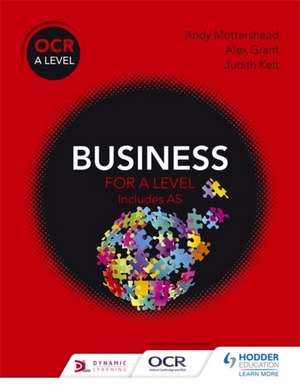
OCR Business for A Level
Autor Andy Mottershead, Alex Grant, Judith Kelten Limba Engleză Paperback – 26 iun 2015 – vârsta până la 19 ani
Level: A-level
Subject: Business
First Teaching: September 2015
First Exam: June 2016
- Guides students through the new course and assessment structure with advice at the start of the book to help them understand what's required
- Enables students to put their knowledge in context and helps them start analysing business data with case studies of real businesses included throughout
- Prepares students for assessment with the 'Your turn' feature that contains practice questions including multiple choice, case study and data response, and those that test their quantitative skills
Preț: 408.05 lei
Preț vechi: 487.89 lei
-16%
Puncte Express: 612
Carte disponibilă
Livrare economică 09-23 noiembrie
Livrare express 23-29 octombrie pentru 155.71 lei
Livrare prin curier în România Termenul estimat este afișat lângă disponibilitate.
Transport gratuit pentru acest produs Plată online sau ramburs, în funcție de opțiunile comenzii.
Retur gratuit în 14 zile Comandă securizată și suport în română.
Specificații
ISBN-13: 9781471836152
ISBN-10: 1471836150
Pagini: 520
Dimensiuni: 212 x 276 x 30 mm
Greutate: 1.4 kg
Editura: Hachette Learning
Colecția Hodder Education
Locul publicării:London, United Kingdom
ISBN-10: 1471836150
Pagini: 520
Dimensiuni: 212 x 276 x 30 mm
Greutate: 1.4 kg
Editura: Hachette Learning
Colecția Hodder Education
Locul publicării:London, United Kingdom
V-ar putea interesa
-
 Sex, Spies and ScandalAlex GrantPreț: 143.86 lei
 -
 Steuerwettbewerb und UnternehmensstrukturSven WegenerPreț: 53.44 lei
 -
 Kritische Analyse von Rating-Agenturen bei VerbriefungenMichael StrulikPreț: 105.87 lei
 -
 Preț: 86.51 lei
 -
 Preț: 74.54 lei
 -
 Public Real Estate Management - Ergebnisse einer Umfrage auf der Ebene der BundesländerNorbert Christian MüllerPreț: 242.90 lei
 -
 Preț: 290.15 lei
 -
 Besondere Merkmale und Methoden des Life Cycle CostingAndreas MützePreț: 311.43 lei
 -
 Preț: 93.84 lei
 -
 Fortentwicklung der GenossenschaftsprüfungRemmer SassenPreț: 100.04 lei
 -
 Preț: 105.56 lei
 -
 APT und Mehrfaktorenmodelle zur Bestimmung der EigenkapitalkostenChristian KronwaldPreț: 75.85 lei
 -
 Preț: 75.85 lei
 -
 Die Beurteilung der Ausbilder und Ausbildungsbeauftragten in der PraxisMonika DimpflmaierPreț: 144.42 lei
 -
 Preț: 367.38 lei
 -
 Preț: 392.75 lei
 -
 Preț: 479.56 lei
 -
 Betriebswirtschaftslehre der IndustrieKarl Wilhelm HennigPreț: 400.69 lei
 -
 Preț: 399.60 lei
 -
 Preț: 405.31 lei
 -
 Preț: 394.96 lei
 -
 Preț: 398.46 lei
 -
 Preț: 399.02 lei
 -
 Handwörterbuch des PostwesensWilhelm KüsgenPreț: 454.50 lei
 -
 Coordinated Multiuser CommunicationsChristian Schlegel-15%Preț: 635.18 lei747.26 lei
Cuprins
- Chapter 74: Location and logistics
- Chapter 73: Internal and external quality standards
- 16: Productive quality (fit for purpose)
- Chapter 72: Technology
- Chapter 71: Lean production
- Chapter 70: Stock control
- Chapter 69: Capacity utilisation and management
- Chapter 68: Economies and diseconomies of scale
- Chapter 67: Productivity
- 15: Productive efficiency
- Chapter 66: Project management
- Chapter 65: Methods of production
- Chapter 64: Innovation, research and development
- 14: The production process
- Chapter 63: Added value
- Chapter 62: Operations management objectives
- 13: Operations management within a business environment
- Chapter 61: Promotion
- Chapter 60: Place
- Chapter 59: Price
- Chapter 58: The marketing mix
- Chapter 57: Product and service marketing
- 12: The marketing strategy
- Chapter 56: Customers and consumers, anticipating consumer needs and the product life cycle
- Chapter 55: Identifying customer needs
- 11: Customer needs
- Chapter 54: Marketing within a business environment
- 10: Marketing within a business environment
- Chapter 53: Employer/employee relations: employment law
- Chapter 52: Employer/employee relations: trade unions and consultation
- Chapter 51: Motivation
- Chapter 50: Functions of management and leadership
- 9: Management
- Chapter 49: Redundancy and dismissal
- Chapter 48: Appraisal
- Chapter 47: Recruitment, selection and training
- Chapter 46: Workforce planning
- 8: The workforce
- Chapter 45: Communication
- Chapter 44: Organisation
- Chapter 43: Human resource management objectives
- 7: Human resource management within a business environment
- Chapter 42: External influences on accounting and finance
- Chapter 41: Ratio analysis
- Chapter 40: Statement of financial position
- Chapter 39: Income statements
- 6: Financial accounting
- Chapter 38: Cash-flow and working capital
- Chapter 37: Budgets and variance
- Chapter 36: Investment appraisal
- Chapter 35: Break-even analysis and contribution
- Chapter 34: Costs, revenue and profit
- 5: Management accounting
- Chapter 33: Accounting concepts
- Chapter 32: Sources of finance
- Chapter 31: Accounting and finance objectives and strategy
- 4: Accounting and finance within a business environment
- Chapter 30: Managing change
- Chapter 29: Causes and effects of change
- Chapter 28: Environmental factors and external factors and influences
- Chapter 27: Legal factors
- Chapter 26: Ethical factors
- Chapter 25: Social and technological factors and the digital revolution
- Chapter 24: Economic factors
- Chapter 23: Political factors
- Chapter 22: International trade and free trade
- Chapter 21: The EU, emerging markets and the global context
- Chapter 20: Competition and market dominance
- Chapter 19: Demand and supply and market forces
- Chapter 18: The market including physical and non-physical markets
- 3: External influences
- Chapter 17: Ansoff’s matrix
- Chapter 16: Decision trees
- Chapter 15: Decision making and conflicts in decision making
- Chapter 14: Forecasting
- Chapter 13: Measures of performance – financial and non-financial
- Chapter 12: Models of strategic choice
- Chapter 11: Contingency planning and crisis management
- Chapter 10: Risk and uncertainty and opportunity cost
- Chapter 9: Business plans
- Chapter 8: Strategy and implementation
- Chapter 7: Corporate social responsibility (CSR)
- Chapter 6: Different stakeholder objectives and mission statements
- Chapter 5: Stakeholders
- 2: Business objectives and strategy
- Chapter 4: Business size, growth and external growth
- Chapter 3: Franchises and co-operatives
- Chapter 2: Business sectors and types of business
- Chapter 1: Enterprise and business functions
- 1: Introduction to business