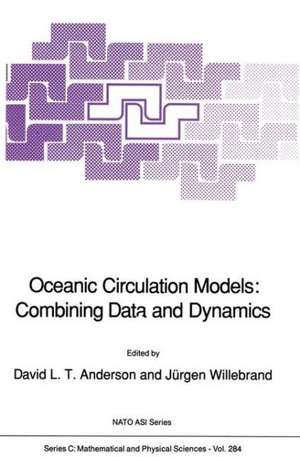
Oceanic Circulation Models: Combining Data and Dynamics: Nato Science Series C:, cartea 284
Editat de J. Willebrand, D. L. T. Andersonen Limba Engleză Hardback – 31 aug 1989
Din seria Nato Science Series C:
- 18%
 Preț: 1897.60 lei
 - 18%
 Preț: 1269.30 lei
 - 24%
 Preț: 904.66 lei
 - 18%
 Preț: 914.52 lei
 - 18%
 Preț: 986.17 lei
 - 18%
 Preț: 1266.27 lei
 -
 Preț: 381.34 lei
 -
 Preț: 388.40 lei
 - 18%
 Preț: 1278.91 lei
 - 18%
 Preț: 1275.73 lei
 - 18%
 Preț: 1270.56 lei
 - 18%
 Preț: 1177.92 lei
 - 18%
 Preț: 1267.73 lei
 - 18%
 Preț: 1175.35 lei
 - 18%
 Preț: 1903.57 lei
 - 24%
 Preț: 1223.36 lei
 -
 Preț: 375.65 lei
 - 18%
 Preț: 1271.33 lei
 - 18%
 Preț: 1265.21 lei
 - 18%
 Preț: 1173.25 lei
 - 18%
 Preț: 1905.18 lei
 - 24%
 Preț: 1713.46 lei
 -
 Preț: 384.68 lei
 -
 Preț: 415.51 lei
 -
 Preț: 422.63 lei
 -
 Preț: 412.15 lei
 - 18%
 Preț: 1908.36 lei
 - 18%
 Preț: 1770.41 lei
 - 18%
 Preț: 979.73 lei
 - 18%
 Preț: 1268.89 lei
 - 18%
 Preț: 1275.73 lei
 -
 Preț: 390.81 lei
 - 18%
 Preț: 1268.60 lei
 -
 Preț: 402.42 lei
 - 18%
 Preț: 1261.20 lei
 - 18%
 Preț: 1169.73 lei
 - 24%
 Preț: 1347.63 lei
 - 18%
 Preț: 984.05 lei
 - 18%
 Preț: 911.49 lei
 - 18%
 Preț: 980.24 lei
 - 18%
 Preț: 1894.27 lei
 -
 Preț: 375.44 lei
Preț: 430.61 lei
Puncte Express: 646
Carte tipărită la comandă
Livrare economică 03-17 decembrie
Livrare prin curier în România Termenul estimat este afișat lângă disponibilitate.
Transport gratuit pentru acest produs Plată online sau ramburs, în funcție de opțiunile comenzii.
Retur gratuit în 14 zile Comandă securizată și suport în română.
Specificații
ISBN-13: 9780792303947
ISBN-10: 0792303946
Pagini: 632
Ilustrații: XXIII, 605 p.
Dimensiuni: 160 x 241 x 40 mm
Greutate: 1.05 kg
Ediția:1989
Editura: SPRINGER NETHERLANDS
Colecția NATO Science Series C:
Seria Nato Science Series C:
Locul publicării:Dordrecht, Netherlands
ISBN-10: 0792303946
Pagini: 632
Ilustrații: XXIII, 605 p.
Dimensiuni: 160 x 241 x 40 mm
Greutate: 1.05 kg
Ediția:1989
Editura: SPRINGER NETHERLANDS
Colecția NATO Science Series C:
Seria Nato Science Series C:
Locul publicării:Dordrecht, Netherlands
V-ar putea interesa
-
 -11%Preț: 736.81 lei827.87 lei
 -
 Marine TurbulenceHelmut Z. Baumert-11%Preț: 609.66 lei685.00 lei
 -
 An Introduction to Ocean TurbulenceS. A. Thorpe-19%Preț: 516.56 lei637.73 lei
 -
 -19%Preț: 581.05 lei717.35 lei
 -
 TidesDavid Edgar Cartwright-14%Preț: 714.88 lei831.26 lei
 -
 The Dynamics of Coastal ModelsClifford J. Hearn-14%Preț: 783.78 lei911.38 lei
 -
 Sounds in the SeaHerman Medwin-14%Preț: 1114.84 lei1296.32 lei
 -
 Lagrangian Analysis and Prediction of Coastal and Ocean DynamicsAnnalisa Griffa-9%Preț: 645.88 lei709.76 lei
 -
 DescentBrad MatsenPreț: 124.10 lei
 -
 Physical Oceanography: A Mathematical Introduction with MATLABReza Malek-Madani-18%Preț: 732.89 lei893.76 lei
 -
 The Middle SeaRt Hon/Viscount John Julius Norwich-26%Preț: 91.43 lei123.96 lei
 -
 Instrumentation and Metrology in OceanographyMarc Le Menn-9%Preț: 1172.23 lei1288.17 lei
 -
 -15%Preț: 633.12 lei744.85 leiRecomandat
Public țintă
ResearchCuprins
Tracer Inverse Problems.- 1. Introduction.- 2. Interpolation and Map Making.- 3. Simple Estimation.- 4. Using Steady Tracers.- 5. Time Dependent Problems.- Appendix. Some Notes on the History of Inverse Methods in Ocean Circulation Problems.- A Geometrical Interpretation of Inverse Problems.- 1. The Overdetermined Case.- 2. The Underdetermined Case.- 3. The Singular Value Decomposition (SVD).- Determining Diffusivities from Hydrographic Data by Inverse Methods with Applications to the Circumpolar Current.- 1. Introduction to Ill-posed and Noisy Problems.- 2. The Physical Model.- 3. The Inverse Model.- 4. Examples: Circulation and mixing in the Southern Ocean.- Ocean Acoustic Tomography: a Primer.- 1. Introduction.- 2. Elementary Hydrodynamics and Acoustics.- 3. Ocean Sound Speed Distribution.- 4. Rays and Modes.- 5. Capsule Description of the Tomographic Method.- 6. A Simple Ray Example.- 7. Notes on Hardware Limitations and Observational Errors.- 8. Inversions.- 9. Some Results and Future Plans.- 10. Conclusions.- 11. Literature.- The Circulation in the Western North Atlantic Determined by a Nonlinear Inverse Method..- 1. Introduction.- 2. A Nonlinear Inverse Formalism.- 3. The Circulation in the Western North Atlantic.- Altimeter Data Assimilation into Ocean Circulation Models — Some Preliminary Results.- 1. Introduction.- 2. A Dynamic Initialization Scheme.- 3. Time and Space Dependence of the Observations.- 4. Geosat Assimilation in the Agulhas Retroflection Region.- 5. Discussion.- Assimilation of Data into Ocean Models.- 1. Introduction.- 2. Theory.- 3. Applications.- 4. Conclusions.- Driving of Non-linear Time-dependent Ocean Models by Observation of Transient Tracers — a Problem of Constrained Optimisation.- 1. Introduction.- 2. A Control Problem.- 3. AnElegant and Efficient Way to Calculate the Gradient of the Cost Function.- 4. The Ocean Model and its Adjoint.- 5. Results.- 6. Model Parameters as Control Variables.- 7. Sensitivity.- 8. Conclusions.- Assimilation of XBT Data Using a Variational Technique.- 1. Introduction.- 2. Implementation of Variational Assimilation Using Lagrange Multipliers.- 3. Results.- The Role of Real-Time Four-Dimensional Data Assimilation in the Quality Control, Interpretation, and Synthesis of Climate Data.- 1. Introduction.- 2. The Importance of Accurate Data Assimilation for NWP.- 3. The Analysis Module.- 4. Non-linear Normal Mode Initialization.- 5. The Forecast Model.- 6. Quality Control and Data Monitoring.- 7. The Value and Limitations of Global NWP Datasets for Climate Studies.- 8. Inversion and Quality Control of Remotely Sensed Data.- 9. Real-Time Integration and Synthesis of WCRP Observations.- to Chemical Tracers of the Ocean Circulation.- 1. Dimensional Analysis of a Tracer Conservation Equation.- 2. General Information on Tracers of Ocean Circulation.- 3. Surface Boundary Conditions.- 4. Mixing in the Deep Ocean.- 5. Conclusion.- On Oceanic Boundary Conditions for Tritium, on Tritiugenic 3He, and on the Tritium-3He Age Concept.- 1. Introduction.- 2. Tritium Ocean Surface Boundary Condition.- 3. Separation of Tritiugenic 3He.- 4. The Tritium-3He Age Concept.- 5. Tritium-3He Age Distributions on Isopycnal Surfaces in the Lower Northeast Atlantic Main Thermocline.- 6. Conclusions.- Ocean Carbon Models and Inverse Methods.- 1. Introduction.- 2. Diagnostic Equations.- 3. Parameterization of the Model: Methodological Issues for Inverse Methods.- 4. Some Preliminary Experiments.- Model of the Nutrient and Carbon Cycles in the North Atlantic. An Application of Linear Programming Methods.- 1. Introduction.- 2. The Model.- 3. Results for the ‘Inorganic’ Case.- 4. Results for the ‘Inorganic and Organic’ Case.- 5. Summary.- The Design of Numerical Models of the Ocean Circulation.- 1. Fundamentals of Model Design.- 2. Stability.- 3. Stability of Advective Schemes and Vertical Coordinates.- 4. The Application of Ocean General Circulation Models.- Instabilities and Multiple Steady States of the Thermohaline Circulation.- 1. Introduction.- 2. Box Models.- 3. 2-D Model.- 4. GFDL Model.- 5. Conclusions.- Subgridscale Representation.- 1. Introduction.- 2. Organization.- 3. Quasi-horizontal Stirring.- 4. Quasi-vertical Mixing.- 5. Benthic Boundary Processes.- Appendix A.- Appendix B.
Recenzii
`In summary, the editors have assembled a rather well integrated collection of lectures... The book should be warmly recommended to anyone, wishing to enter this burgeoning oceanographic discipline.'
Pageoph 135 (1) 1991
Pageoph 135 (1) 1991