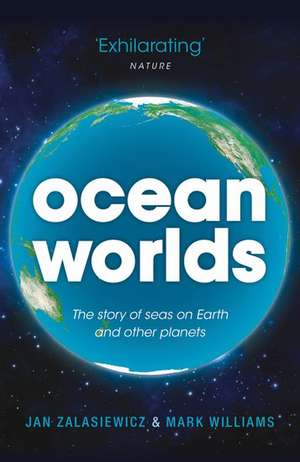
Ocean Worlds: The story of seas on Earth and other planets
Autor Jan Zalasiewicz, Mark Williamsen Limba Engleză Paperback – 9 noi 2017
Preț: 84.23 lei
Preț vechi: 105.83 lei
-20%
Puncte Express: 126
Carte disponibilă
Livrare economică 06-17 noiembrie
Livrare express 24-30 octombrie pentru 37.95 lei
Livrare prin curier în România Termenul estimat este afișat lângă disponibilitate.
Transport gratuit de la 400.00 lei Plată online sau ramburs, în funcție de opțiunile comenzii.
Retur gratuit în 14 zile Comandă securizată și suport în română.
Specificații
ISBN-13: 9780199672899
ISBN-10: 019967289X
Pagini: 320
Ilustrații: 18 black and white illustrations and 8pp colour plate section
Dimensiuni: 130 x 196 x 19 mm
Greutate: 0.14 kg
Editura: OUP OXFORD
Colecția OUP Oxford
Locul publicării:Oxford, United Kingdom
ISBN-10: 019967289X
Pagini: 320
Ilustrații: 18 black and white illustrations and 8pp colour plate section
Dimensiuni: 130 x 196 x 19 mm
Greutate: 0.14 kg
Editura: OUP OXFORD
Colecția OUP Oxford
Locul publicării:Oxford, United Kingdom
V-ar putea interesa
-
 Marine Biology: A Very Short IntroductionPhilip V. Mladenov-19%Preț: 58.13 lei71.69 lei
 -
 Earth and Life: A History of Four Billion YearsAnne Nédélec-12%Preț: 274.99 lei311.54 lei
 -
 Vanished Ocean: How Tethys Reshaped the WorldDorrik Stow-18%Preț: 75.99 lei93.07 lei
 -
 Oceans: A Very Short IntroductionDorrik Stow-19%Preț: 58.13 lei71.69 lei
 -
 -13%Preț: 213.20 lei245.59 lei
 -
 -14%Preț: 130.08 lei150.82 lei
 -
 Ocean of LifeCallum Roberts-37%Preț: 99.41 lei157.04 lei
 -
 A Little History of the EarthJamie WoodwardPreț: 151.53 lei
 -
 Preț: 35.10 lei
 -
 OceanAsha de Vos-16%Preț: 303.76 lei361.15 lei
 -
 Oceans For DummiesAshlan CousteauPreț: 124.30 lei
 -
 Ocean: Earth's Last Wilderness - THE LANDMARK NEW BOOK BY DAVID ATTENBOROUGHSir David AttenboroughPreț: 158.83 lei
 -
 Our StoryColin Butfield-21%Preț: 133.36 lei168.13 lei
 -
 Marine GeochemistryRoy Chester-19%Preț: 423.69 lei523.07 lei
 -
 National Geographic OceanSylvia A. EarlePreț: 483.55 lei
 -
 -34%Preț: 83.56 lei126.58 lei
 -
 The UnderworldSusan CaseyPreț: 87.16 lei
 -
 How Do Oceans Help Us Breathe?Eliza JefferyPreț: 73.82 lei
 -
 The OceanSturla HenriksenPreț: 194.28 lei
 -
 Life on a Little-Known PlanetElizabeth KolbertPreț: 193.02 lei
Recenzii
This book crams a lot of information into its 265 pages, all well referenced with notes at the back. From pirates to exoplanets and penis-worms to space probes this is truly the story of water, life, and discovery. A must-read for those with a hunger for general knowledge, or any interest in the topic. You will certainly find something new to explore further in this fascinating and accessibly written book.
Fluid and fascinating prose with just the right dosage of entertaining anecdotes and human interest
readable and absorbing account
[A] fast-paced but very readable ride through deep time ... Recommended. All academic library collections
Exhilirating foray
Fluid and fascinating prose with just the right dosage of entertaining anecdotes and human interest
readable and absorbing account
[A] fast-paced but very readable ride through deep time ... Recommended. All academic library collections
Exhilirating foray
Notă biografică
Jan Zalasiewicz teaches and researches geology at the University of Leicester, and previously was a field geologist and biostratigrapher at the British Geological Survey. His interests range from the early Palaeozoic world of half a billion years ago to the geology of the present day. He has served with the Palaeontographical Society and the Geological Society of London, and is now Chair of the Anthropocene Working Group of the International Commission on Stratigraphy and Vice-Chair of the International Subcommission of Stratigraphic Classification. Mark Williams is a palaeontologist who teaches the geological history of climate change at the University of Leicester. He has worked as a field geologist for the British Geological and British Antarctic surveys, and served on the council of the Palaeontographical Society both as an Editor and Vice-President. Currently he is a member of the Anthropocene Working Group of the International Commission on Stratigraphy, and the Stratigraphy Commission of the Geological Society of London. Together they have co-authored The Goldilocks Planet: The four billion year story of Earth's Climate (OUP, 2012).
Cuprins
- Preface
- 1: Water in the Cosmos
- 2: Ocean Origins on Earth
- 3: Ocean Forms
- 4: The Salt of the Earth
- 5: Moving the Waters
- 6: Life of the Oceans
- 7: Oceans in Crisis
- 8: The End of Earthly Oceans
- 9: Oceans of the Solar System
- 10: Undreamed Shores
- Notes
- References and Further Reading
- Index