Occupied Territory
Autor Simon Baltoen Limba Engleză Paperback – feb 2020
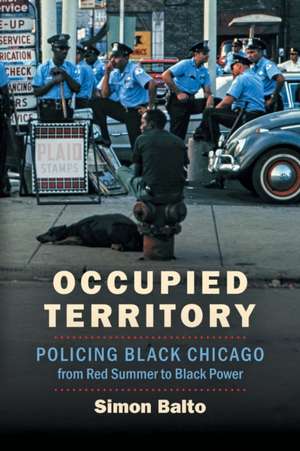
In this history of Chicago from 1919 to the rise and fall of Black Power in the 1960s and 1970s, Simon Balto narrates the evolution of racially repressive policing in black neighborhoods as well as how black citizen-activists challenged that repression. Balto demonstrates that punitive practices by and inadequate protection from the police were central to black Chicagoans' lives long before the late-century "wars" on crime and drugs. By exploring the deeper origins of this toxic system, Balto reveals how modern mass incarceration, built upon racialized police practices, emerged as a fully formed machine of profoundly antiblack subjugation.
Preț: 302.15 lei
Puncte Express: 453
Carte tipărită la comandă
Livrare economică 23 noiembrie-07 decembrie
Livrare prin curier în România Termenul estimat este afișat lângă disponibilitate.
Transport gratuit de la 400.00 lei Plată online sau ramburs, în funcție de opțiunile comenzii.
Retur gratuit în 14 zile Comandă securizată și suport în română.
Specificații
ISBN-13: 9781469659176
ISBN-10: 1469659174
Pagini: 360
Dimensiuni: 156 x 234 x 22 mm
Greutate: 0.61 kg
Editura: The University of North Carolina Press
ISBN-10: 1469659174
Pagini: 360
Dimensiuni: 156 x 234 x 22 mm
Greutate: 0.61 kg
Editura: The University of North Carolina Press
Notă biografică
Simon Balto is assistant professor of history and African American studies at the University of Iowa.
Descriere
In this history of Chicago from 1919 to the rise and fall of Black Power in the 1960s and 1970s, Simon Balto narrates the evolution of racially repressive policing in black neighbourhoods as well as how black citizen-activists challenged that repression.