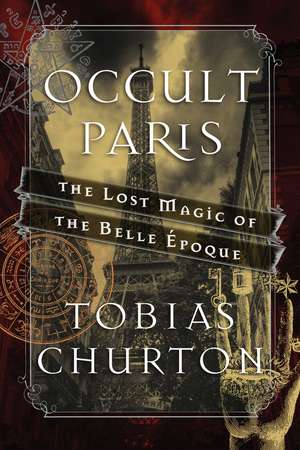
Occult Paris: The Lost Magic of the Belle Époque
Autor Tobias Churtonen Limba Engleză Hardback – 15 dec 2016
Ne-a atras atenția modul în care Tobias Churton deconstruiește mitul Parisului modern prin prisma fermentului ermetic care a definit perioada 1871-1914. În Occult Paris, autorul demonstrează că efervescența artistică a Belle Époque nu a fost un fenomen pur estetic, ci a fost profund ancorată în activitatea societăților secrete și a ordinelor inițiatice. Suntem de părere că această lucrare reîncadrează istoria culturală a Europei, arătând cum teozofii, rozicrucienii și martiniștii au influențat direct viziunile unor artiști precum Claude Debussy sau Georges Seurat.
Spre deosebire de abordările pur biografice, volumul analizează intersecția dintre ezoterism și avangardă, oferind detalii despre figuri precum Papus sau Joséphin Peladan. Cititorii familiarizați cu Modernism and the Occult de John Bramble vor aprecia modul în care acest volum mută centrul de greutate de la teoria generală a modernismului către o geografie spirituală specifică a „Orașului Luminii”. Dacă lucrarea lui Bramble se concentrează pe afilierea imperială a cunoașterii heterodoxe, Churton preferă o imersiune documentată în saloanele pariziene, susținută de peste 160 de ilustrații care dau viață acestor cercuri oculte.
În contextul operei sale vaste, Occult Paris continuă preocupările autorului din Gnostic Philosophy, însă aplică acele concepte abstracte pe un cadru istoric și geografic bine definit. Față de Aleister Crowley in Paris, unde accentul cade pe parcursul individual al „Bestiei”, acest titlu oferă o perspectivă panoramică asupra întregului ecosistem magic parizian, fiind o resursă esențială pentru înțelegerea rădăcinilor ezoterice ale culturii moderne.
Preț: 149.13 lei
Preț vechi: 207.67 lei
-28%
Carte disponibilă
Livrare economică 14-26 august
Livrare express 29 iulie-04 august pentru 111.89 lei
Specificații
ISBN-10: 162055545X
Pagini: 528
Ilustrații: Includes 16-page color insert and 160 b&w illustrations
Dimensiuni: 152 x 229 x 30 mm
Greutate: 0.88 kg
Editura: Inner Traditions/Bear & Company
Colecția Inner Traditions
V-ar putea interesa
-
 Preț: 156.87 lei
 -
 Alfred JarryAlastair BrotchiePreț: 400.49 lei
 -
 Speaking to the Rose: Writings, 1912-1932Robert WalserPreț: 89.93 lei
 -
 Curves to the AppleRosmarie WaldropPreț: 97.72 lei
 -
 Erotic PoemsE. E. CummingsPreț: 73.69 lei
 -
 -48%Preț: 75.42 lei146.43 lei
 -
 Living CurrencyPierre Klossowski-45%Preț: 98.80 lei179.93 lei
 -
 Schopenhauer as EducatorFriedrich NietzschePreț: 73.74 lei
 -
 Ooh La La!: Contemporary French Erotica by WomenFranck SpenglerPreț: 158.09 lei
 -
 -25%Preț: 73.39 lei98.15 lei
 -
 Vectors of the Counter-InitiationCharles UptonPreț: 151.70 lei
 -
 -18%Preț: 87.56 lei107.33 lei
 -
 -27%Preț: 156.28 lei215.45 lei
 -
 -29%Preț: 153.02 lei214.65 lei
 -
 Walter Benjamin's ArchiveWalter BenjaminPreț: 223.33 lei
 -
 African Myths & Tales: Epic TalesDr. Kwadwo Osei-Nyame, Jnr-10%Preț: 131.11 lei146.42 lei
 -
 The Situationists and the CityTom McDonoughPreț: 163.69 lei
 -
 Exploits & Opinions of Dr. Faustroll, PataphysicianAlfred JarryPreț: 76.01 lei
 -
 The BookStéphane MallarméPreț: 92.78 lei
 -
 Preț: 206.07 lei
 -
 MysticismEvelyn UnderhillPreț: 131.87 lei
De ce să citești această carte
Această carte este esențială pentru cei interesați de istoria secretă a artei și a mișcărilor spirituale. Cititorul va descoperi cum simbolismul și modernismul au fost modelate de ritualuri magice și filozofii gnostice. Este o lectură densă, documentată academic, dar accesibilă, care transformă percepția asupra Parisului, oferind un context fascinant pentru operele marilor compozitori și scriitori de la sfârșitul secolului al XIX-lea.
Despre autor
Tobias Churton este unul dintre cei mai importanți cercetători britanici în domeniul ezoterismului occidental, fiind o autoritate recunoscută în gnosticism, hermetism și rozicrucianism. Licențiat în teologie la Brasenose College, Oxford, și membru onorific al Universității din Exeter, unde predă cursuri despre masonerie, Churton îmbină rigoarea academică cu experiența de realizator de documentare. Printre realizările sale se numără seria premiată „The Gnostics” și numeroase biografii ale unor figuri emblematice din istoria magiei, expertiza sa fiind evidentă în modul în care sintetizează complexitatea curentelor de gândire fin-de-siècle în lucrări accesibile publicului larg.
Notă biografică
Tobias Churton is Britain’s leading scholar of Western Esotericism, a world authority on Gnosticism, Hermeticism, and Rosicrucianism. An Honorary Fellow of Exeter University, where he is a faculty lecturer, he holds a master’s degree in Theology from Brasenose College, Oxford, and is the author of many books, including Gnostic Philosophy and Aleister Crowley: The Beast in Berlin. He lives in England.
Extras
Meetings with Remarkable Men
We can see that symbolic powers, occult powers, and poetic powers emerge from the same source, the same depths.
Gaston Bachelard, Preface to Richard Knowles’s Victor-Émile Michelet, Poète Ésotérique
During the 1960s and 70s, British historian Dame Frances Yates astonished and perplexed the community of historical scholarship by her reasoned advocacy of the view that a highly significant factor in promoting the genesis of modern science and its representative the “scientist” was the Renaissance Hermetic movement’s veneration for the Magus. The Magus is concerned with extending his powers over all aspects of creation, even unto immaterial realms. In analyzing the life of Dominican friar Giordano Bruno in particular (Giordano Bruno and the Hermetic Tradition, 1964), Yates demonstrated how the opposition of the Catholic Inquisition created the idea of Bruno as a “martyr to science”--he was burned at the stake in Rome in 1600 as an impenitent heretic--when his actual views were regarded in the main as superstitious claptrap by many 19th-and 20th-century scientists operating on “Newtonian” lines. Rekindled in Florence after 1460, Yates declared the gnostic “Hermetic Tradition” stimulated the rediscovery of Man as a free-willed Operator in the universe, a co-creator with the divine, to whom no secret need remain hid. [. . .] Thus “occult philosophy” was not in fact “hidden philosophy”--the deliberate cultivation of esoteric obscurity--but revealed what had formerly been hidden to the eyes of the fearful and the ignorant; in another word, science, but science with esoteric and spiritual balls: Gnostic science was the vehicle of revelation.
What is truly fascinating about developments in Paris in the 1880s and ’90s is that at the very time when many scientists had reached an apogee of materialist certainty verging on hubris--feeling themselves and their experimental methods utterly alien to the figure of the Mage who “dreamed but did not get real results”--yet at that very moment we find the Magus’s position as the desirable ideal and archetype being assumed not as the ideation of the scientist, but as the apotheosis of the ARTIST. The aim? That Art trump Science. New men will embrace the new religion, universal, already hidden in spiritual symbols, which, while the traditions and cultures around them might differ superficially, exist as one in essence.
Esotericism insists there is correspondence between all things. One thing opens a door to another: all rooms are connected. The new religion was at home in the Temple, whether of ancient Egypt, the Panthéon in modern Paris, or the contemplative mind in its study, or with like-minded friends. [. . .] In this religion, the Magus and prophet is not the scientist who limits the universe to measure it, but the Artist who seeks the infinite, the one who accepts the “open secret” of the universe as mystery. The Artist becomes one who reveals the hidden truth, not of matter itself, but of Man and the determinative occult world behind nature. Hail the Artist as custodian of spiritual being, of idealization, of beauty, of essential truth!
The dizzy heights of this realization were given verbal form in sweeping style by Bailly bookshop habitué Joséphin Péladan: “There is no reality other than God. There is no Truth other than God. There is no Beauty other than God.”3 Péladan deduced that the greatest art had necessarily been generated for the Catholic Church and the time had come for the Church to realize that the true hierophant of the mysteries was the Artist, the Magus come to the cradle of the Lord with gifts. [. . .] He was sacrificer and bridge-builder between the invisible and the visible, between this world and the world to come: the master of the ikon and of memory. The Artist’s business was with the ideal and the spiritual, not with reproducing the visual plane of nature like an ape. Paraphrasing Hermes Trismegistus, Péladan concluded: “Artist, you are Magus: Art is the great miracle.” The materialist scientist will only take you further into the endless darkness of matter, progressively enslaving the spirit to rational categories and destroying the divine humanity. The Magus, of whom Leonardo was a shining exemplar, combined search into the quantitative visible world with a no less penetrating search into the invisible and symbolic world, the infinite worlds, the boundless worlds of imagination, not to be confused with merely external fantasies as in the vulgar notion of “surrealism” or visual whimsicality. He was a man of imagination and his genius transcended his time, perhaps time itself.
So we see the figure of the Hermetic Magus return, and his gift was to justify the position of the artist, to secure him at the heights. [. . .] Hermetism made exalted sense of the Artist and his peculiar life and vocation. It thus became desirable for the new artist, who, like Redon, found the “ceiling” of the Impressionists too low for comfort to explore occult traditions, to partake more fully in the insights of the condemned gnosis. For this purpose, the L’Art Indépendant shop in the Rue de la Chaussée d’Antin and the Librairie du Merveilleux in the Rue de Trévise became essential calling points. In those oases of the ideal freedom, the movement could take its store of inspiration while sharing thoughts and carrying them out into the artists’ apartments, studios, informal salons, and café meetings. Now joined, Symbolism and Occultism shared mutual waves that would rise into an aesthetic flood, rolling through the streets of Paris in an attempt to sweep away the barricades of materialism, to oppose the Barbarians at home and abroad with unearthly Beauty and the power of the Spirit. After all the historic, failed revolutions that promoted what was perceived to be Paris’s decline into decadence, a spiritual revolution was afoot. Its weapon: ART, perceived as the exercise of the “High Science,” that is to say, Hermetic magic.
Recenzii
“With Tobias Churton as the cicerone--or dare I say psychopomp?--the reader is expertly guided in the labyrinthine world of the Occult Paris of the Belle Époque (1871-1914). This is the best introduction to the French occult revival ever written in English.”
“Music, art, literature, mysticism--fin-de-siècle Paris had it all in great abundance, and in Tobias Churton’s latest tome he uncovers the hidden and not-so-hidden connections between Satie, Debussy, Redon, Rops, Khnopff, Gauguin, Crowley, Lévi, Papus, Mathers, Péladan, Michelet, Blavatsky, Reuss, Huysmans, Breton, and countless others. . . . Eminently readable and filled with meticulous historical details, this is a fabulous depiction of one of the most exciting and fervent periods of creativity in modern times.”
“A tour de force. A stunning account of fin-de-siècle Occult Paris and its lasting influence on the counterculture. . . . Churton gives comprehensive portrayals of such occult luminaries as Péladan, Papus, and de Guaita as well as a portrayal of their movements and a seminal analysis of esoteric art--in particular the ‘Rosicrucian’ art of the salons--locating its place in the intellectual, cultural, and political milieu of the Belle Époque. Tobias is as erudite as he is excited and exciting. His scholarship is alive with passion, imagination, humor, and, most of all, humanity. A must-read for students of European history, Art Nouveau, Symbolism, Idealism, Surrealism, and the Decadents as well as for neo-Rosicrucian, Templar and Gnostic esotericists, and modern-day alchemists and magicians.”
“No one can evoke the feel of a place and an era like Tobias Churton! This is Paris in the Belle Époque, but behind the city of the can-can, Toulouse-Lautrec, and the Moulin Rouge, Churton shows us a Paris of seekers in mysterious worlds--magic, Hermeticism, Kabbalah, alchemy--and of artists, writers, and composers who were also drawn to those realms. The spirit of their compelling quest is stamped on every page of this book.”
Descriere
Exploring the magical, artistic, and intellectual world of the Belle Époque, Tobias Churton shows how a wide variety of Theosophists, Rosicrucians, Martinists, Freemasons, Gnostics, and neo-Cathars called fin-de-siècle Paris home. He examines the precise interplay of occultists Joséphin Peladan, Papus, Stanislas de Guaïta, and founder of the modern Gnostic Church Jules Doinel, along with lesser known figures such as Saint-Yves d’Alveydre, Paul Sédir, Charles Barlet, Edmond Bailly, Albert Jounet, Abbé Lacuria, and Lady Caithness. He reveals how the work of many masters of modern culture such as composers Claude Debussy and Erik Satie, writers Arthur Rimbaud and Charles Baudelaire, and painters Georges Seurat and Alphonse Osbert bear signs of immersion in the esoteric circles that were thriving in Paris at the time. The author demonstrates how the creative hermetic ferment that animated the City of Light in the decades leading up to World War I remains an enduring presence and powerful influence today. Where, he asks, would Aleister Crowley and all the magicians of today be without the Parisian source of so much creativity in this field?