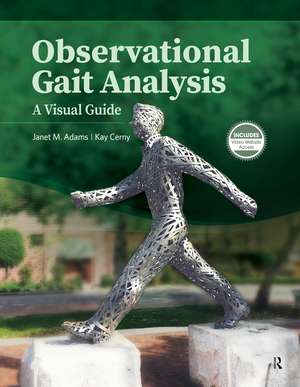
Observational Gait Analysis: A Visual Guide
Autor Janet Adams, Kay Cernyen Limba Engleză Paperback – 15 feb 2018
This visual guide by Drs. Jan Adams and Kay Cerny has unique features to further the understanding of examination and evaluation of the subject’s gait, such as:
- Normal and pathological gait are described using figures and graphs, along with gait videos and 3D graphs to show the kinematics and kinetics described
- Functional tools used as outcome measures to evaluate gait performance in the community environment including Dynamic Gait Test, Six Minute Walk Test, Ten Meter Walk Test, to name a few
Bonus!
Students will be able to watch antero-posterior and lateral videos of individuals with gait deviations, complete the OGA tool to document their gait examination, and evaluate their examination results. They will then validate their observational skills by comparing their results to the text’s case study OGA results and the skeletal model and motion and moment graphs completed by 3D instrumented analysis of the same individual. The student will then compare their evaluation of causes of deviations to that included in the case study.
Included with the text are online supplemental materials for faculty use in the classroom.
Observational Gait Analysis: A Visual Guide will be the go-to resource for clinical tools to analyze gait for physical therapy and prosthetic and orthotic students and clinicians, as well as other professionals interested in the clinical analysis of persons with gait disability.
Preț: 741.94 lei
Preț vechi: 780.98 lei
-5%
Puncte Express: 1113
Carte disponibilă
Livrare economică 02-16 noiembrie
Livrare express 16-22 octombrie pentru 47.88 lei
Livrare prin curier în România Termenul estimat este afișat lângă disponibilitate.
Transport gratuit pentru acest produs Plată online sau ramburs, în funcție de opțiunile comenzii.
Retur gratuit în 14 zile Comandă securizată și suport în română.
Specificații
ISBN-13: 9781630910402
ISBN-10: 1630910406
Pagini: 248
Dimensiuni: 216 x 279 x 13 mm
Greutate: 0.8 kg
Ediția:1
Editura: Taylor & Francis
Colecția Routledge
Locul publicării:Oxford, United Kingdom
ISBN-10: 1630910406
Pagini: 248
Dimensiuni: 216 x 279 x 13 mm
Greutate: 0.8 kg
Ediția:1
Editura: Taylor & Francis
Colecția Routledge
Locul publicării:Oxford, United Kingdom
V-ar putea interesa
-
 Manual of Neurological SignsJohn G. Morris-5%Preț: 1243.49 lei1308.94 lei
 -
 -28%Preț: 453.96 lei631.01 lei
 -
 Occupational Therapy Pocket GuideLyndsey Jarvis-31%Preț: 331.73 lei478.92 lei
 -
 Miller's Review of OrthopaedicsStephen R. Thompson-27%Preț: 893.13 lei1223.55 lei
 -
 Atlas of Orthoses and Assistive DevicesDouglas P. Murphy-28%Preț: 1141.83 lei1590.55 leiRecomandat
 -
 McGee's Evidence-Based Physical DiagnosisSteven McGee-27%Preț: 435.33 lei595.49 lei
 -
 Whittle's Gait AnalysisJim Richards-31%Preț: 320.69 lei461.45 lei
 -
 Fundamentals of Musculoskeletal Assessment TechniquesM. Lynn Palmer PhD, PT-21%Preț: 638.45 lei806.73 lei
 -
 100 Cases in Clinical MedicineEamon Shamil-5%Preț: 259.20 lei272.84 leiRecomandat
 -
 -5%Preț: 469.32 lei494.02 leiRecomandat
 -
 CURRENT Medical Diagnosis & Treatment 2026Maxine A. Papadakis-24%Preț: 478.55 lei633.64 lei
 -
 DeJong's The Neurologic ExaminationWilliam W. Campbell-27%Preț: 1020.70 lei1393.75 lei
 -
 -5%Preț: 383.27 lei403.44 leiRecomandat
 -
 Measuring WalkingRichard W Baker-5%Preț: 534.93 lei563.08 lei
 -
 Born to WalkJames Earls-5%Preț: 158.66 lei167.01 lei
 -
 -24%Preț: 454.42 lei600.02 lei
 -
 Operative Techniques in Foot and Ankle SurgeryMark E. Easley MD-20%Preț: 2035.74 lei2557.00 lei
 -
 -21%Preț: 593.58 lei750.40 lei
Public țintă
Professional Practice & Development, Undergraduate Advanced, and Undergraduate CoreCuprins
Dedications Acknowledgments About the AuthorsContributing AuthorIntroduction Section I Normal and Pathological Gait Chapter 1 Walking Speed: The Sixth Vital Sign Chapter 2 Temporal and Spatial Gait Characteristics Chapter 3 Normal Gait Kinematics Chapter 4 Normal Gait Kinetics Chapter 5 Functional Gait Measures Chapter 6 Pathological Gait Section II Case Studies Section III AppendicesAppendix A JAKC Observational Gait Analysis FormAppendix B Stride Characteristics for Adults Ages 20 to 59 YearsAppendix C Stride Characteristics for Adults Ages 60 to 80 YearsAppendix D Gait Analysis Report RubricFinancial Disclosures Index
Recenzii
“This is an invaluable source of information about gait, with excellent physical, graphical, and visual presentations that can assist in applying this information to patient problems. There is no other book like it. It is an invaluable resource for all new and experienced clinicians.”
- Christopher D. Blessing, MS, MPT, OCS, CSCS, Doody's Review Service
- Christopher D. Blessing, MS, MPT, OCS, CSCS, Doody's Review Service
Notă biografică
Janet M. Adams, PT, MS, DPT earned her bachelor’s degree in Physical Therapy from the University of Illinois in Chicago in 1976. She began her physical therapy career specializing in pediatrics at Spalding School for Handicapped Children (Chicago, Illinois) until 1978 when she moved to Phoenix, Arizona where she was the Director of the Physical Therapy Department at Gompers Rehabilitation Center. In 1980, following her move to Los Angeles, California she began her master of science degree at University of Southern California (USC) and began working with Dr. Jacquelin Perry at the Pathokinesiology Service at Rancho Los Amigos National Rehabilitation Center (Downey, California). Dr. Adams earned both her master of science and doctorate of Physical Therapy at USC. In 1992, Dr. Adams began her career in academia at California State University, Northridge (CSUN) where she has taught for over 25 years. Currently, Dr. Adams is a full-time tenured professor in the Department of Physical Therapy at CSUN and a Research Associate at California State University, Long Beach (CSULB) where she works on doctoral research projects with Dr. Cerny. Dr. Adams has taught classes in applied biomechanics, normal and pathological gait analysis, prosthetics and orthotics, applied anatomy, evidence based practice, and research design and methodology. She supervises doctoral research students at both CSUN and CSULB. In addition to numerous publications, Dr. Adams has authored 2 chapters with Dr. Perry in 2 editions of Verne Inman’s text Human Walking.
Kay Cerny, PT, PhD earned her bachelor’s degree from Miami University (Oxford, Ohio). She received her certificate in Physical Therapy from the D.T Watson School of Physiatrics (Leetsdale, Pennsylvania) in 1963. Dr. Cerny began her clinical practice at Rancho Los Amigos National Rehabilitation Center, and was one of the original physical therapists who worked with Dr. Jacquelin Perry on developing observational gait analysis (OGA) for clinicians and helped author the first edition of the Rancho OGA manual. She was one of the traveling Rancho therapists who introduced the then-new approach of clinical gait analysis to physical therapists across the country and Canada in the early 1970s.
At Rancho, Dr. Cerny planned, wrote, and executed teaching materials for physical therapy staff, interns, and aides. Her part-time teaching included kinesiology for orthotic-prosthetic students at Cerritos College (Cerritos, California). In 1969, she took a 1-year leave from Rancho to teach physical therapy students full time at the University of Texas, Medical Branch in Galveston. Returning to Rancho, she soon transferred to the Pathokinesiology Service to evaluate patients with Dr. Perry. Dr. Cerny earned her master of science in Physical Therapy from the University of Southern California (Los Angeles) studying walking and wheelchair energetics in people with paraplegia secondary to spinal cord injury.
In 1978, Dr. Cerny accepted a full-time position teaching physical therapy at California State University, Northridge. Four years later, after earning tenure, she accepted a tenure-track position at California State University, Long Beach (CSULB), where she earned tenure and advanced to full professor. At CSULB, she taught applied biomechanics, including normal and pathological gait, and supported student research projects that have resulted in subsequent peer-reviewed publications. In 2004, she accepted the Department Chair position, which she held from 2004 until 2014. Under her chairmanship, the Department of Physical Therapy advanced to the DPT program, began an out patient faculty practice, and was successfully reaccredited. She earned her PhD from the University of Southern California in 1987 where she studied the effect of simulated knee flexion contractures on gait. Dr. Cerny retired in 2015 to limit her teaching to supervising DPT student research and to assist in writing this text.
Kay Cerny, PT, PhD earned her bachelor’s degree from Miami University (Oxford, Ohio). She received her certificate in Physical Therapy from the D.T Watson School of Physiatrics (Leetsdale, Pennsylvania) in 1963. Dr. Cerny began her clinical practice at Rancho Los Amigos National Rehabilitation Center, and was one of the original physical therapists who worked with Dr. Jacquelin Perry on developing observational gait analysis (OGA) for clinicians and helped author the first edition of the Rancho OGA manual. She was one of the traveling Rancho therapists who introduced the then-new approach of clinical gait analysis to physical therapists across the country and Canada in the early 1970s.
At Rancho, Dr. Cerny planned, wrote, and executed teaching materials for physical therapy staff, interns, and aides. Her part-time teaching included kinesiology for orthotic-prosthetic students at Cerritos College (Cerritos, California). In 1969, she took a 1-year leave from Rancho to teach physical therapy students full time at the University of Texas, Medical Branch in Galveston. Returning to Rancho, she soon transferred to the Pathokinesiology Service to evaluate patients with Dr. Perry. Dr. Cerny earned her master of science in Physical Therapy from the University of Southern California (Los Angeles) studying walking and wheelchair energetics in people with paraplegia secondary to spinal cord injury.
In 1978, Dr. Cerny accepted a full-time position teaching physical therapy at California State University, Northridge. Four years later, after earning tenure, she accepted a tenure-track position at California State University, Long Beach (CSULB), where she earned tenure and advanced to full professor. At CSULB, she taught applied biomechanics, including normal and pathological gait, and supported student research projects that have resulted in subsequent peer-reviewed publications. In 2004, she accepted the Department Chair position, which she held from 2004 until 2014. Under her chairmanship, the Department of Physical Therapy advanced to the DPT program, began an out patient faculty practice, and was successfully reaccredited. She earned her PhD from the University of Southern California in 1987 where she studied the effect of simulated knee flexion contractures on gait. Dr. Cerny retired in 2015 to limit her teaching to supervising DPT student research and to assist in writing this text.
Descriere
Observational Gait Analysis: A Visual Guide is a pedagogical manual and video library that provides a thorough review of key characteristics of normal gait that are important for observational clinical gait analysis. This visual guide by.