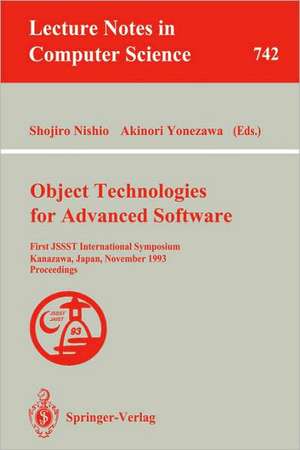
Object Technologies for Advanced Software
Editat de Shojiro Nishio, Akinori Yonezawaen Limba Engleză Paperback – 7 oct 1993
Preț: 335.48 lei
Preț vechi: 419.35 lei
-20%
Puncte Express: 503
Carte tipărită la comandă
Livrare economică 26 noiembrie-10 decembrie
Livrare prin curier în România Termenul estimat este afișat lângă disponibilitate.
Transport gratuit de la 400.00 lei Plată online sau ramburs, în funcție de opțiunile comenzii.
Retur gratuit în 14 zile Comandă securizată și suport în română.
Specificații
ISBN-13: 9783540573425
ISBN-10: 3540573429
Pagini: 560
Ilustrații: X, 550 p.
Dimensiuni: 155 x 235 x 30 mm
Greutate: 0.84 kg
Ediția:1993
Editura: Springer
Locul publicării:Berlin, Heidelberg, Germany
ISBN-10: 3540573429
Pagini: 560
Ilustrații: X, 550 p.
Dimensiuni: 155 x 235 x 30 mm
Greutate: 0.84 kg
Ediția:1993
Editura: Springer
Locul publicării:Berlin, Heidelberg, Germany
V-ar putea interesa
-
 -27%Preț: 676.09 lei926.15 lei
 -
 Software Modeling and DesignHassan Gomaa-20%Preț: 665.25 lei831.56 lei
 -
 KanbanDavid J. Anderson-20%Preț: 264.20 lei330.25 lei
 -
 The Human Side of AgileGil BrozaPreț: 271.68 lei
 -
 Software EngineeringRuneson-20%Preț: 471.15 lei588.94 lei
 -
 Professional GitBrent Laster-20%Preț: 256.78 lei320.97 lei
 -
 Python AlgorithmsMagnus Lie Hetland-20%Preț: 468.00 lei584.99 lei
 -
 The Definitive Guide to HTML5 WebSocketVanessa Wang-20%Preț: 372.28 lei465.36 lei
 -
 Head First AgileAndrew Stellman-20%Preț: 343.20 lei429.00 lei
 -
 Computer Aided Software EngineeringHausi A. Muller-20%Preț: 1218.28 lei1522.85 lei
 -
 Continuous Delivery with Visual Studio ALM 2015Mathias Olausson-20%Preț: 299.70 lei374.63 lei
 -
 Design It! : Pragmatic ProgrammersMicahel Keeling-20%Preț: 257.50 lei321.87 lei
 -
 Mastering ServiceNow - Second EditionMartin Wood-20%Preț: 368.74 lei460.93 lei
 -
 -20%Preț: 625.58 lei781.98 lei
 -
 -20%Preț: 624.19 lei780.23 lei
 -
 Metalevel Architectures and Separation of Crosscutting ConcernsAkinori Yonezawa-20%Preț: 322.16 lei402.70 lei
 -
 -20%Preț: 619.76 lei774.69 lei
 -
 Database Application Engineering with DAIDAMatthias Jarke-20%Preț: 633.52 lei791.91 lei
 -
 Theory and Practice of Parallel ProgrammingTakayasu Ito-20%Preț: 332.39 lei415.48 lei
 -
 Object-Based Models and Languages for Concurrent SystemsPaolo Ciancarini-20%Preț: 317.66 lei397.08 lei
 -
 Object-Based Parallel and Distributed ComputationJean-Pierre Briot-20%Preț: 325.83 lei407.29 lei
 -
 Advanced Multimedia Content ProcessingShojiro Nishio-20%Preț: 331.16 lei413.95 lei
 -
 Preț: 302.39 lei
 -
 Distributed SystemsAlbert Fleischmann-20%Preț: 328.16 lei410.20 lei
 -
 Objekte integrieren mit OLE2Hanns-Martin Meyer-20%Preț: 364.85 lei456.05 lei
 -
 Preț: 377.79 lei
Public țintă
ResearchCuprins
Uniting functional and object-oriented programming.- Traces (A cut at the “make isn't generic” problem).- Gluons: A support for software component cooperation.- TAO: An object orientation kernel.- Change management and consistency maintenance in software development environments using object oriented attribute grammars.- Design of an integrated and extensible C++ programming environment.- Metalevel decomposition in AL-1/D.- Definition of a reflective kernel for a prototype-based language.- Kernel structuring for object-oriented operating systems: The Apertos approach.- Object database systems: Functional architecture.- Maintaining behavioral consistency during schema evolution.- An object-centered approach for manipulating hierarchically complex objects.- Towards the unification of views and versions for object databases.- Abstract view objects for multiple OODB integration.- An object-oriented query model supporting views.- Refactoring and aggregation.- Transverse activities: Abstractions in object-oriented programming.- Dynamic extensibility in a statically-compiled object-oriented language.- Managing change in persistent object systems.- An object-oriented pattern matching language.- CLOG: A class-based logic language for object-oriented databases.- Name management and object technology for advanced software.- Constraints in object-oriented analysis.- Integration of the tool (AWB) supporting the O* method in the PCTE-based software engineering environment.- Minimizing dependency on class structures with adaptive programs.- First class messages as first class continuations.- A typing system for a calculus of objects.- A type mechanism based on restricted CCS for distributed active objects.- Adding implicit invocation to languages: Three approaches.- Requirementsand early experiences in the implementation of the SPADE repository using object-oriented technology.- Object-oriented formal specification development using VDM.