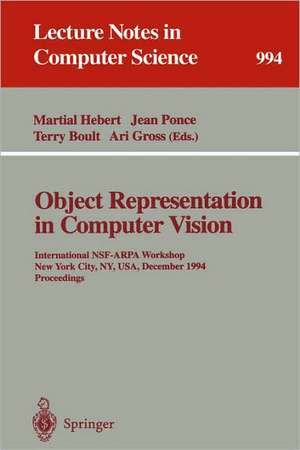
Object Representation in Computer Vision
Editat de Martial Hebert, Jean Ponce, Terry Boult, Ari Grossen Limba Engleză Paperback – 18 oct 1995
The volume presents the complete set of papers in revised full-length versions. In addition, the first paper is a report on the workshop in which the panel discussions as well as the conclusions and recommendations reached by the workshop participants are summarized.
Altogether the volume provides an excellent, in-depth view of the state of the art in this active area of research and applications.
Preț: 326.05 lei
Preț vechi: 407.56 lei
-20%
Puncte Express: 489
Carte tipărită la comandă
Livrare economică 26 noiembrie-10 decembrie
Livrare prin curier în România Termenul estimat este afișat lângă disponibilitate.
Transport gratuit de la 400.00 lei Plată online sau ramburs, în funcție de opțiunile comenzii.
Retur gratuit în 14 zile Comandă securizată și suport în română.
Specificații
ISBN-13: 9783540604778
ISBN-10: 3540604774
Pagini: 376
Ilustrații: X, 366 p.
Dimensiuni: 155 x 235 x 21 mm
Greutate: 0.57 kg
Ediția:1995
Editura: Springer
Locul publicării:Berlin, Heidelberg, Germany
ISBN-10: 3540604774
Pagini: 376
Ilustrații: X, 366 p.
Dimensiuni: 155 x 235 x 21 mm
Greutate: 0.57 kg
Ediția:1995
Editura: Springer
Locul publicării:Berlin, Heidelberg, Germany
V-ar putea interesa
-
 -27%Preț: 833.99 lei1147.93 lei
 -
 Computer Vision: A Modern ApproachDavid A. Forsyth-23%Preț: 1290.05 lei1675.40 lei
 -
 Video Text DetectionTong Lu-20%Preț: 349.10 lei436.36 lei
 -
 Visualization of Natural PhenomenaRobert S. Wolff-20%Preț: 637.51 lei796.88 lei
 -
 Digital Image Processing HandbookNiceto Salazar-20%Preț: 576.87 lei721.08 lei
 -
 Sparse Modeling for Image and Vision ProcessingJulien Mairal-20%Preț: 496.31 lei620.39 lei
 -
 -20%Preț: 311.36 lei389.19 lei
 -
 Visual Saliency ComputationJia Li-20%Preț: 332.47 lei415.58 lei
 -
 Artificial Intelligence and Signal ProcessingAli Movaghar-20%Preț: 326.81 lei408.50 lei
 -
 Deep Learning and Data Labeling for Medical ApplicationsGustavo Carneiro-20%Preț: 334.80 lei418.50 lei
 -
 -20%Preț: 312.17 lei390.21 lei
 -
 -20%Preț: 320.72 lei400.90 lei
 -
 -20%Preț: 337.30 lei421.62 lei
 -
 -20%Preț: 344.49 lei430.61 lei
 -
 Computational Color ImagingSimone Bianco-20%Preț: 322.16 lei402.70 lei
 -
 -20%Preț: 333.24 lei416.55 lei
 -
 Object Representation in Computer Vision IIJean Ponce-20%Preț: 328.29 lei410.37 lei
 -
 Toward Category-Level Object RecognitionJean Ponce-20%Preț: 640.88 lei801.10 lei
 -
 Intelligence Science and Big Data EngineeringChangyin Sun-20%Preț: 682.39 lei852.99 lei
 -
 -20%Preț: 271.77 lei339.72 lei
 -
 -20%Preț: 300.33 lei375.41 lei
 -
 -20%Preț: 259.68 lei324.61 lei
 -
 Pathological Brain DetectionShui-Hua Wang-20%Preț: 347.14 lei433.92 lei
 -
 Facial Kinship VerificationHaibin Yan-20%Preț: 335.21 lei419.01 lei
Public țintă
ResearchCuprins
Report on the 1995 workshop on 3-D object representations in computer vision.- Object recognition: The search for representation.- Appearance-based 3D object recognition.- Using quasi-invariants for automatic model building and object recognition: An overview.- Object representation for recognition-by-alignment.- Distinctive representations for the recognition of curved surfaces using outlines and markings.- The epipolar parametrization.- Using two-dimensional models to interact with the three-dimensional world.- Representations for recognizing complex curved 3D objects.- On representation and invariant recognition of complex objects based on patches and parts.- Algebraic geometry and object representation in computer vision.- Discrete surface signal processing: The polygon as the surface element.- Spline representations in 3-D vision.- Triangles as a primary representation.- Body-centered representation and perception.- The challenge of generic object recognition.- A physics-based framework for segmentation, shape and motion estimation.- Modal represenations.- Time representation of deformations: Combining vibration modes and Fourier analysis.- Physics in a fantasy world vs robust statistical estimation.- Towards a robust physics-based object recognition system.- Toward non-parametric digital shape representation and recovery.- Spherical representations: From EGI to SAI.- From physics-based representation to functional modeling of highly complex objects.