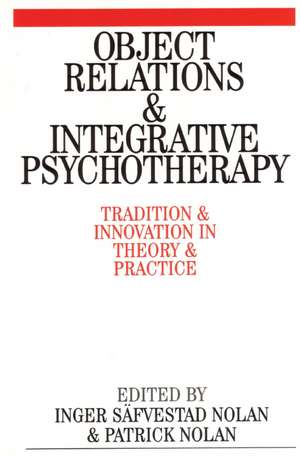
Object Relations and Integrative
Autor Nolanen Limba Engleză Paperback – 21 sep 2002
Preț: 497.21 lei
Preț vechi: 523.39 lei
-5%
Puncte Express: 746
Carte tipărită la comandă
Livrare economică 10-24 noiembrie
Livrare prin curier în România Termenul estimat este afișat lângă disponibilitate.
Transport gratuit pentru acest produs Plată online sau ramburs, în funcție de opțiunile comenzii.
Retur gratuit în 14 zile Comandă securizată și suport în română.
Specificații
ISBN-13: 9781861563385
ISBN-10: 1861563388
Pagini: 240
Dimensiuni: 152 x 229 x 13 mm
Greutate: 0.35 kg
Editura: JOHN WILEY & SONS INC
Locul publicării:Chichester, United Kingdom
ISBN-10: 1861563388
Pagini: 240
Dimensiuni: 152 x 229 x 13 mm
Greutate: 0.35 kg
Editura: JOHN WILEY & SONS INC
Locul publicării:Chichester, United Kingdom
V-ar putea interesa
-
 Narrative of a Child AnalysisMelanie Klein-23%Preț: 92.95 lei120.82 lei
 -
 Narrative TherapyGene CombsPreț: 317.87 lei
 -
 -5%Preț: 348.73 lei367.08 lei
 -
 Preț: 370.33 lei
 -
 The Art of the QuestionMarilee C Goldberg-9%Preț: 712.76 lei783.26 lei
 -
 The Influence of Race and Racial Identity in PsychotherapyRobert T. Carter-23%Preț: 620.21 lei805.47 lei
 -
 Personality-Guided TherapyMillon-27%Preț: 836.34 lei1145.68 lei
 -
 Paradox Passion in Psychotherapyvan Deurzen-5%Preț: 551.19 lei580.21 lei
 -
 The Magic YearsSelma H FraibergPreț: 113.48 lei
 -
 -24%Preț: 589.32 lei780.06 lei
 -
 Brief Therapy with Intimidating CasesRichard FischPreț: 467.54 lei
 -
 -5%Preț: 511.57 lei538.49 lei
 -
 Human TypesSusan ZannosPreț: 137.13 lei
 -
 Gestalt TherapyMargaret P KorbPreț: 157.64 lei
 -
 Latina Psychologists: Thriving in the Cultural BorderlandsLillian Comas-Diaz-15%Preț: 420.65 lei494.88 lei
 -
 -5%Preț: 1044.97 lei1099.97 lei
 -
 Attachment in Group PsychotherapyCheri L. Marmarosh-5%Preț: 1287.91 lei1355.70 lei
 -
 -5%Preț: 1050.86 lei1106.17 lei
 -
 -5%Preț: 420.60 lei442.73 lei
 -
 -5%Preț: 344.28 lei362.39 lei
 -
 -5%Preț: 1224.64 lei1289.10 lei
 -
 Techniques In Adlerian PsychologyJon Carlson-15%Preț: 445.82 lei524.50 lei
 -
 PsychotherapyMarie-Louise Von Franz-5%Preț: 202.65 lei213.32 lei
 -
 Printmaking as Therapy: Frameworks for FreedomLucy Mueller White-29%Preț: 204.18 lei288.51 lei
 -
 Therapeutic Presence: Bridging Expression and FormArthur RobbinsPreț: 264.81 lei
 -
 -28%Preț: 260.10 lei361.32 lei
Notă biografică
Patrick Nolan is a Psychotherapist and the Director of the Irish Institute for Integrated Psychotherapy. He is co-author of Object Relations and Integrative Psychotherapy: Tradition and Innovation in Theory and Practice and has written about integrative, psychoanalytic and body psychotherapy in numerous publications.
Cuprins
Acknowledgements. List of contributors.
Chapter 1 Tradition and innovation in theory and practice: an orientation, Inger Safvestad Nolan and Patrick Nolan.
Chapter 2 Object relations as a context for an integrative approach to psychotherapy, Patrick Nolan.
Chapter 3 Integrative and object relations focused approaches to psychotherapy: theoretical concerns and outcome research, George Stricker and Jane Gooen-Piels.
Chapter 4 An object relations based integrative psychotherapy: the use of conceptuala analysis in understanding change, Hilde Rapp.
Chapter 5 Integration of theory: methodolical issues, Mikael Leiman and William B. Stiles.
Chapter 6 Developmetnal theories in the process of change, Margareta Broden.
Chapter 7 Integrating object relations narratives in analytic work with children and adolescents, Paul Sepping.
Chapter 8 The weave of object relations and familty systems thinking: working therapeutically with families and couples in a community alcohol service, Arlene Vetere and Mavis Henley.
Chapter 9 Cognitive Analytic Therapy: a Vygotskian development of object relations theory, Anthony Ryle and Fierman Bennink-Bolt.
Chapter 10 Sexual abuse, post-traumatic stress and object relations: an integrative way of working, Deirdre Mannion.
Chapter 11 An integrative approach to body oriented psychotherapy, Lennart Ramberg and Bjorn Wrangsjo.
Chapter 12 Supervision from an object relations and integrative perspective: a learning from experience, Gertrud Mander.
Chapter 13 The strengths and limitations of a psychodynamic perspective in organizational consultancy, Eric Miller.
Chapter 14 Tribal processes in psychotherapy: the stand off between psychoanalytic and systemic schools, Sebastian Kraemer.
Index.
Chapter 1 Tradition and innovation in theory and practice: an orientation, Inger Safvestad Nolan and Patrick Nolan.
Chapter 2 Object relations as a context for an integrative approach to psychotherapy, Patrick Nolan.
Chapter 3 Integrative and object relations focused approaches to psychotherapy: theoretical concerns and outcome research, George Stricker and Jane Gooen-Piels.
Chapter 4 An object relations based integrative psychotherapy: the use of conceptuala analysis in understanding change, Hilde Rapp.
Chapter 5 Integration of theory: methodolical issues, Mikael Leiman and William B. Stiles.
Chapter 6 Developmetnal theories in the process of change, Margareta Broden.
Chapter 7 Integrating object relations narratives in analytic work with children and adolescents, Paul Sepping.
Chapter 8 The weave of object relations and familty systems thinking: working therapeutically with families and couples in a community alcohol service, Arlene Vetere and Mavis Henley.
Chapter 9 Cognitive Analytic Therapy: a Vygotskian development of object relations theory, Anthony Ryle and Fierman Bennink-Bolt.
Chapter 10 Sexual abuse, post-traumatic stress and object relations: an integrative way of working, Deirdre Mannion.
Chapter 11 An integrative approach to body oriented psychotherapy, Lennart Ramberg and Bjorn Wrangsjo.
Chapter 12 Supervision from an object relations and integrative perspective: a learning from experience, Gertrud Mander.
Chapter 13 The strengths and limitations of a psychodynamic perspective in organizational consultancy, Eric Miller.
Chapter 14 Tribal processes in psychotherapy: the stand off between psychoanalytic and systemic schools, Sebastian Kraemer.
Index.
Descriere
This book explores how an object relations--integrative perspective may combine in--depth psychodynamic principles and theories with the flexibility afforded by an integrative framework. Object relations theory is rooted in a psychoanalytic tradition which views individuals essentially social and holds that their need for others is primary.