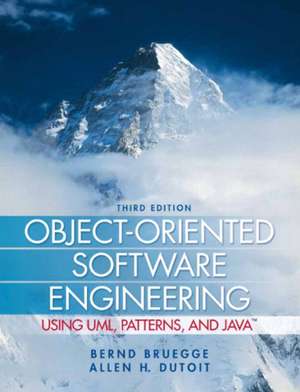
Object Oriented Software Engineering Using UML, Patterns, and Java
Autor Bernd Bruegge, Allen H. Dutoiten Limba Engleză Hardback – 30 iun 2009
Preț: 1325.33 lei
Preț vechi: 1721.21 lei
-23%
Puncte Express: 1988
Carte tipărită la comandă
Livrare economică 26 noiembrie-10 decembrie
Livrare prin curier în România Termenul estimat este afișat lângă disponibilitate.
Transport gratuit pentru acest produs Plată online sau ramburs, în funcție de opțiunile comenzii.
Retur gratuit în 14 zile Comandă securizată și suport în română.
Specificații
ISBN-13: 9780136061250
ISBN-10: 0136061257
Pagini: 778
Dimensiuni: 183 x 236 x 33 mm
Greutate: 1.34 kg
Ediția:3Nouă
Editura: Prentice Hall
Locul publicării:Upper Saddle River, United States
ISBN-10: 0136061257
Pagini: 778
Dimensiuni: 183 x 236 x 33 mm
Greutate: 1.34 kg
Ediția:3Nouă
Editura: Prentice Hall
Locul publicării:Upper Saddle River, United States
V-ar putea interesa
-
 Programming for Everyone in JavaPer B. Hansen-20%Preț: 321.03 lei401.30 lei
 -
 -20%Preț: 627.14 lei783.93 lei
 -
 Automated Market MakersMiguel Ottina-20%Preț: 261.03 lei326.28 lei
 -
 Software Development with GoNanik Tolaram-20%Preț: 189.29 lei236.61 lei
 -
 The Enterprise Linux AdministratorKenneth Hitchcock-20%Preț: 341.00 lei426.25 lei
 -
 Practical OpenTelemetryDaniel Gomez Blanco-20%Preț: 264.28 lei330.35 lei
 -
 -20%Preț: 253.54 lei316.92 lei
 -
 Foundations of Linux Debugging, Disassembling, and ReversingDmitry Vostokov-20%Preț: 260.04 lei325.05 lei
 -
 -20%Preț: 572.64 lei715.79 lei
 -
 -20%Preț: 401.75 lei502.20 lei
 -
 Trends in Functional ProgrammingWouter Swierstra-20%Preț: 301.38 lei376.72 lei
 -
 Static AnalysisGagandeep Singh-20%Preț: 487.76 lei609.69 lei
 -
 -20%Preț: 328.65 lei410.81 lei
 -
 Rationale Management in Software EngineeringAllen H. Dutoit-20%Preț: 683.75 lei854.69 lei
 -
 Design Patterns with JavaOlaf Musch-20%Preț: 392.73 lei490.91 lei
 -
 Personalized City ToursMatthias Michael Jöst-20%Preț: 436.00 lei545.00 lei
 -
 RFID in ManufacturingLenka Ivantysynova-20%Preț: 492.66 lei615.83 lei
 -
 From Files to SilesBernhard Schandl-20%Preț: 492.66 lei615.83 lei
 -
 Manuale di laboratorio di programmazione in C++Rajesh Kanna R.-20%Preț: 240.96 lei301.20 lei
 -
 Mastering ChatGPTCea West-20%Preț: 67.91 lei84.88 lei
Descriere
For courses in Software Engineering, Software Development, or Object-Oriented Design and Analysis at the Junior/Senior or Graduate level. This text can also be utilized in short technical courses or in short, intensive management courses.
Shows students how to use both the principles of software engineering and the practices of various object-oriented tools, processes, and products.
Using a step-by-step case study to illustrate the concepts and topics in each chapter, Bruegge and Dutoit emphasize learning object-oriented software engineer through practical experience: students can apply the techniques learned in class by implementing a real-world software project.
The third edition addresses new trends, in particular agile project management (Chapter 14 Project Management) and agile methodologies (Chapter 16 Methodologies).
Shows students how to use both the principles of software engineering and the practices of various object-oriented tools, processes, and products.
Using a step-by-step case study to illustrate the concepts and topics in each chapter, Bruegge and Dutoit emphasize learning object-oriented software engineer through practical experience: students can apply the techniques learned in class by implementing a real-world software project.
The third edition addresses new trends, in particular agile project management (Chapter 14 Project Management) and agile methodologies (Chapter 16 Methodologies).
Notă biografică
Dr. Bernd Bruegge has been studying and teaching Software Engineering at Carnegie Mellon University for 20 years, where he received his masters and doctorate degrees. He received his Diplom from the University of Hamburg. He is now a university professor of Computer Science with a chair for Applied Software Engineering at the Technische Universitat Munchen and an adjunct faculty member of Carnegie Mellon University. He has taught object-oriented software engineering project courses on the text materials and website described in this book since 1988. He won the Herbert A. Simon Excellence in Teaching Award at Carnegie Mellon University in 1995. Bruegge is also an international consultant and has used the techniques in this book to design and implement many real systems, including an engineering feedback system for DaimlerChrysler, an environmental modeling system for the U.S. Environmental Protection Agency, an accident management system for a municipal police department and a 3-D visualization system for the Munich Airport, to name just a few.
Dr. Allen Dutoit works in the aerospace industry in the area of avionics systems. He received his M.S. and Ph.D. from Carnegie Mellon University and his Diplôme d'Ingenieur from the Swiss Federal Institute of Technology in Lausanne. He has taught software engineering project courses with Professor Bruegge since 1993, both at Carnegie Mellon University and the Technische Universitat Munchen, where they used and refined the methods described in this book. Dutoit's research covered several areas of software engineering and object-oriented systems, including requirements engineering, rationale management, distributed development, and prototype-based systems. He was previously affiliated with the Software Engineering Institute and the Institute for Complex Engineered Systems at Carnegie Mellon University.
Dr. Allen Dutoit works in the aerospace industry in the area of avionics systems. He received his M.S. and Ph.D. from Carnegie Mellon University and his Diplôme d'Ingenieur from the Swiss Federal Institute of Technology in Lausanne. He has taught software engineering project courses with Professor Bruegge since 1993, both at Carnegie Mellon University and the Technische Universitat Munchen, where they used and refined the methods described in this book. Dutoit's research covered several areas of software engineering and object-oriented systems, including requirements engineering, rationale management, distributed development, and prototype-based systems. He was previously affiliated with the Software Engineering Institute and the Institute for Complex Engineered Systems at Carnegie Mellon University.
Caracteristici
For the Student
An object-oriented modeling approach covers techniques in a step-by-step manner, from requirements elicitation to testing, enabling students to grasp the complexity of object-oriented modeling.
State-of-the-art coverage of Object-Oriented software engineering shows students how to use the most practical aspects of software engineering including the basic elements of UML (Unified Modeling Language), Java, Distributed Development, Rationale Management, Configuration Management, and Build- and Release Management.
The "Further Readings" section enables students to search for specialized material on the topic presented.
For the Instructor
The Instructor Resource Center includes a new series of directory resources and lecture slides. These resources offer instructors excellent support and flexibility in planning their course, and they provide students with more hands-on practice at modeling skills.
Instructor Directory Resources: Contains 39 PowerPoint presentations organized in 16 chunks which correspond to the chapters of the book. The slides are in "PowerPoint Microsoft PowerPoint 97-2004" format. We have chosen this format for compatibility reasons. We have successfully tested the slides with the 2008 version of PowerPoint. The chunks contain the slides and additional materials the authors use in their lectures. Some of the chapters also contain material or large homework exercises. The lecture and materials can be used for a two semester course with up to 39 lectures and a final review session. The material can also be used for a single semester class, in which case the chunks provide the basis for 17 lectures and a final review session. Finally, the slides can be used for a senior software engineering project course usually includes lectures, project reviews, and tool tutorials. Some materials from past project courses such as problement statements, slides and movies from project kickoff, project review and client acceptance events are available for instructors on request from the authors.
PowerPoint Lecture Slides: Contain solely the PowerPoint Lecture Slides (also included in Instructor Directory Resources).
Solutions: The homework solutions are available for instructors on request.
The "Further Readings" section gives instructors flexibility when assigning out-of-class readings.
An object-oriented modeling approach covers techniques in a step-by-step manner, from requirements elicitation to testing, enabling students to grasp the complexity of object-oriented modeling.
State-of-the-art coverage of Object-Oriented software engineering shows students how to use the most practical aspects of software engineering including the basic elements of UML (Unified Modeling Language), Java, Distributed Development, Rationale Management, Configuration Management, and Build- and Release Management.
The "Further Readings" section enables students to search for specialized material on the topic presented.
For the Instructor
The Instructor Resource Center includes a new series of directory resources and lecture slides. These resources offer instructors excellent support and flexibility in planning their course, and they provide students with more hands-on practice at modeling skills.
Instructor Directory Resources: Contains 39 PowerPoint presentations organized in 16 chunks which correspond to the chapters of the book. The slides are in "PowerPoint Microsoft PowerPoint 97-2004" format. We have chosen this format for compatibility reasons. We have successfully tested the slides with the 2008 version of PowerPoint. The chunks contain the slides and additional materials the authors use in their lectures. Some of the chapters also contain material or large homework exercises. The lecture and materials can be used for a two semester course with up to 39 lectures and a final review session. The material can also be used for a single semester class, in which case the chunks provide the basis for 17 lectures and a final review session. Finally, the slides can be used for a senior software engineering project course usually includes lectures, project reviews, and tool tutorials. Some materials from past project courses such as problement statements, slides and movies from project kickoff, project review and client acceptance events are available for instructors on request from the authors.
PowerPoint Lecture Slides: Contain solely the PowerPoint Lecture Slides (also included in Instructor Directory Resources).
Solutions: The homework solutions are available for instructors on request.
The "Further Readings" section gives instructors flexibility when assigning out-of-class readings.
Caracteristici noi
NEW. A comprehensive upgrade to the latest version of UML and OCL. All diagrams were checked and revised to take advantage of the latest development in UML. Chapters on System Design and Object Design now include new material on component diagrams and modeling of services.
NEW. Material on agile methods. The chapter on "Configuration Management" describes continuous integration; the chapter on "Project Management" covers Scrum; the chapter on "Methodologies" contrasts agile methodologies--such as XP, Scrum, and Rugby--with traditional methodologies based on the Unified process.
NEW. Material on U2TP. The chapter on "Testing" includes new material on modeling the test system, test automation, and the UML2 Testing Profile.
UPDATED. Examples. The examples in the new edition are updated and improved based on feedback from many readers and students.
NEW. Material on agile methods. The chapter on "Configuration Management" describes continuous integration; the chapter on "Project Management" covers Scrum; the chapter on "Methodologies" contrasts agile methodologies--such as XP, Scrum, and Rugby--with traditional methodologies based on the Unified process.
NEW. Material on U2TP. The chapter on "Testing" includes new material on modeling the test system, test automation, and the UML2 Testing Profile.
UPDATED. Examples. The examples in the new edition are updated and improved based on feedback from many readers and students.