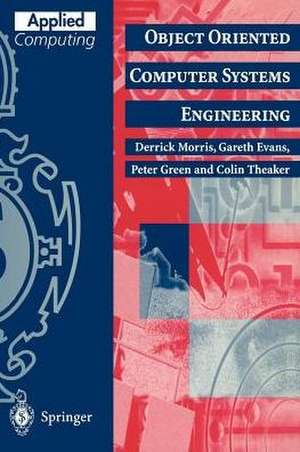
Object Oriented Computer Systems Engineering
Autor Derrick Morris, David Evans, Peter Green, Colin Theakeren Limba Engleză Paperback – 29 mar 1996
Preț: 324.85 lei
Preț vechi: 406.07 lei
-20%
Puncte Express: 487
Carte tipărită la comandă
Livrare economică 03-17 decembrie
Livrare prin curier în România Termenul estimat este afișat lângă disponibilitate.
Transport gratuit de la 400.00 lei Plată online sau ramburs, în funcție de opțiunile comenzii.
Retur gratuit în 14 zile Comandă securizată și suport în română.
Specificații
ISBN-13: 9783540760207
ISBN-10: 3540760202
Pagini: 348
Ilustrații: IX, 337 p. 25 illus.
Dimensiuni: 155 x 235 x 19 mm
Greutate: 0.53 kg
Ediția:Softcover reprint of the original 1st ed. 1996
Editura: Springer
Locul publicării:London, United Kingdom
ISBN-10: 3540760202
Pagini: 348
Ilustrații: IX, 337 p. 25 illus.
Dimensiuni: 155 x 235 x 19 mm
Greutate: 0.53 kg
Ediția:Softcover reprint of the original 1st ed. 1996
Editura: Springer
Locul publicării:London, United Kingdom
V-ar putea interesa
-
 Principles of Computer HardwareAlan Clements-29%Preț: 602.71 lei846.14 lei
 -
 -20%Preț: 370.60 lei463.25 lei
 -
 -20%Preț: 678.86 lei848.58 lei
 -
 -40%Preț: 458.81 lei768.90 lei
 -
 Foundations of Computer EngineeringMarilyn Wolf-41%Preț: 471.78 lei796.01 lei
 -
 Systems EngineeringDerek K Hitchins-23%Preț: 778.18 lei1010.62 lei
 -
 Notes on the Synthesis of FormChristopher AlexanderPreț: 235.55 lei
 -
 Systems Engineering Principles and Practice, Third EditionAlexander Kossiakoff-23%Preț: 872.28 lei1132.83 lei
 -
 -19%Preț: 526.02 lei649.41 lei
 -
 -23%Preț: 813.65 lei1056.69 lei
 -
 -20%Preț: 627.14 lei783.93 lei
 -
 MechatronicsW. Bolton-11%Preț: 667.57 lei750.07 lei
 -
 Modern Systems Analysis and Design, Global EditionJoseph Valacich-8%Preț: 606.91 lei659.70 lei
 -
 -18%Preț: 945.22 lei1152.70 lei
 -
 Foundations of Analog and Digital Electronic CircuitsAnant Agarwal-28%Preț: 546.19 lei754.30 lei
 -
 Practical Model-Based Systems EngineeringJose L Fernandez-18%Preț: 661.59 lei806.81 lei
 -
 Python in Easy StepsMike Mcgrath-20%Preț: 74.68 lei93.35 lei
 -
 Components Operationally: Reversibility and System EngineeringClaudio Antares Mezzina-20%Preț: 389.32 lei486.66 lei
 -
 -20%Preț: 391.26 lei489.08 lei
 -
 Preț: 320.68 lei
Public țintă
GraduateCuprins
1 Introduction to Computer Systems.- 1.1 Structure of the Book.- 1.2 Definition of Computer Systems.- 1.3 Computer Systems Technology.- 1.4 Introduction to Computer Systems Engineering.- 1.5 The Characteristics of Computer Systems.- 1.6 Recorded Experiences with Computer Systems.- 2 Engineering Computer Systems.- 2.1 Terminology of the Development Process.- 2.2 Software Engineering Paradigms.- 2.3 Approaches to Computer System Development.- 2.4 System Development Tools.- 2.5 Model-based Object Oriented Systems Engneering (MOOSE).- 3 Methods of Analysis and Design.- 3.1 Structured Methods.- 3.2 Object Oriented Software Development.- 3.3 Concluding Remarks.- 4 An Object Oriented Notation for Computer System Models.- 4.1 Features of the Notation.- 4.2 Extending the Mechanisms of Object Orientation.- 4.3 Definition of the MOOSE notation.- 4.4 Summary.- 5 Developing a Computer System Architecture.- 5.1 The MOOSE Architectural Models.- 5.2 Analysing and Classifying Requirements.- 5.3 Creating a MOOSE Behavioural Model.- 5.4 Constructing the Domain Model.- 5.5 Summary.- 6 Creating an Executable Model of a Computer System.- 6.1 Creating an Executable Model.- 6.2 Creating Class Definitions for Primitive Objects.- 6.3 Comparing an Executable Model to an Implementation.- 6.4 The Dynamics of an Executable Model.- 6.5 Simulating the Execution of a MOOSE Model.- 6.6 Using an Executable Model.- 6.7 Summary.- 7 Designing to Meet Constraints.- 7.1 Constraints on the Design Process.- 7.2 Evaluating Non-functional Requirements.- 7.3 Frameworks for Evaluating Non-functional Requirements.- 7.4 Non-functional Requirements and the MOOSE Paradigm.- 8 Partitioning and Detailing a Computer System Design.- 8.1 The Method of Transformational Codesign.- 8.2 Transformation of the Executable Model.-8.3 The Platform Model.- 8.4 Transforming the Platform Model.- 8.5 Synthesising an Implementation.- 9 Pragmatics of Using MOOSE.- 9.1 The Use of Standard System Software.- 9.2 The Physical Construction and Packaging of Hardware.- 9.3 Implementation of Hardware.- 9.4 Evaluating Performance by Simulation.- 10 Concluding Remarks.- Appendix 1 MOOSE Workbench User Guide.- A1.1 Installation and Operation.- A1.2 Operations for Manipulating Projects.- A1.3 Entering the Capture Facilities.- A1.4 The MOOSE Diagram Editor.- Al.5 Textual Specifications in an Executable Model.- Appendix 2 Ward-Mellor Model of the Mine Pump Control System.- A2.1 The Transformation Schema.- A2.2 Data Dictionary.- A2.3 PSPECs.- Appendix 3 Moose Models for Mine Pump Control System.- A3.1 The Behavioural Model.- A3.2 Extensions to Make the Model Executable.- A3.3 The Committed Model.- Appendix 4 VCR Control System.- A4.1 The Behavioural Model.- A4.2 Extensions to Make the Model Executable.- A4.3 The Committed Model.- Appendix 5 Dynamic Object Creation.- A5.1 The Behavioural Model.- A5.2 Extensions to Make the Model Executable.- References.