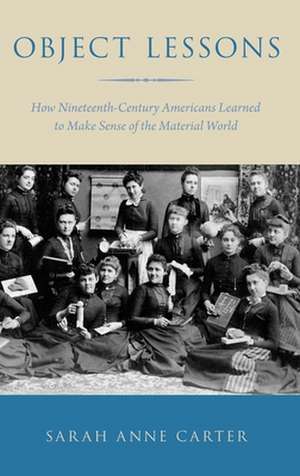
Object Lessons: How Nineteenth-Century Americans Learned to Make Sense of the Material World
Autor Sarah Anne Carteren Limba Engleză Hardback – 6 sep 2018
Preț: 338.94 lei
Preț vechi: 416.31 lei
-19%
Puncte Express: 508
Carte tipărită la comandă
Livrare economică 26 noiembrie-02 decembrie
Livrare prin curier în România Termenul estimat este afișat lângă disponibilitate.
Transport gratuit de la 400.00 lei Plată online sau ramburs, în funcție de opțiunile comenzii.
Retur gratuit în 14 zile Comandă securizată și suport în română.
Specificații
ISBN-13: 9780190225032
ISBN-10: 0190225033
Pagini: 218
Ilustrații: 26 color halftones; 30 b&w halftones
Dimensiuni: 236 x 155 x 23 mm
Greutate: 0.52 kg
Editura: Oxford University Press
Colecția OUP USA
Locul publicării:New York, United States
ISBN-10: 0190225033
Pagini: 218
Ilustrații: 26 color halftones; 30 b&w halftones
Dimensiuni: 236 x 155 x 23 mm
Greutate: 0.52 kg
Editura: Oxford University Press
Colecția OUP USA
Locul publicării:New York, United States
Recenzii
Blending intellectual and cultural history with material and visual analysis, Sarah Anne Carter's Object Lessons: How Nineteenth-Century Americans Learned to Make Sense of the Material World reveals new perspectives on how American educators used material knowledge to provide children with the language and thinking skills needed to navigate the social turmoil of industrialization, urbanization and race relations.
Moving between Europe and North America, [Carter's] work concretizes abstract notions about the international circulation of ideas and practices. As is proper for a book about object lessons, its heart lies in the material: the volume boasts more than fifty illustrations, almost half of them gorgeous colored plates... It is an homage to the book's argument and subject matter to say that this is a book worth acquiring even if just for the illustrations.
This is a short, persuasive book important for education historians and all historians interested in the turn to material culture of the early twentieth century.
Carter's work is most nuanced when it addresses the complications of race, class, and gender in the conceptualizations and goals of the "object lessons" and how their practitioners perceived their efforts. When she teases out the intentionality underlying the pedagogy of teaching with and through objects, Carter shows how people can learn from objects and how this pedagogy was used in past centuries to excite learning, generate deep thinking, and at the same time train the bodies and minds of those who learned through its sensory approach.
This short read is the result of ten years of work at noted institutions consulting with skilled professionals. It contains 143 pages of text with the remaining 56 pages made up of an index, some rich footnotes, and a large selected bibliography. The book is well researched and documented
Carter's book is accessible, evovative, and engaging...[it] contributes to the fields of American studies, American history, and the history and foundations of American education.
Moving between Europe and North America, [Carter's] work concretizes abstract notions about the international circulation of ideas and practices. As is proper for a book about object lessons, its heart lies in the material: the volume boasts more than fifty illustrations, almost half of them gorgeous colored plates... It is an homage to the book's argument and subject matter to say that this is a book worth acquiring even if just for the illustrations.
This is a short, persuasive book important for education historians and all historians interested in the turn to material culture of the early twentieth century.
Carter's work is most nuanced when it addresses the complications of race, class, and gender in the conceptualizations and goals of the "object lessons" and how their practitioners perceived their efforts. When she teases out the intentionality underlying the pedagogy of teaching with and through objects, Carter shows how people can learn from objects and how this pedagogy was used in past centuries to excite learning, generate deep thinking, and at the same time train the bodies and minds of those who learned through its sensory approach.
This short read is the result of ten years of work at noted institutions consulting with skilled professionals. It contains 143 pages of text with the remaining 56 pages made up of an index, some rich footnotes, and a large selected bibliography. The book is well researched and documented
Carter's book is accessible, evovative, and engaging...[it] contributes to the fields of American studies, American history, and the history and foundations of American education.
Notă biografică
Sarah Anne Carte is the curator and director of research at the Chipstone Foundation in Milwaukee. She has published, lectured, and taught courses on material culture, museum practice, and American cultural history. At Chipstone, Carter has collaboratively curated several exhibitions, including Mrs. M.-----'s Cabinet, and directs Chipstone's active museum Think Tank program.