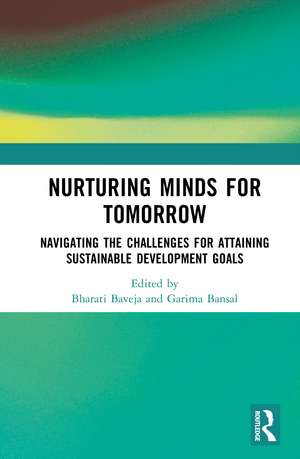
Nurturing Minds for Tomorrow: Navigating the Challenges for Attaining Sustainable Development Goals
Editat de Bharati Baveja, Garima Bansalen Limba Engleză Hardback – 28 aug 2026
This volume empowers readers to be equipped for a collective future that might be volatile, uncertain, complex and ambiguous, owing to the numerous challenges posed by technological advancements, natural calamities and warfare. These external influences often seep into classrooms through the lived experiences of teachers, students, leaders and the cultural norms of educational institutions. The book uses concrete examples of thinking and practice across the spectrum of education and training sectors, both formal and informal, in handling emerging challenges.
Written in an engaging conversational style, this book makes complex topics accessible to prospective teachers as well as seasoned school leaders. It will be useful to academics, researchers, postgraduates and students of education, anthropology, psychology and training. It will also be of interest to policy developers and government agencies who are engaged with the drafting of policies on SDGs.
Preț: 1161.59 lei
Preț vechi: 1416.57 lei
-18% Nou
Puncte Express: 1742
Carte tipărită la comandă
Livrare economică 08-22 decembrie
Livrare prin curier în România Termenul estimat este afișat lângă disponibilitate.
Transport gratuit pentru acest produs Plată online sau ramburs, în funcție de opțiunile comenzii.
Retur gratuit în 14 zile Comandă securizată și suport în română.
Specificații
ISBN-13: 9781041137177
ISBN-10: 1041137176
Pagini: 322
Ilustrații: 54
Dimensiuni: 156 x 234 mm
Greutate: 0.76 kg
Ediția:1
Editura: Taylor & Francis
Colecția Routledge
Locul publicării:Oxford, United Kingdom
ISBN-10: 1041137176
Pagini: 322
Ilustrații: 54
Dimensiuni: 156 x 234 mm
Greutate: 0.76 kg
Ediția:1
Editura: Taylor & Francis
Colecția Routledge
Locul publicării:Oxford, United Kingdom
Public țintă
PostgraduateRecenzii
“Nurturing Minds for Tomorrow, edited by Professor Bharati Baveja and Dr. Garima Bansal, addresses the challenges inherent in organising education to meet the demands of today’s complex, uncertain and challenging environment. Focusing on transforming pedagogical culture in vogue, the contributions included in this volume promote the notion of ‘learning community’. Building on the insights from past research and theorisation, the volume ventures to a careful analysis of ground realities of marginalization and epistemic justice in the Indian and other contexts. The volume convincingly advances the case for a pedagogy based on social constructivism and critically explores the potential of the Indian Knowledge System as an alternative paradigm which can augment adaptive competence. Another attractive feature of the volume is that it showcases a variety of pedagogical interventions planned and implemented in various parts of the globe. Taken together, the chapters strongly suggest that education must evolve to meet the global challenges, especially those related to sustainable developmental goals. The volume is a must-read for scholars as well as policy makers concerned with education, human development and social change. It’s a welcome addition to the emerging tradition of culturally informed analysis of social and educational issues.”
Girishwar Misra
Former Vice Chancellor, Mahatma Gandhi Antarrashtriya Hindi Vishwavidyalaya Wardha
Girishwar Misra
Former Vice Chancellor, Mahatma Gandhi Antarrashtriya Hindi Vishwavidyalaya Wardha
Cuprins
List of Figures x
List of Tables xii
About the Editors xiii
List of Contributors xiv
Foreword xix
Preface xx
Acknowledgements xxi
List of Abbreviations xxii
Introduction 1
BHARATI BAVEJA
PART A
Biological Imperatives and the Socio-Cultural Context of Learning 17
1 A Kind Beginning: Unfolding Human Nature Through the Lens of Childhood Prosociality 19
REKHA BHASKAR
2 Everyday Cultural Experiences of Munda Tribe Children and Their Participation in Formal Education 35
TANU SHIKHA ARYA
3 A Cross-Cultural Comparison Between South Africa and India: Perspectives on Inquiry-Based School Science Learning 50
UMESH RAMNARAIN AND GARIMA BANSAL
4 Learning Ecology of Urban Middle-Class Children 65
RAVNEET KAUR
PART B
Receptivity to Alternative Epistemologies 77
5 Reclaiming Wholeness in Education – Epistemic, Ethical,
and Embodied Knowing: An Indian Knowledge System–
Based Alternative to Western Educational Frameworks 79
ANAND KRISHNASWAMY
6 Indian Knowledge Systems in the Science Classroom:
Teachers’ Understanding and the Way Forward 96
MAMTA SINGHAL
7 Finding Freedom From FOSS: Insights From Urban
Elementary Teachers on an Ambitious Science Teaching
Professional Learning Community Experience 115
KATHERINE RICHARDSON BRUNA, STEPHANIE SCHNEIDER, AND
LYRIC BARTHOLOMAY
8 From Conceptual to Performative Blending: An Enactive
Cognition Framework to Systematically Bridge the Gap
Between Curricula and Scientific Practice 131
K. K. MASHOOD, JOSEPH SALVE, PRANSHI UPADHYAY, PRIYADHARSHNI ELANGAIVENDAN, AND SANJAY CHANDRASEKHARAN
PART C
Pedagogy as a Bridge From Curriculum to Lived Reality 155
9 Making Learning Meaningful: A Socio-Cultural Approach to Teaching Social Science 157
RISHABH KUMAR MISHRA
10 Beyond Decontextualized Learning: A Psychological Tools Theory Lens to Middle-School Science Education 170
JYOTI RAINA
11 Inclusive Pedagogies for a Sustainable Tomorrow: Teachers’ Perspectives and Practices of Scaffolding 182
ASHU KAPOOR
12 Contextualizing Pedagogy: Leveraging Storytelling for Understanding Basic Astronomy 198
SHRUTI CHOPRA AND ABHISHREYA SASAN
PART D
Equity and Technology 217
13 Reimagining Learner-Centred Education for Sustainability in India: A Perspective Grounded in Epistemic (In)Justice 219
MANASA N. MAHESH
14 Culturally Responsive Assessment for Foundational Learning in India: From Principles to Practice and SDG
4.1.1 Reporting 236
POOJA NAGPAL
15 Empowering Marginalized Voices: AI Literacy as a Tool for Emancipation in K–12 Borderland Spaces 255
LIU WENPANG, GOH YING SOON, SUYAN ZHANG, YIMING CHEN,
XIAOSHENG ZHOU, AND GAO MANMAN
16 Bridging the Digital Divide: Socio-Cultural Perspectives on STEM Education in India’s Borderland Schools 273
REKHA KOUL AND RACHEL SHEFFIELD
Index 290
List of Tables xii
About the Editors xiii
List of Contributors xiv
Foreword xix
Preface xx
Acknowledgements xxi
List of Abbreviations xxii
Introduction 1
BHARATI BAVEJA
PART A
Biological Imperatives and the Socio-Cultural Context of Learning 17
1 A Kind Beginning: Unfolding Human Nature Through the Lens of Childhood Prosociality 19
REKHA BHASKAR
2 Everyday Cultural Experiences of Munda Tribe Children and Their Participation in Formal Education 35
TANU SHIKHA ARYA
3 A Cross-Cultural Comparison Between South Africa and India: Perspectives on Inquiry-Based School Science Learning 50
UMESH RAMNARAIN AND GARIMA BANSAL
4 Learning Ecology of Urban Middle-Class Children 65
RAVNEET KAUR
PART B
Receptivity to Alternative Epistemologies 77
5 Reclaiming Wholeness in Education – Epistemic, Ethical,
and Embodied Knowing: An Indian Knowledge System–
Based Alternative to Western Educational Frameworks 79
ANAND KRISHNASWAMY
6 Indian Knowledge Systems in the Science Classroom:
Teachers’ Understanding and the Way Forward 96
MAMTA SINGHAL
7 Finding Freedom From FOSS: Insights From Urban
Elementary Teachers on an Ambitious Science Teaching
Professional Learning Community Experience 115
KATHERINE RICHARDSON BRUNA, STEPHANIE SCHNEIDER, AND
LYRIC BARTHOLOMAY
8 From Conceptual to Performative Blending: An Enactive
Cognition Framework to Systematically Bridge the Gap
Between Curricula and Scientific Practice 131
K. K. MASHOOD, JOSEPH SALVE, PRANSHI UPADHYAY, PRIYADHARSHNI ELANGAIVENDAN, AND SANJAY CHANDRASEKHARAN
PART C
Pedagogy as a Bridge From Curriculum to Lived Reality 155
9 Making Learning Meaningful: A Socio-Cultural Approach to Teaching Social Science 157
RISHABH KUMAR MISHRA
10 Beyond Decontextualized Learning: A Psychological Tools Theory Lens to Middle-School Science Education 170
JYOTI RAINA
11 Inclusive Pedagogies for a Sustainable Tomorrow: Teachers’ Perspectives and Practices of Scaffolding 182
ASHU KAPOOR
12 Contextualizing Pedagogy: Leveraging Storytelling for Understanding Basic Astronomy 198
SHRUTI CHOPRA AND ABHISHREYA SASAN
PART D
Equity and Technology 217
13 Reimagining Learner-Centred Education for Sustainability in India: A Perspective Grounded in Epistemic (In)Justice 219
MANASA N. MAHESH
14 Culturally Responsive Assessment for Foundational Learning in India: From Principles to Practice and SDG
4.1.1 Reporting 236
POOJA NAGPAL
15 Empowering Marginalized Voices: AI Literacy as a Tool for Emancipation in K–12 Borderland Spaces 255
LIU WENPANG, GOH YING SOON, SUYAN ZHANG, YIMING CHEN,
XIAOSHENG ZHOU, AND GAO MANMAN
16 Bridging the Digital Divide: Socio-Cultural Perspectives on STEM Education in India’s Borderland Schools 273
REKHA KOUL AND RACHEL SHEFFIELD
Index 290
Notă biografică
Bharati Baveja is a distinguished scholar in the fields of cognitive psychology and pedagogy, with a career spanning nearly four decades of research and institutional leadership. She formerly served as Dean and Head of the Faculty of Education and Director of the Women’s Studies and Development Centre at the University of Delhi. Initially trained in the life sciences (zoology), she brings a unique interdisciplinary lens to education. Her work synthesises cognitive
psychology with socio-cultural and biological perspectives, offering a profound understanding of how biological foundations and cultural contexts intersect in the learning and development processes. An awardee of the British Technical Cooperation Scholarship (1983–1984), her academic outlook is shaped by both Eastern pedagogical traditions and global psychological frameworks.
Garima Bansal is an inspiring educationist, researcher and visionary leader in science education, curriculum design and teacher professional development. With a doctoral grounding from the University of Delhi, she has nurtured educators across universities, schools and national institutions. Formerly Head of Professional Learning at the Australian Council for Educational Research (India), she led transformative teacher learning initiatives and research collaborations. A recipient of prestigious international scholarships and fellowships across the United States, United Kingdom, Ireland and South Africa, she is a published author and global scholar who blends inquirybased pedagogy with compassionate leadership – igniting classrooms with evidence-informed practice and hope.
psychology with socio-cultural and biological perspectives, offering a profound understanding of how biological foundations and cultural contexts intersect in the learning and development processes. An awardee of the British Technical Cooperation Scholarship (1983–1984), her academic outlook is shaped by both Eastern pedagogical traditions and global psychological frameworks.
Garima Bansal is an inspiring educationist, researcher and visionary leader in science education, curriculum design and teacher professional development. With a doctoral grounding from the University of Delhi, she has nurtured educators across universities, schools and national institutions. Formerly Head of Professional Learning at the Australian Council for Educational Research (India), she led transformative teacher learning initiatives and research collaborations. A recipient of prestigious international scholarships and fellowships across the United States, United Kingdom, Ireland and South Africa, she is a published author and global scholar who blends inquirybased pedagogy with compassionate leadership – igniting classrooms with evidence-informed practice and hope.
Descriere
This book throws light on the cultural situatedness of education, the understanding of which enables the attainment of sustainable development goals (SDG) for education. It is aimed at sharpening the core decision-making skills of teachers, leaders, curriculum designers, policy makers and teacher educators.