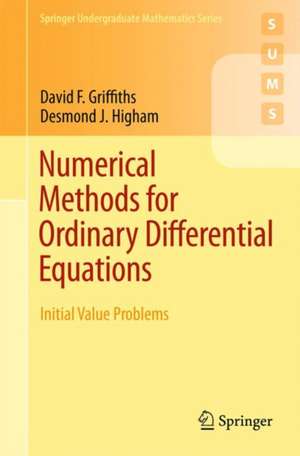
Numerical Methods for Ordinary Differential Equations
Autor David F Griffiths, Desmond J Highamen Limba Engleză Paperback – 25 noi 2010
Manualul Numerical Methods for Ordinary Differential Equations reprezintă o introducere de sine stătătoare în analiza numerică, fiind calibrat specific pentru nevoile studenților de la facultățile de matematică și științe aplicate. Remarcăm organizarea pedagogică eficientă: capitolele sunt fragmentate sub forma unor prelegeri ușor de parcurs, fiecare fiind susținută de exemple teoretice și computaționale care ancorează conceptele abstracte în realitatea calculului științific. Structura urmărește o progresie logică, pornind de la metoda lui Euler și seriile Taylor, trecând prin metodele Runge-Kutta și stabilitatea sistemelor, pentru a culmina cu subiecte avansate precum integrarea geometrică și ecuațiile diferențiale stocastice. Această ediție din 2010 se distinge prin includerea celor peste 200 de exerciții marcate cu asterisc în funcție de dificultate, oferind un instrument de lucru excelent pentru studiul individual. Considerăm acest volum o alternativă solidă la A First Course in the Numerical Analysis of Differential Equations de Arieh Iserles pentru cursurile de analiză numerică. În timp ce lucrarea lui Iserles acoperă și ecuațiile cu derivate parțiale, volumul de față, semnat de David F Griffiths și Desmond J Higham, oferă avantajul unei specializări mai profunde pe ecuațiile diferențiale ordinare, integrând perspective moderne precum selecția adaptivă a pasului de calcul și dinamica pe termen lung, aspecte esențiale în modelarea computațională contemporană. Recomandăm acest titlu pentru rigoarea cu care tratează convergența și stabilitatea fără a sacrifica latura practică, oferind totodată apendice utile pentru recapitularea rezultatelor fundamentale necesare parcurgerii textului.
Preț: 263.31 lei
Carte indisponibilă temporar
Specificații
ISBN-10: 0857291475
Pagini: 271
Ilustrații: XIV, 271 p. 69 illus.
Dimensiuni: 156 x 236 x 20 mm
Greutate: 0.46 kg
Ediția:2010 edition
Editura: SPRINGER LONDON
Locul publicării:London, United Kingdom
V-ar putea interesa
-
 Number Words and Number SymbolsKarl MenningerPreț: 181.76 lei
 -
 Vikings of the Irish SeaDavid GriffithsPreț: 151.10 lei
 -
 Adaptive Moving Mesh MethodsWeizhang HuangPreț: 405.90 lei
 -
 Numerical Methods for Fluid DynamicsDale R. Durran-15%Preț: 599.52 lei705.32 lei
 -
 Computational StatisticsJames E. Gentle-15%Preț: 611.13 lei718.98 lei
 -
 Introduction to Elementary ParticlesDavid Griffiths-11%Preț: 490.46 lei551.08 lei
 -
 Preț: 175.91 lei
 -
 -18%Preț: 1401.61 lei1709.28 lei
 -
 Solving Ordinary Differential Equations IErnst Hairer-19%Preț: 470.63 lei581.02 lei
 -
 The Training of Noh Actors and The Dove^nDavid Griffiths-18%Preț: 1108.88 lei1352.29 lei
 -
 HILBERT-HUANG TRANSFORM & ITS APP...(V5)Huang Norden E-18%Preț: 1228.65 lei1498.36 lei
 -
 NUMBER THEORYKanemitsu Shigeru-18%Preț: 843.43 lei1028.58 lei
Public țintă
Upper undergraduateDe ce să citești această carte
Recomandăm această carte studenților care doresc o bază teoretică și practică solidă în rezolvarea numerică a ecuațiilor diferențiale. Cititorul câștigă acces la metode moderne, precum integrarea geometrică și ecuațiile stocastice, explicate într-un stil accesibil. Este un instrument didactic complet datorită celor 200 de exerciții gradate, fiind ideal pentru pregătirea examenelor și pentru inițierea în cercetarea din domeniul calculului științific.
Descriere scurtă
It covers the topics traditionally treated in a first course, but also highlights new and emerging themes. Chapters are broken down into `lecture' sized pieces, motivated and illustrated by numerous theoretical and computational examples.
Over 200 exercises are provided and these are starred according to their degree of difficulty. Solutions to all exercises are available to authorized instructors.
The book covers key foundation topics:
o Taylor series methods
o Runge--Kutta methods
o Linear multistep methods
o Convergence
o Stability
and a range of modern themes:
o Adaptive stepsize selection
o Long term dynamics
o Modified equations
o Geometric integration
o Stochastic differential equations
The prerequisite of a basic university-level calculus class is assumed, although appropriate background results are also summarized in appendices. A dedicated website for the book containing extra information can be found via www.springer.com
Cuprins
Recenzii
“This book by Griffiths (Univ. of Dundee, UK) and Higham (Univ. of Strathclyde, UK) introduces the fields of numerical analysis and scientific computation. … Overall, there are many examples and exercises for students to read and try. … The work is very readable for an introductory course. An undergraduate who has completed at least the full calculus sequence should find the material interesting and accessible. Summing Up: Recommended. Lower-division undergraduates.” (S. L. Sullivan, Choice, Vol. 48 (10), June, 2011)
“There is a place for an elementary text that concentrates on the mathematical aspects while still referring to the applications of initial-value ODEs, and have set out to produce such a book. … Each chapter ends with a set of graded exercises … . In addition, there are worked examples throughout the book that illustrate the important ideas being covered. … a preparatory text for students taking a graduate course in numerical analysis. … this book is very well suited to its intended purpose.” (Philip W. Sharp, Mathematical Reviews, Issue 2012 g)
“This book provides material for a first typical course introducing numerical methods for initial-value ordinary differential equations but also highlights some new and emerging themes. … The authors include a wealth of theoretical and numerical examples that motivate and illustrate the fundamental ideas … . Although the book is aimed to be used by undergraduate students I felt that it might well be of interest to academic teachers in the field. … I highly recommend the book … .” (Rolf Dieter Grigorieff, Zentralblatt MATH, Vol. 1209, 2011)
“This textbook introduces undergraduates in mathematics, engineering and the physical sciences to the use of numerical methods for solving ordinary differential equations. … The primary practical goal of the book is to show students what’s going on inside scientific computing software, and to give them a sense of the strengths and limitations of numerical methods. … This is an attractive, very readable introduction to the subject for students … .” (William J. Satzer, The Mathematical Association of America, May, 2011)