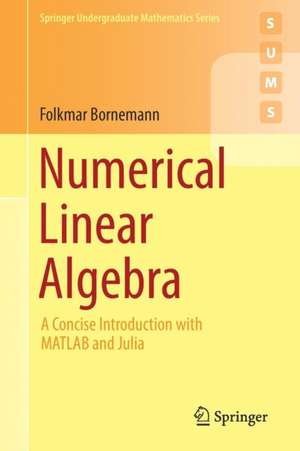
Numerical Linear Algebra: Springer Undergraduate Mathematics Series
Autor Folkmar Bornemann Traducere de Walter Simsonen Limba Engleză Paperback – 28 feb 2018
Din seria Springer Undergraduate Mathematics Series
-
 Preț: 366.50 lei
 -
 Preț: 400.74 lei
 -
 Preț: 413.31 lei
 -
 Preț: 414.81 lei
 -
 Preț: 422.57 lei
 -
 Preț: 390.50 lei
 -
 Preț: 383.13 lei
 - 20%
 Preț: 374.59 lei
 -
 Preț: 373.88 lei
 -
 Preț: 339.27 lei
 -
 Preț: 465.31 lei
 -
 Preț: 404.72 lei
 -
 Preț: 368.16 lei
 -
 Preț: 282.72 lei
 -
 Preț: 306.67 lei
 -
 Preț: 261.80 lei
 -
 Preț: 269.23 lei
 -
 Preț: 267.01 lei
 -
 Preț: 267.95 lei
 -
 Preț: 362.56 lei
 -
 Preț: 270.56 lei
 -
 Preț: 276.73 lei
 -
 Preț: 278.40 lei
 -
 Preț: 273.62 lei
 -
 Preț: 254.58 lei
 -
 Preț: 267.93 lei
 -
 Preț: 260.53 lei
 -
 Preț: 318.36 lei
 -
 Preț: 353.46 lei
 -
 Preț: 271.48 lei
 - 15%
 Preț: 506.44 lei
 -
 Preț: 282.17 lei
 -
 Preț: 265.85 lei
 -
 Preț: 275.65 lei
 -
 Preț: 280.67 lei
 -
 Preț: 272.15 lei
 -
 Preț: 274.44 lei
 -
 Preț: 323.68 lei
 -
 Preț: 281.19 lei
 -
 Preț: 281.87 lei
 -
 Preț: 272.46 lei
 -
 Preț: 265.55 lei
 -
 Preț: 271.25 lei
 -
 Preț: 276.32 lei
 -
 Preț: 257.69 lei
 -
 Preț: 254.70 lei
 -
 Preț: 270.73 lei
 -
 Preț: 270.64 lei
 -
 Preț: 360.36 lei
 -
 Preț: 277.36 lei
Preț: 461.42 lei
Puncte Express: 692
Carte tipărită la comandă
Livrare economică 05-19 decembrie
Livrare express 31 octombrie-06 noiembrie pentru 58.14 lei
Livrare prin curier în România Termenul estimat este afișat lângă disponibilitate.
Transport gratuit pentru acest produs Plată online sau ramburs, în funcție de opțiunile comenzii.
Retur gratuit în 14 zile Comandă securizată și suport în română.
Specificații
ISBN-13: 9783319742212
ISBN-10: 3319742213
Pagini: 164
Ilustrații: X, 153 p. 1 illus. in color.
Dimensiuni: 155 x 235 x 10 mm
Greutate: 0.26 kg
Ediția:1st ed. 2018
Editura: Springer
Colecția Springer Undergraduate Mathematics Series
Seria Springer Undergraduate Mathematics Series
Locul publicării:Cham, Switzerland
ISBN-10: 3319742213
Pagini: 164
Ilustrații: X, 153 p. 1 illus. in color.
Dimensiuni: 155 x 235 x 10 mm
Greutate: 0.26 kg
Ediția:1st ed. 2018
Editura: Springer
Colecția Springer Undergraduate Mathematics Series
Seria Springer Undergraduate Mathematics Series
Locul publicării:Cham, Switzerland
Cuprins
Preface.- I Computing with Matrices.- II Matrix Factorization.- III Error Analysis.- IV Least Squares.- V Eigenvalue Problems.- Appendix.- Notation.- Index.
Notă biografică
Folkmar Bornemann is Professor for Numerical Analysis and Scientific Computing at the Technical University of Munich.
Textul de pe ultima copertă
This book offers an introduction to the algorithmic-numerical thinking using basic problems of linear algebra. By focusing on linear algebra, it ensures a stronger thematic coherence than is otherwise found in introductory lectures on numerics. The book highlights the usefulness of matrix partitioning compared to a component view, leading not only to a clearer notation and shorter algorithms, but also to significant runtime gains in modern computer architectures. The algorithms and accompanying numerical examples are given in the programming environment MATLAB, and additionally – in an appendix – in the future-oriented, freely accessible programming language Julia. This book is suitable for a two-hour lecture on numerical linear algebra from the second semester of a bachelor's degree in mathematics.
Caracteristici
Interactive, compact textbook with links to interesting contributions Introduces algorithmic-numerical thinking using the linear algebra to students of mathematics from the second semester onwards Offers a focused introduction to error analysis and perturbation theory Includes complete programs and numeric examples in MATLAB and Julia