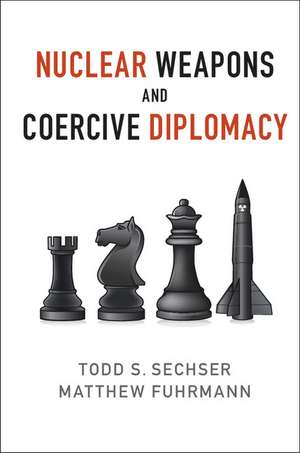
Nuclear Weapons and Coercive Diplomacy
Autor Todd S. Sechseren Limba Engleză Paperback – 2 feb 2017
În analiza relațiilor internaționale contemporane, aplicabilitatea practică a arsenalului nuclear este adesea redusă la conceptul de descurajare. Volumul Nuclear Weapons and Coercive Diplomacy, semnat de Todd S. Sechser și publicat de Cambridge University Press, intervine critic în această paradigmă, explorând dacă amenințarea atomică poate fi utilizată eficient pentru a forța un adversar să cedeze teritorii sau să își schimbe conduita politică. Observăm că autorii demontează mitul „șantajului nuclear” succesiv, demonstrând prin date riguroase că posesia acestor arme oferă beneficii aproape exclusiv defensive. Structura lucrării facilitează o parcurgere progresivă: prima parte stabilește cadrul teoretic al scepticismului nuclear, urmată de secțiuni dedicate tendințelor în negocierea de criză și disputelor teritoriale. Partea a treia este deosebit de valoroasă prin studiile de caz care analizează eșecurile strategiei de tip „brinkmanship” și reevaluează victoriile nucleare atribuite eronat în istoriografie. Această abordare metodologică, ce îmbină analiza cantitativă cu cea istorică, oferă o rigoare superioară lucrărilor pur teoretice. Considerăm această carte o alternativă necesară la Nuclear Reactions de Mark S. Bell pentru cursurile de securitate internațională și diplomație. În timp ce Bell sugerează că armele nucleare permit statelor să își diversifice strategiile de politică externă, Sechser și colaboratorii săi aduc argumente solide care limitează utilitatea acestora la palierul defensiv. De asemenea, lucrarea completează temele abordate de autor în Emerging Technologies and International Stability, unde Todd S. Sechser analiza modul în care noile tehnologii reconfigurează competiția între marii actori globali, păstrând aceeași preocupare pentru stabilitatea sistemică.
Preț: 248.98 lei
Carte tipărită la comandă
Livrare economică 07-21 decembrie
Specificații
ISBN-10: 1107514517
Pagini: 348
Ilustrații: 7 b/w illus. 20 tables
Dimensiuni: 152 x 229 x 19 mm
Greutate: 0.51 kg
Editura: Cambridge University Press
Locul publicării:New York, United States
V-ar putea interesa
-
 The Palgrave Macmillan Dictionary of DiplomacyG. Berridge-18%Preț: 964.99 lei1176.82 lei
 -
 Real-Time DiplomacyP. SeibPreț: 370.65 lei
 -
 The New Muslim Brotherhood in the WestLorenzo VidinoPreț: 475.55 lei
 -
 -15%Preț: 439.93 lei517.56 lei
 -
 Preț: 447.56 lei
 -
 Diplomatic Theory of International RelationsPaul SharpPreț: 318.95 lei
 -
 The Public Diplomacy ReaderJ. Michael WallerPreț: 221.36 lei
 -
 Parting ShotsMatthew ParrisPreț: 94.06 lei
 -
 Humanitarian Intervention and the United NationsNorrie Macqueen-16%Preț: 212.82 lei251.99 lei
 -
 Diplomatic Incidents: Memoirs of an (Un)diplomatic WifeCherry Denman-27%Preț: 67.67 lei92.31 lei
 -
 Causes of WarThomas LindemannPreț: 273.14 lei
De ce să citești această carte
Recomandăm această lucrare studenților și cercetătorilor în științe politice care doresc să înțeleagă limitele puterii nucleare. Cititorul câștigă o perspectivă demistificată asupra diplomației de coerciție, sprijinită de 20 de tabele statistice și analize istorice clare. Este un instrument esențial pentru a distinge între retorica politică și eficacitatea strategică reală a arsenalelor atomice în conflictele moderne.
Descriere scurtă
Cuprins
Recenzii
'Todd S. Sechser and Matthew Fuhrmann make a compelling case that, during the Cold War, nuclear weapons played a critically important role in deterring a nuclear attack on the US; but, importantly, they argue that this was the only role they played. They did not deter the many other security crises we had to deal with, including the Berlin crisis, the Korean War, and the Vietnam War. And they argue that this historical fact has great significance to today's security issues. This book is an important read, not only for its clear articulation of history, but for its relevance to planning nuclear forces or nuclear policy today.' William J. Perry, former United States Secretary of Defense
'This is the most important study on nuclear compellence since Richard Betts published his landmark book in 1987. In fact, Sechser and Fuhrmann have likely written the definitive study on why nuclear compellence has not worked and cannot work.' Robert J. Art, Christian A. Herter Professor of International Relations, Brandeis University,Massachusetts
'Scholars and policymakers have long debated whether obtaining nuclear weapons would allow powerful states to bully or blackmail weaker adversaries, but previous efforts to address this question have lacked both strong logical foundations and systematic empirical evidence. In this rigorous and clearly written study, Todd S. Sechser and Matthew Fuhrmann explain why nuclear superiority confers far less leverage than hardliners typically believe. It is a model of policy-relevant social science that deserves a wide audience.' Stephen M. Walt, Robert and Renee Belfer Professor of International Affairs, Harvard University, Massachusetts
'How do nuclear weapons shape international politics? Does the possession of nuclear weapons provide states with coercive advantages during a crisis? Many scholars and policy makers assume that they do. In their well-researched, crisply argued book, Todd S. Sechser and Matthew Fuhrmann rely on both historical and quantitative approaches to develop their theory of nuclear skepticism. Nuclear weapons, they argue, remain powerful tools for deterrence but contribute little to successful coercive diplomacy. This is an important book: Sechser and Fuhrmann's arguments have potentially significant consequences for both our understanding of nuclear dynamics and the practice of nuclear statecraft, and deserve great attention and debate.' Francis J. Gavin, Frank Stanton Chair in Nuclear Security Policy, Massachusetts Institute of Technology
'A solid and thorough deconstruction and reconstruction of theories about the utility of nuclear threats. Required reading for anyone interested in nuclear diplomacy.' Bruce M. Russett, Dean Acheson Professor of Political Science, Yale University, Connecticut
'Nuclear Weapons and Coercive Diplomacy is well organized and accessible … reads with great relevance to the current international environment.' Catherine Greene, International Studies Review