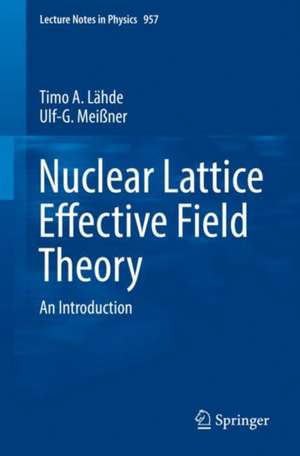
Nuclear Lattice Effective Field Theory
Autor Timo A. Lähde, Ulf-G. Meißneren Limba Engleză Paperback – 8 mai 2019
Observăm că aplicabilitatea practică a acestui volum rezidă în capacitatea sa de a transforma conceptele abstracte de Teorie Eficientă a Câmpului (EFT) în instrumente de calcul riguroase pentru fizica nucleară modernă. Suntem de părere că această lucrare, semnată de Timo A. Lähde și Ulf-G. Meißner, reprezintă un ghid tehnic esențial pentru înțelegerea modului în care forțele nucleare sunt derivate din principii fundamentale prin utilizarea unei rețele spațiu-timp euclidiene.
Comparabil cu An Advanced Course in Computational Nuclear Physics de Morten Hjorth-Jensen în ceea ce privește rigoarea academică, textul de față este actualizat pentru progresele recente în metodele de rețea (lattice) și oferă o perspectivă mai concentrată pe implementarea algoritmilor Monte Carlo. Structura volumului este progresivă: începe cu bazele EFT și forțele chirale, avansează către problema celor doi nucleoni pe rețea și culminează cu metode complexe de proiecție temporală pentru nuclee de masă medie. Un element distinctiv este includerea Hamiltonianului adiabatic, care permite modelarea precisă a reacțiilor nucleare, precum și analiza procesului triplu-alfa, oferind cititorului o deschidere rară către implicațiile antropice ale parametrilor fizicii fundamentale.
Apreciem claritatea cu care sunt prezentate corecțiile perturbative și funcțiile de undă de test, elemente care transformă adesea „arta” calculului nuclear într-o metodologie sistematică. Această primă ediție publicată de Springer reușește să fie în același timp un manual de studiu individual și o referință tehnică pentru metodele computaționale de ultimă oră.
Preț: 392.98 lei
Preț vechi: 462.34 lei
-15%
Carte disponibilă
Livrare economică 15-29 mai
Livrare express 30 aprilie-06 mai pentru 39.62 lei
Specificații
ISBN-10: 303014187X
Pagini: 408
Ilustrații: XI, 396 p. 52 illus., 37 illus. in color.
Dimensiuni: 155 x 235 x 23 mm
Greutate: 0.62 kg
Ediția:1st ed. 2019
Editura: Springer
Locul publicării:Cham, Switzerland
V-ar putea interesa
-
 Computer Simulation of LiquidsMichael P. Allen-22%Preț: 455.63 lei583.02 lei
 -
 The Art of Molecular Dynamics SimulationD. C. Rapaport-9%Preț: 827.14 lei908.95 lei
 -
 Student Friendly Quantum Field Theory Volume 2Robert D. KlauberPreț: 392.73 lei
 -
 Nuclear ModelsWalter Greiner-23%Preț: 861.56 lei1118.90 lei
De ce să citești această carte
Recomandăm această carte oricărui doctorand sau cercetător care dorește să stăpânească tehnicile de calcul ab initio în fizica nucleară. Veți câștiga o înțelegere profundă a algoritmilor Monte Carlo aplicați pe rețea și a metodelor de proiecție euclidiană, instrumente indispensabile pentru modelarea structurii nucleare și a reacțiilor complexe într-un cadru teoretic modern și unitar.
Cuprins
Recenzii
Textul de pe ultima copertă
In the last part of the book, the Euclidean time projection method is introduced and used to compute the ground-state properties of nuclei up to the mid-mass region. In this context, the construction of appropriate trial wave functions for the Euclidean time projection is discussed, as well as methods for determining the energies of the low-lying excitations and their spatial structure. In addition, the so-called adiabatic Hamiltonian, which allows nuclear reactions to be precisely calculated, is introduced using the example of alpha-alpha scattering. In closing, the book demonstrates how Nuclear Lattice EFT can be extended to studies of unphysical values of the fundamental parameters, using the triple-alpha process as a concrete example with implications for the anthropic view of the Universe. Nuclear Lattice Effective Field Theory offers a concise, self-contained, and introductory text suitable for self-study use by graduate students and newcomers to the field of modern computational techniques for atomic nuclei and nuclear reactions.