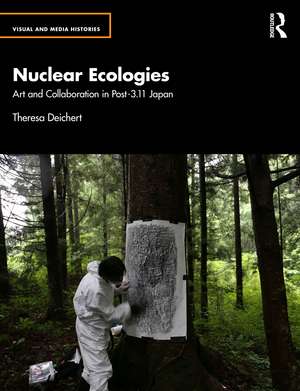
Nuclear Ecologies: Art and Collaboration in Post-3.11 Japan: Visual and Media Histories
Autor Theresa Deicherten Limba Engleză Hardback – 29 dec 2025
Bringing ecological thought into conversation with transcultural art history, Nuclear Ecologies reconsiders collaboration not simply as a method of shared authorship, but as a distributed process shaped by complex networks of human and nonhuman agencies. Through close analysis of post-3.11 artworks, including site-specific projects within the Fukushima exclusion zone to participatory installations in Tokyo, the book explores how artists respond to, and are shaped by, local ecologies and the post-disaster politics of visibility and expression. Five in-depth case studies trace how artistic collaborations confront pressing post-disaster concerns: from radioactive contamination and structural inequalities to the lived realities of both human and nonhuman disaster victims.
Situating post-3.11 artistic practices within wider trajectories of socially engaged art and global art systems, this book—part of the Visual Media Histories series—challenges persistent boundaries between nature and culture, aesthetics and politics. It will be of interest to scholars and students in art history, Japanese studies, transcultural studies, environmental humanities, and those working across eco-aesthetics, posthumanism, and disaster studies.


Preț: 1067.19 lei
Preț vechi: 1301.44 lei
-18%
Puncte Express: 1601
Carte tipărită la comandă
Livrare economică 19 noiembrie-03 decembrie
Livrare prin curier în România Termenul estimat este afișat lângă disponibilitate.
Transport gratuit pentru acest produs Plată online sau ramburs, în funcție de opțiunile comenzii.
Retur gratuit în 14 zile Comandă securizată și suport în română.
Specificații
ISBN-13: 9781032968025
ISBN-10: 1032968028
Pagini: 300
Ilustrații: 194
Dimensiuni: 189 x 246 x 18 mm
Greutate: 0.72 kg
Ediția:1
Editura: Taylor & Francis
Colecția Routledge India
Seria Visual and Media Histories
Locul publicării:Oxford, United Kingdom
ISBN-10: 1032968028
Pagini: 300
Ilustrații: 194
Dimensiuni: 189 x 246 x 18 mm
Greutate: 0.72 kg
Ediția:1
Editura: Taylor & Francis
Colecția Routledge India
Seria Visual and Media Histories
Locul publicării:Oxford, United Kingdom
V-ar putea interesa
-
 Through Post-Atomic EyesClaudette LauzonPreț: 423.07 lei
 -
 -23%Preț: 583.78 lei758.15 lei
 -
 Ecologies of Artistic PracticeAshley Lee WongPreț: 401.80 lei
 -
 Resisting the NuclearElyssa FaisonPreț: 269.53 lei
 -
 Art Is: A Journey into the LightMakoto FujimuraPreț: 185.69 lei
 -
 Art and Climate ChangeMaja Fowkes-17%Preț: 104.80 lei125.74 lei
 -
 -9%Preț: 1331.84 lei1463.57 lei
 -
 Preț: 405.48 lei
 -
 Preț: 424.79 lei
 -
 -25%Preț: 182.22 lei242.35 lei
 -
 -32%Preț: 551.25 lei816.36 lei
 -
 Arts of Living on a Damaged Planet: Ghosts and Monsters of the AnthropoceneAnna Lowenhaupt TsingPreț: 160.15 lei
 -
 Medium HotHito SteyerlPreț: 135.26 lei
 -
 eco-operationsFabienne LiptayPreț: 341.28 lei
 -
 -17%Preț: 291.75 lei350.56 lei
 -
 Residencies ReflectedIrmeli Kokko-17%Preț: 136.04 lei163.79 lei
 -
 Sketches of Transition: An Atlas on Growth and DecayMichele Bazzoli-23%Preț: 173.17 lei224.66 lei
 -
 HabitatKatalin Harangozo et AlPreț: 225.24 lei
Public țintă
Academic, General, Postgraduate, and Undergraduate AdvancedCuprins
List of Figures. List of Tables. Preface. Acknowledgements. Author’s Note 1. Introduction 2. Metabolic Ecologies: Nonhuman Collaborations and the Affective Power of Contaminated Foodstuff 3. Utopian Democracies? Collaborations in Contested Spaces of Anti-Nuclear Activism 4. Cast in (In)visibility: Collaborations and the Exclusion Zone’s Ambiguity 5. Toxic Waste and “Pristine Nature”: Collaborations with Nonhuman Animals 6. Exposing Continuity: Nonhuman Collaborators as Nuclear History’s Witnesses 7. Taking Stock Bibliography. Index.
Recenzii
'Nuclear Ecologies is a highly original study of how different collaborative artistic practices have addressed the Fukushima reactor meltdown to raise public awareness. In presenting this compelling model, Theresa Deichert argues that the current era of planetary precarity requires an ecological approach to the study of art in a de-centered network connecting humans, nonhumans, and the material environment.'
Claire Farago, Professor Emerita at the University of Colorado Boulder, United States, and author of Writing Borderless Histories of Art: Human Exceptionalism and the Climate Crisis
'Deichert lucidly analyzes how more-than-human collaboration and complex transculturation affectively constitute artistic responses to the 2011 triple disaster in Japan. From serving radioactive soup to exhibiting in the nuclear exclusion zone and connecting irradiated trees across Hiroshima and Fukushima - Nuclear Ecologies shows us less anthropocentric ways of being that are urgently needed.'
Franziska Koch, lecturer for Transcultural Studies at Heinrich-Heine University Düsseldorf, Germany
'Through employing an ‘ecological’ art historical research methodology decentering human agency, Deichert takes a fresh look at socio-politically engaged Japanese art. In five rich chapters, she adroitly contextualizes contemporary works of art within their social and cultural context, making a convincing case for a critical ecological engagement with art today.'
Hans-Martin Krämer, Professor of Japanese Studies and Dean of the Faculty of Humanities, Heidelberg University, Germany
Claire Farago, Professor Emerita at the University of Colorado Boulder, United States, and author of Writing Borderless Histories of Art: Human Exceptionalism and the Climate Crisis
'Deichert lucidly analyzes how more-than-human collaboration and complex transculturation affectively constitute artistic responses to the 2011 triple disaster in Japan. From serving radioactive soup to exhibiting in the nuclear exclusion zone and connecting irradiated trees across Hiroshima and Fukushima - Nuclear Ecologies shows us less anthropocentric ways of being that are urgently needed.'
Franziska Koch, lecturer for Transcultural Studies at Heinrich-Heine University Düsseldorf, Germany
'Through employing an ‘ecological’ art historical research methodology decentering human agency, Deichert takes a fresh look at socio-politically engaged Japanese art. In five rich chapters, she adroitly contextualizes contemporary works of art within their social and cultural context, making a convincing case for a critical ecological engagement with art today.'
Hans-Martin Krämer, Professor of Japanese Studies and Dean of the Faculty of Humanities, Heidelberg University, Germany
Notă biografică
Theresa Deichert is a curator at KUNSTHALLE GIESSEN, holding a PhD in Transcultural Studies from Heidelberg University and an MA in History of Art from University College London. Her research and curatorial work center on sociopolitical and ecological engagement in contemporary art. She has published in the Journal of Transcultural Studies, among others, and coedited Imagining the Apocalypse (2022).
Descriere
This book traces the Fukushima nuclear disaster of March 2011 and how art emerged as a powerful response to the socio-political and environmental consequences. Artists turned to collaborative and ecological practices to make sense of the crisis, challenging official narratives and responding to the violence of radioactive contamination.