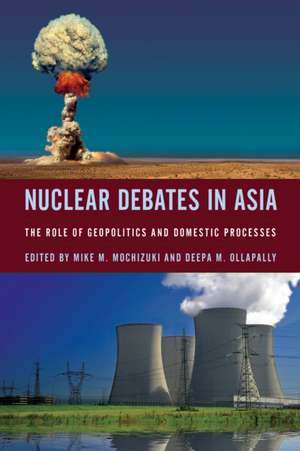
Nuclear Debates in Asia: The Role of Geopolitics and Domestic Processes
Editat de Mike Mochizuki, Deepa M. Ollapallyen Limba Engleză Hardback – 21 iul 2016
Preț: 551.46 lei
Preț vechi: 641.24 lei
-14%
Puncte Express: 827
Carte tipărită la comandă
Livrare economică 08-22 iunie
Specificații
ISBN-13: 9781442246997
ISBN-10: 1442246995
Pagini: 296
Ilustrații: 1 BW Illustration, 7 Tables
Dimensiuni: 160 x 238 x 27 mm
Greutate: 0.61 kg
Editura: Bloomsbury Publishing
Colecția Rowman & Littlefield
Locul publicării:New York, United States
ISBN-10: 1442246995
Pagini: 296
Ilustrații: 1 BW Illustration, 7 Tables
Dimensiuni: 160 x 238 x 27 mm
Greutate: 0.61 kg
Editura: Bloomsbury Publishing
Colecția Rowman & Littlefield
Locul publicării:New York, United States
Cuprins
Acknowledgments
Chapter 1: Introduction: Uncovering Nuclear Thinking in Asia, by Deepa M. Ollapally
Chapter 2: China: Evolving Attitudes on Nuclear Affairs, by Hui Zhang
Chapter 3: India: The Nuclear Debate of a Rising Power, by Deepa M. Ollapally and Rajesh Rajagopalan
Chapter 4: Japan: Tremors in the Nuclear Consensus after Fukushima , by Mike Mochizuki
Chapter 5: South Korea: Intense Debates and Global Nuclear Ambitions, by Scott Snyder
Chapter 6: Taiwan: Commitment to a Nuclear-Free Future, by Robert Sutter and Yuan-Ming Alvin Yao
Chapter 7: Vietnam: Nuclear Ambitions and Domestic Dynamics, by Linda J. Yarr and Nguyê~n Thi. Thanh Thu' y
Chapter 8: Southeast Asia: A Measured Nuclear Policy, by Catharin Dalpino and Timothy Westmyer
Chapter 9: Pakistan: The Nuclear Consensus, by Christopher Clary
Chapter 10: Conclusion: Policy Implications of Changing Domestic Debates, by Mike Mochizuki
Index
About the Contributors
Chapter 1: Introduction: Uncovering Nuclear Thinking in Asia, by Deepa M. Ollapally
Chapter 2: China: Evolving Attitudes on Nuclear Affairs, by Hui Zhang
Chapter 3: India: The Nuclear Debate of a Rising Power, by Deepa M. Ollapally and Rajesh Rajagopalan
Chapter 4: Japan: Tremors in the Nuclear Consensus after Fukushima , by Mike Mochizuki
Chapter 5: South Korea: Intense Debates and Global Nuclear Ambitions, by Scott Snyder
Chapter 6: Taiwan: Commitment to a Nuclear-Free Future, by Robert Sutter and Yuan-Ming Alvin Yao
Chapter 7: Vietnam: Nuclear Ambitions and Domestic Dynamics, by Linda J. Yarr and Nguyê~n Thi. Thanh Thu' y
Chapter 8: Southeast Asia: A Measured Nuclear Policy, by Catharin Dalpino and Timothy Westmyer
Chapter 9: Pakistan: The Nuclear Consensus, by Christopher Clary
Chapter 10: Conclusion: Policy Implications of Changing Domestic Debates, by Mike Mochizuki
Index
About the Contributors
Recenzii
Although of interest primarily to political scientists and those with a security studies focus in particular, Nuclear Debates in Asia provides a thorough introduction to the region and its nuclear concerns, potentially appealing to the historian, and perhaps even to the historian of science. Area specialists will also find much of interest.... [T]he volume offers a fresh rejoinder to the established wisdom on many of these issues, and in this respect, points the way towards potentially challenging a primarily Americanist, prescriptive approach to the nuclear issue.
For those of us struggling to understand and anticipate the future of nuclear energy and nuclear weapons programs in Asia, this deeply insightful and timely book reveals the critical role played by domestic forces in the region. Its contributors know well the domestic scene that is driving nuclear outcomes in each of the countries, and they make a persuasive case that these internal forces eclipse external geopolitical forces in shaping Asia's nuclear future. This essential volume sheds new light on the Asian nuclear landscape.
This must-read book assembles a veritable who's who of nuclear experts on Asia. The volume skillfully opens the black box of domestic politics across Asian nations with nuclear energy and nuclear weapons programs, tracking the balance of Nationalists, Realists, and Globalists in each and analyzing how domestic political configurations affect the nuclear policies of these Asian nations-states that comprise the most dynamic terrain in the global nuclear landscape. Each chapter should be read by anyone who cares not only about the respective state's nuclear policies, but how it is in fact domestic politics driving them, a factor whose emphasis in these countries is long overdue.
Warning against relying on state-centric assumptions that seem more a matter of faith than empirical evidence, the volume finds that elusive 'geopolitical' factors are not decisive. Domestic politics mediate their actual impact. A welcome corrective for improving our understanding of nuclear futures.
For those of us struggling to understand and anticipate the future of nuclear energy and nuclear weapons programs in Asia, this deeply insightful and timely book reveals the critical role played by domestic forces in the region. Its contributors know well the domestic scene that is driving nuclear outcomes in each of the countries, and they make a persuasive case that these internal forces eclipse external geopolitical forces in shaping Asia's nuclear future. This essential volume sheds new light on the Asian nuclear landscape.
This must-read book assembles a veritable who's who of nuclear experts on Asia. The volume skillfully opens the black box of domestic politics across Asian nations with nuclear energy and nuclear weapons programs, tracking the balance of Nationalists, Realists, and Globalists in each and analyzing how domestic political configurations affect the nuclear policies of these Asian nations-states that comprise the most dynamic terrain in the global nuclear landscape. Each chapter should be read by anyone who cares not only about the respective state's nuclear policies, but how it is in fact domestic politics driving them, a factor whose emphasis in these countries is long overdue.
Warning against relying on state-centric assumptions that seem more a matter of faith than empirical evidence, the volume finds that elusive 'geopolitical' factors are not decisive. Domestic politics mediate their actual impact. A welcome corrective for improving our understanding of nuclear futures.