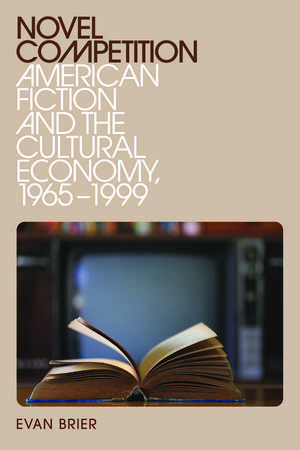
Novel Competition: American Fiction and the Cultural Economy, 1965-1999: New American Canon
Autor Evan Brieren Limba Engleză Paperback – 16 apr 2024 – vârsta ani
Din seria New American Canon
-
 Preț: 312.63 lei
 -
 Preț: 199.61 lei
 - 15%
 Preț: 457.21 lei
 - 19%
 Preț: 544.54 lei
 -
 Preț: 199.72 lei
 - 15%
 Preț: 442.80 lei
 - 15%
 Preț: 561.15 lei
 -
 Preț: 151.71 lei
 - 7%
 Preț: 369.90 lei
 - 7%
 Preț: 354.29 lei
 - 7%
 Preț: 369.86 lei
 - 19%
 Preț: 483.68 lei
 -
 Preț: 331.69 lei
 - 19%
 Preț: 581.10 lei
 - 19%
 Preț: 596.64 lei
 - nou
 Preț: 225.61 lei
 - nou
 Preț: 606.87 lei
 - nou
 Preț: 599.11 lei
 - nou
 Preț: 598.58 lei
Preț: 506.86 lei
Preț vechi: 625.75 lei
-19%
Puncte Express: 760
Carte indisponibilă temporar
Doresc să fiu notificat când acest titlu va fi disponibil:
Se trimite...
Specificații
ISBN-13: 9781609389390
ISBN-10: 1609389395
Pagini: 254
Dimensiuni: 152 x 229 x 18 mm
Greutate: 0.34 kg
Editura: University of Iowa Press
Colecția University Of Iowa Press
Seria New American Canon
ISBN-10: 1609389395
Pagini: 254
Dimensiuni: 152 x 229 x 18 mm
Greutate: 0.34 kg
Editura: University of Iowa Press
Colecția University Of Iowa Press
Seria New American Canon
Recenzii
“Novel Competition is a beautifully written institutional history of the literary novel in the United States from 1965 to 1999. Placing the novel in a larger cultural field—in competition with journalism, popular music, and films for cultural prestige—Brier illuminates not only novels, but their readers, critics, editors, publishers, and booksellers.”—Erin A. Smith, University of Texas at Dallas
“Novel Competition confronts a fascinating and important subject: an examination of how the novel came to matter differently over the last third of the twentieth century. This decline is something that scholars of the novel have bemoaned for some time, and Brier offers a useful approach to making sense of it without resorting to well-trod and over-simplified answers. It is an engaging and important book.”—Emily Johansen, author, Beyond Safety: Risk, Cosmopolitanism, and the Neoliberal Contemporary Life
“As a longtime Evan Brier fan, I’ve been eagerly waiting this book, his account of the American novel’s response to its declining fortunes. Brier dazzles with a virtuosic reading of Truman Capote’s In Cold Blood that takes us through the culture of The New Yorker, the Kansas literati, and the first stirrings of publishing’s conglomeration. He delivers an extraordinary investigation into Toni Morrison’s career as an editor—culminating in Toni Cade Bambara’s The Salt Eaters—and her publication of The Black Book. We follow Philip Roth to Eastern Europe and Cynthia Ozick’s and Saul Bellow’s characters into diaspora. Minimalism, rock and roll, New Hollywood, Rushdie’s fatwa, the American West—an astounding account of Larry McMurtry’s career—the memoir boom. Brier touches it all. Brier quietly transcends the limitations of dominant norms in the practices of literary history and the sociology of literature to give us an nth-dimensional view of American literature since 1965: how the novel became residual. He tells us what it means to believe—or disbelieve—in the power of fiction. It’s no less than thrilling.”—Dan Sinykin, author, Big Fiction: How Conglomeration Changed the Publishing Industry and American Literature
"Novel Competition . . . distinguishes itself through the depth of its research and the resulting complexity and nuance that it brings to accounts of late twentieth-century US literary history. Brier has combed authors’ and publishers’ archives as well as regional literary magazines, small town newspapers, and publishing trade periodicals to offer subtle and richly detailed examinations of the novel’s shifting position in the US cultural economy. Perhaps his book’s most striking finding is just how sustained, widespread, and impassioned discussions of fiction’s institutional structures have been among authors, editors, agents, book reviewers, and other professionals in the post-45 US literary field. In this light, the recent reorientation toward institutions among Americanist scholars appears long overdue.”—American Literary History Review
"Novel Competition is no ‘death of the novel’ diatribe. In fact, Brier gives short shrift to the doom-and-gloomers; American authors, in his view, remain as talented as ever. . . . Although the literary novel remains the touchstone for what ‘elite’ cultural status might mean, its former midcentury monopoly on prestige, Brier claims, has been shattered. . . . This ‘novel competition’ is one prong of his argument. His second prong involves what we might now call literary sociology: the material processes by which books are acquired, edited, published, distributed, sold, and reviewed. . . . This two-pronged approach helps distinguish Novel Competition from other important books tackling the notion of literary reputation . . . Brier’s thesis is immensely useful, mainly because it helps explain so many things beyond the literary mainstream.”—Dennis Wilson Wise, Los Angeles Review of Books
“Novel Competition confronts a fascinating and important subject: an examination of how the novel came to matter differently over the last third of the twentieth century. This decline is something that scholars of the novel have bemoaned for some time, and Brier offers a useful approach to making sense of it without resorting to well-trod and over-simplified answers. It is an engaging and important book.”—Emily Johansen, author, Beyond Safety: Risk, Cosmopolitanism, and the Neoliberal Contemporary Life
“As a longtime Evan Brier fan, I’ve been eagerly waiting this book, his account of the American novel’s response to its declining fortunes. Brier dazzles with a virtuosic reading of Truman Capote’s In Cold Blood that takes us through the culture of The New Yorker, the Kansas literati, and the first stirrings of publishing’s conglomeration. He delivers an extraordinary investigation into Toni Morrison’s career as an editor—culminating in Toni Cade Bambara’s The Salt Eaters—and her publication of The Black Book. We follow Philip Roth to Eastern Europe and Cynthia Ozick’s and Saul Bellow’s characters into diaspora. Minimalism, rock and roll, New Hollywood, Rushdie’s fatwa, the American West—an astounding account of Larry McMurtry’s career—the memoir boom. Brier touches it all. Brier quietly transcends the limitations of dominant norms in the practices of literary history and the sociology of literature to give us an nth-dimensional view of American literature since 1965: how the novel became residual. He tells us what it means to believe—or disbelieve—in the power of fiction. It’s no less than thrilling.”—Dan Sinykin, author, Big Fiction: How Conglomeration Changed the Publishing Industry and American Literature
"Novel Competition . . . distinguishes itself through the depth of its research and the resulting complexity and nuance that it brings to accounts of late twentieth-century US literary history. Brier has combed authors’ and publishers’ archives as well as regional literary magazines, small town newspapers, and publishing trade periodicals to offer subtle and richly detailed examinations of the novel’s shifting position in the US cultural economy. Perhaps his book’s most striking finding is just how sustained, widespread, and impassioned discussions of fiction’s institutional structures have been among authors, editors, agents, book reviewers, and other professionals in the post-45 US literary field. In this light, the recent reorientation toward institutions among Americanist scholars appears long overdue.”—American Literary History Review
"Novel Competition is no ‘death of the novel’ diatribe. In fact, Brier gives short shrift to the doom-and-gloomers; American authors, in his view, remain as talented as ever. . . . Although the literary novel remains the touchstone for what ‘elite’ cultural status might mean, its former midcentury monopoly on prestige, Brier claims, has been shattered. . . . This ‘novel competition’ is one prong of his argument. His second prong involves what we might now call literary sociology: the material processes by which books are acquired, edited, published, distributed, sold, and reviewed. . . . This two-pronged approach helps distinguish Novel Competition from other important books tackling the notion of literary reputation . . . Brier’s thesis is immensely useful, mainly because it helps explain so many things beyond the literary mainstream.”—Dennis Wilson Wise, Los Angeles Review of Books
Notă biografică
Evan Brier is associate professor of English at the University of Minnesota Duluth. He is author of A Novel Marketplace: Mass Culture, the Book Trade, and Postwar American Fiction. He lives in Duluth, Minnesota.
Descriere
Novel Competition describes the literary and institutional struggle to make American novels matter between 1965 and 1999. As corporations took over the book business, Hollywood movies, popular music, and other forms of mass-produced culture competed with novels as never before for a form of prestige that had mostly been attached to novels in previous decades. This book brings to light the story of the novel’s perceived decline and the surprising ways American fiction transformed in its wake.