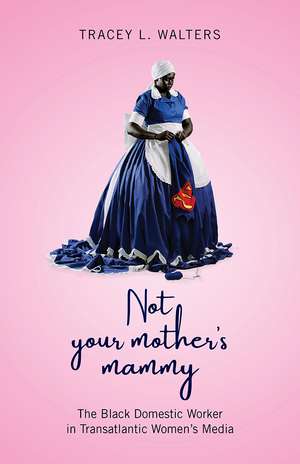
Not Your Mother's Mammy: The Black Domestic Worker in Transatlantic Women’s Media
Autor Tracey L Waltersen Limba Engleză Paperback – 16 apr 2021 – vârsta ani
Preț: 312.39 lei
Puncte Express: 469
Preț estimativ în valută:
55.21€ • 63.80$ • 47.85£
55.21€ • 63.80$ • 47.85£
Carte indisponibilă temporar
Doresc să fiu notificat când acest titlu va fi disponibil:
Se trimite...
Specificații
ISBN-13: 9781978808577
ISBN-10: 1978808577
Pagini: 252
Ilustrații: 4 color images
Dimensiuni: 140 x 216 x 23 mm
Greutate: 0 kg
Editura: Rutgers University Press
Colecția Rutgers University Press
ISBN-10: 1978808577
Pagini: 252
Ilustrații: 4 color images
Dimensiuni: 140 x 216 x 23 mm
Greutate: 0 kg
Editura: Rutgers University Press
Colecția Rutgers University Press
Notă biografică
TRACEY L. WALTERS is an associate professor of literature in the Department of Africana Studies at Stony Brook University in New York, where she also holds an affiliate appointment with the Department of English and the Department of Women’s and Gender Studies.
Recenzii
"What Walters achieves is an aesthetic of the black female domestic, a study of the representational dynamics of the figure in film, visual art, and literature. This book is a fascinating showcase of black women's nuanced reimaginings of servitude's long afterlife."
"Challenging mainstream media’s unidimensional portrayal and mis/representation of black female domestic workers as vulnerable and lacking agency, Not Your Mother’s Mammy identifies the myriad ways domestic workers, i.e. essential services workers, engender the politics of subversion and exercise their (labor) rights. This book will certainly influence future studies on labor rights of black female domestic workers."
Descriere
Not Your Mother’s Mammy examines how black artists, mostly women of the diaspora, many of them former domestics, reconstruct the black female subjectivities of domestics in black media. In doing so, they undermine and defamiliarize the reductive, one-dimensional images of black domestics as perpetual victims lacking voice and agency. In line with international movements like #MeToo and #timesup, the women in these stories demand to be heard.