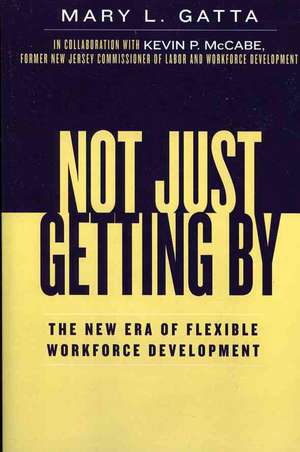
Not Just Getting By: The New Era of Flexible Workforce Development
Autor Mary L. Gatta Kevin P. McCabeen Limba Engleză Paperback – 28 noi 2005
It explores how to rethink workforce development so that online learning for low wage workers and other innovative programs can be successful.
As both a piece of scholarship and a case study in successful policy development, this text will be a useful supplement for courses in the sociology of labor, women's studies, or adult education. It will also serve policymakers and others who are looking for a model of training and skills delivery that actually works.
Preț: 319.28 lei
Preț vechi: 415.47 lei
-23%
Puncte Express: 479
Carte tipărită la comandă
Livrare economică 30 noiembrie-14 decembrie
Livrare prin curier în România Termenul estimat este afișat lângă disponibilitate.
Transport gratuit de la 400.00 lei Plată online sau ramburs, în funcție de opțiunile comenzii.
Retur gratuit în 14 zile Comandă securizată și suport în română.
Specificații
ISBN-13: 9780739111543
ISBN-10: 073911154X
Pagini: 192
Dimensiuni: 180 x 228 x 13 mm
Greutate: 0.25 kg
Ediția:New.
Editura: Bloomsbury Publishing
Colecția Lexington Books
Locul publicării:New York, United States
ISBN-10: 073911154X
Pagini: 192
Dimensiuni: 180 x 228 x 13 mm
Greutate: 0.25 kg
Ediția:New.
Editura: Bloomsbury Publishing
Colecția Lexington Books
Locul publicării:New York, United States
Cuprins
Chapter 1 A Brief Introduction to Workforce Systems
Chapter 2 The New Workforce Challenge: Finding the Skills to Move Up and Out of Poverty
Chapter 3 Workforce Development and Welfare Policy: Explored Through an Intersectional Lens
Chapter 4 Policy and Programs: Single Working Poor Mothers and Online Learning
Chapter 5 Rethinking Workforce Development: Reflections from a State Commissioner of Labor
Chapter 6 Concluding Remarks: Development an Agenda for Low-Wage Workers
Chapter 2 The New Workforce Challenge: Finding the Skills to Move Up and Out of Poverty
Chapter 3 Workforce Development and Welfare Policy: Explored Through an Intersectional Lens
Chapter 4 Policy and Programs: Single Working Poor Mothers and Online Learning
Chapter 5 Rethinking Workforce Development: Reflections from a State Commissioner of Labor
Chapter 6 Concluding Remarks: Development an Agenda for Low-Wage Workers
Recenzii
Not Just Getting By stresses the need for workforce development policies that not only acknowledge the many barriers to education and job training facing low-wage workers, but that are also fashioned to minimize or eliminate those barriers. As this book makes clear, workforce development must be a priority for state and federal policymakers if the United States is to remain a leader in the global economy - and if America wants all Americans to have a shot at economic self-sufficiency and a better life.
After all the talk we have heard about family values, this book builds on New Jersey's success to show a clear way that government can actually work to value families. This book outlines how a flexible workforce can help all Americans reach economic self-sufficiency by training on their own terms and on their own time.
For too long now, policymakers have looked at workforce development as though all workers were the same, with the same needs and the same problems. Not Just Getting By documents how policymakers must step outside of this "one-size-fits-all box". The authors show that workforce development policies that are sensitive to the needs of all kinds of workers-including ones with family responsibilities-will be more effective in the long run in moving individuals toward stable employment. This book is a must read for those interested in bringing workforce development policy into the 21st century.
After all the talk we have heard about family values, this book builds on New Jersey's success to show a clear way that government can actually work to value families. This book outlines how a flexible workforce can help all Americans reach economic self-sufficiency by training on their own terms and on their own time.
For too long now, policymakers have looked at workforce development as though all workers were the same, with the same needs and the same problems. Not Just Getting By documents how policymakers must step outside of this "one-size-fits-all box". The authors show that workforce development policies that are sensitive to the needs of all kinds of workers-including ones with family responsibilities-will be more effective in the long run in moving individuals toward stable employment. This book is a must read for those interested in bringing workforce development policy into the 21st century.