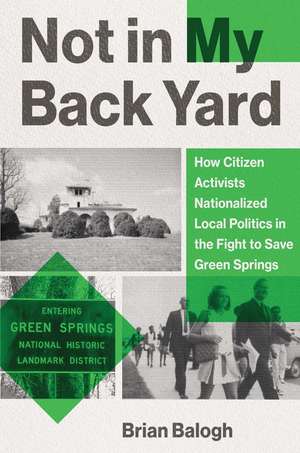
Not in My Backyard: How Citizen Activists Nationalized Local Politics in the Fight to Save Green Springs
Autor Brian Baloghen Limba Engleză Hardback – 2 ian 2024
Această lucrare aduce o perspectivă nouă asupra modului în care politica locală americană a fost naționalizată prin eforturile grupurilor de cetățeni, transformând conflicte aparent izolate în precedente juridice și administrative majore. Remarcăm modul în care Brian Balogh deconstruiește succesul grupului condus de Rae Ely în Green Springs, Virginia, demonstrând cum o comunitate rurală a reușit să blocheze mașinăria politică locală prin strategii inovatoare de conservare istorică și apeluri federale. Cartea extinde cadrul propus de Nimby Is Beautiful de Carol Hager cu date noi din perioada anilor '70, demonstrând că protestele de tip NIMBY nu sunt doar reacții parohiale, ci pot genera schimbări sistemice în guvernarea regională.
Observăm o structură narativă riguroasă, susținută de interviuri și cercetare de arhivă, care plasează această monografie socială la intersecția dintre istoria politică și protecția mediului. Autorul analizează compromisurile economice inerente refuzului dezvoltării industriale — în acest caz, o închisoare și o mină — în favoarea păstrării patrimoniului. Tonul este unul analitic, evitând idealizarea activiștilor și evidențiind faptul că aceleași tactice sunt astăzi folosite la scară națională pentru a rezista oricărei forme de dezvoltare urbană, un aspect explorat și în The Politics of Downtown Development. În contextul operei sale, Not in My Backyard continuă preocuparea lui Balogh pentru „statul invizibil” și mecanismele subtile de putere, teme centrale și în A Government Out of Sight sau The Associational State.
Preț: 217.88 lei
Carte disponibilă
Livrare economică 14-28 noiembrie
Livrare express 31 octombrie-06 noiembrie pentru 74.06 lei
Specificații
ISBN-10: 0300253788
Pagini: 384
Ilustrații: 8 b-w illus.
Dimensiuni: 156 x 235 x 30 mm
Greutate: 0.68 kg
Editura: Yale University Press
Colecția Yale University Press
De ce să citești această carte
O lectură esențială pentru cei interesați de științe politice, urbanism și istorie socială. Cititorul înțelege cum mecanismele federale pot fi activate pentru a proteja interesele locale și descoperă rădăcinile istorice ale mișcărilor de conservare moderne. Este un studiu de caz fascinant despre cum interpretarea istoriei poate deveni un instrument juridic puternic în fața expansiunii industriale necontrolate.
Despre autor
Brian Balogh este profesor asociat în cadrul Departamentului de Istorie de la University of Virginia și președinte al programului „Governing America in a Global Era” la Miller Center of Public Affairs. Recunoscut pentru analizele sale profunde asupra politicilor publice americane, Balogh a explorat în lucrările sale anterioare, precum Chain Reaction, intersecția dintre expertiza tehnică și participarea publică. Experiența sa în studierea legăturilor dintre grupurile de interese și politicile guvernamentale, vizibilă și în volumul Integrating the Sixties, îi permite să abordeze cazul Green Springs cu o rigoare academică ce îmbină istoria politică cu sociologia activismului.
Descriere scurtă
This social history of local political activism tells the story of the decades-long fight to save Green Springs, Virginia, illuminating the economic tradeoffs of protecting the environment, the origins of NIMBYism, the changing nature of local control, and the surprising power of history to advance public policy.
Rae Ely faced long odds when she launched a campaign in 1970 to stop a prison, then a strip mine, in Green Springs. The local political machine supported both projects, promising jobs for impoverished Louisa County, Virginia. But Ely and her allies prevailed by repurposing the same tactics used by the Civil Rights movement—the appeal to federal agencies and courts to circumvent local control—and by using new historical interpretations to create the first rural National Historic Landmark District.
The Green Springs protesters fought to preserve the historic character of their neighborhood and the surrounding environment in a quest that epitomized the conflict in late twentieth-century America between unbridled economic development for all and protecting the quality of life for an economically privileged few. Ely’s tactics are now used by neighborhood groups across the nation, even if they have been applied in ways she never intended: to resist any form of development.
Recenzii
“Balogh’s gripping tale of one woman’s fight against the odds to preserve her historic community isn’t just an invaluable contribution to the history of land use—it’s also a terrific read.”—Yoni Appelbaum, deputy editor, The Atlantic
“This close and engaging look at a group of citizen activists reveals how NIMBYism has the potential to serve the public good and force federal action on the environment and offers powerful lessons for scholars and grassroots activists alike.”—Lily Geismer, author of Left Behind: The Democrats’ Failed Attempt to Solve Inequality
“A masterpiece of historical storytelling written in the rich vein of Faulkner. Balogh shows that everything we need to know about postwar United States history can be observed in one place (Louisa County, VA), and in the fantastic life and relentless organizing of the irreplaceable and magnetic Rae Ely. A must read for anyone who wants to know more about feminism, environmentalism, the tensions between local and federal power, carceral policies, and the nitty-gritty of getting things done.”—Bryant Simon, author of The Hamlet Fire
“Political history as page turner! Follow a feisty heroine as she battles to save her neighborhood, and learn how the legal tools of the civil rights and environmental movements allowed local citizens to forge controversial new relationships with the federal government.”—Sarah T. Phillips, Boston University
“Not in My Backyard is that rare portrait of citizen activism in all of its virtues and complexities. There are villains and heroes here, but they are not always the usual suspects. This is a fascinating work of local history, but one that links up effectively—and sometimes counterintuitively—with a national story. As Balogh demonstrates, politics looks different from the ground up.”—Beverly Gage, Yale University
“American politics changed in about a million ways, large and small, in the 1960s and 1970s, and Brian Balogh captures nearly all of them in this captivating history of grassroots activism. A front-row seat to the stunning drama of how citizens made politics in the last third of the twentieth century, this book is arresting and poignant, fascinating and sobering, and above all instructive for our gridlocked politics today.”—James Sparrow, University of Chicago