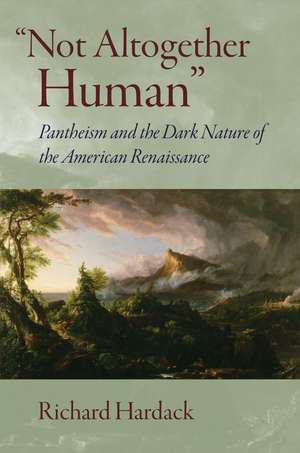
"Not Altogether Human": Pantheism and the Dark Nature of the American Renaissance
Autor Richard Hardacken Limba Engleză Paperback – 19 iul 2012
In "Not Altogether Human," Hardack reevaluates transcendentalism in the context of nineteenth-century concerns about individual and national racial identity. Elucidating the influence of pantheism, Hardack draws on an array of canonical and unfamiliar materials to remap the boundaries of what has long been viewed as white male transcendental discourse.
This book significantly revises notions of what transcendentalism and pantheism mean and how they relate to each other. Hardack's close analysis of pantheism and its influence on major works and lesser known writing of the nineteenth century opens up a new perspective on American culture during this key moment in the country's history.
Preț: 232.89 lei
Puncte Express: 349
Carte indisponibilă temporar
Doresc să fiu notificat când acest titlu va fi disponibil:
Se trimite...
Specificații
ISBN-13: 9781558499577
ISBN-10: 1558499571
Pagini: 304
Dimensiuni: 152 x 229 x 23 mm
Greutate: 0.48 kg
Ediția:First Edition
Editura: University of Massachusetts Press
Colecția University of Massachusetts Press
ISBN-10: 1558499571
Pagini: 304
Dimensiuni: 152 x 229 x 23 mm
Greutate: 0.48 kg
Ediția:First Edition
Editura: University of Massachusetts Press
Colecția University of Massachusetts Press
Notă biografică
RICHARD HARDACK completed his PhD in English and a JD at the University of California, Berkeley. He has taught at Haverford College and Bryn Mawr College.
Recenzii
“Compelling and persuasive. . . . Hardack provides fresh perspectives on nineteenth-century transcendentalism and pantheism and provides meticulous readings of Emerson, Melville, and Hawthorne. Newcomers to Hardack's work will find that they are in good hands as he expertly navigates a complex literary landscape.”—Journal of American Studies
“[A] stimulating, interpretive ride through once-familiar texts such as Moby-Dick and ‘The American Scholar.’ . . . Hardack's work will be of interest to scholars of both Emerson and Melville for its fresh and rigorous examination of the broad extent to which Melville responded to Emerson's transcendentalist thought. Additionally, cultural historians will find much of value in this new examination of pantheism as a force in American identity politics during the antebellum period.”—New England Quarterly
“Among the surprising insights of Hardack's book is the ubiquity of pantheism. . . . Historians [will] appreciate his deft recovery of a hitherto unappreciated cultural conversation.”—Journal of American History
“Arguing convincingly for the importance of pantheism to Emersonian and Melvillean epistemology, . . . ‘Not Altogether Human’ contains a valuable reading of pantheism in antebellum American literature, and of the Emerson-Melville relationship specifically.”—ISLE
“[Hardack] takes a meticulous look at the connections between some of the most well-known texts of the American Renaissance and how the infusion of pantheistic thinking helped to shape discussions of identity, race, and gender. . . . Hardack does an excellent job of revealing how the reach of pantheism goes far beyond the scope of just [Emerson and Melville]. The argument is convincing, and the scholarship is wonderfully arranged. . . . ‘Not Altogether Human’ adds a fresh perspective to arguably the richest period of American literature."—Religion Literature
“Hardack's scholarship on Emerson and Melville (and to some extent Hawthorne, Poe, and Lawrence) is not only up-to-date but revelatory, as the author reads and re-reads well known passages in essays, novels, and letters in the light of a philosophy (pantheism) which has not received this kind of attention before. . . . [Hardack] produces such unexpected insights, such brilliant passages of writing and thought, that I have made many new discoveries among texts I thought I knew well and wish to return to for further reflection.”—Wyn Kelley, author of Melville's City: Literary and Urban Form in Nineteenth-Century New York
“[A] stimulating, interpretive ride through once-familiar texts such as Moby-Dick and ‘The American Scholar.’ . . . Hardack's work will be of interest to scholars of both Emerson and Melville for its fresh and rigorous examination of the broad extent to which Melville responded to Emerson's transcendentalist thought. Additionally, cultural historians will find much of value in this new examination of pantheism as a force in American identity politics during the antebellum period.”—New England Quarterly
“Among the surprising insights of Hardack's book is the ubiquity of pantheism. . . . Historians [will] appreciate his deft recovery of a hitherto unappreciated cultural conversation.”—Journal of American History
“Arguing convincingly for the importance of pantheism to Emersonian and Melvillean epistemology, . . . ‘Not Altogether Human’ contains a valuable reading of pantheism in antebellum American literature, and of the Emerson-Melville relationship specifically.”—ISLE
“[Hardack] takes a meticulous look at the connections between some of the most well-known texts of the American Renaissance and how the infusion of pantheistic thinking helped to shape discussions of identity, race, and gender. . . . Hardack does an excellent job of revealing how the reach of pantheism goes far beyond the scope of just [Emerson and Melville]. The argument is convincing, and the scholarship is wonderfully arranged. . . . ‘Not Altogether Human’ adds a fresh perspective to arguably the richest period of American literature."—Religion Literature
“Hardack's scholarship on Emerson and Melville (and to some extent Hawthorne, Poe, and Lawrence) is not only up-to-date but revelatory, as the author reads and re-reads well known passages in essays, novels, and letters in the light of a philosophy (pantheism) which has not received this kind of attention before. . . . [Hardack] produces such unexpected insights, such brilliant passages of writing and thought, that I have made many new discoveries among texts I thought I knew well and wish to return to for further reflection.”—Wyn Kelley, author of Melville's City: Literary and Urban Form in Nineteenth-Century New York